PT
PT  EN
EN  DE
DE  RU
RU  JA
JA  ES
ES  IT
IT 

|
In an automotive body-in-white shop, a standard wire mesh fence isn’t enough. When you are dealing with high-speed robotic welding arms and heavy payload transfers, the margin for error is zero. You need a perimeter that withstands high-kinetic impact, contains welding spatter, and integrates seamlessly with your PLC safety logic without delaying the commissioning timeline. |
The Structural Integrity Standard: Surviving the “Runaway Robot”
In robotic welding cells, the primary risk isn’t just unauthorized entry; it is the potential for a manipulator or a heavy workpiece to breach the perimeter during a programming error or mechanical failure. A standard fence panel will buckle under the force of a robotic arm moving at 2m/s.
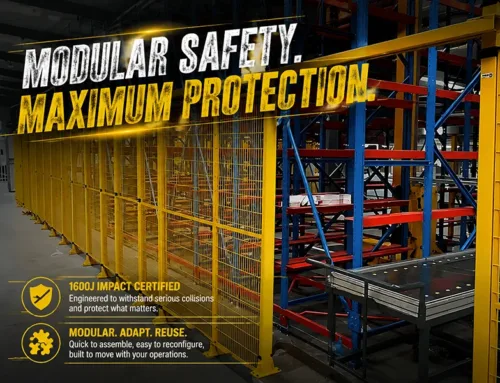
The Mdfence standard for Cerca de Segurança para Robôs relies on Aço carbono Q235. Unlike hollow-frame competitors, our system utilizes 60 x 60mm posts with a wall thickness up to 2.0mm. This ensures that the kinetic energy of an accidental collision is absorbed by the structure rather than causing a catastrophic breach. This structural rigidity is critical for maintaining the ISO 13857 safety distances, ensuring the fence does not deflect into the danger zone upon impact.

Figure 1: High-strength Q235 Carbon Steel post profile designed for maximum impact resistance.
Containment Protocols: Managing Welding Spatter and Arc Glare
Automotive welding generates significant environmental hazards. Standard open mesh allows welding spatter to escape into walkways, creating fire hazards and slip risks. Furthermore, the UV radiation from the arc can cause “welder’s flash” to passing personnel.
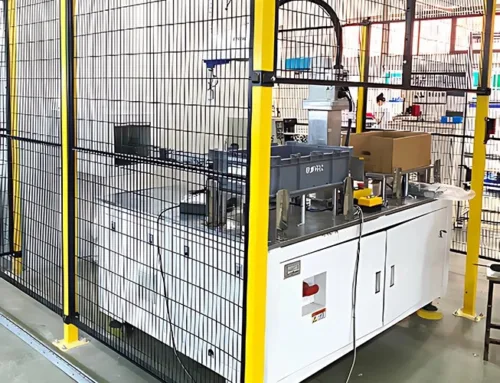
Our Framed Panel design allows for mixed-media infills. For welding cells, we recommend replacing standard mesh with solid steel sheet lower sections to contain sparks, combined with UV-filtering polycarbonate upper sections. This configuration maintains visibility for line supervisors while blocking harmful radiation and physical debris. The frames are constructed from 20x30mm tubing with flattened, fully welded contact points, eliminating sharp edges that could snag PPE.

Figure 2: Robust Framed Panel construction essential for maintaining cell integrity.
Logic Integration: Beyond the Physical Barrier
In modern Tier 1 automotive plants, a fence is useless if it doesn’t talk to the PLC. The days of retrofitting limit switches with zip ties are over. Best practice demands a dedicated Safety Interlock Carrier.
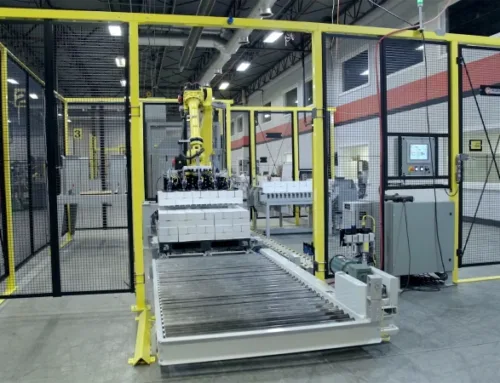
Mdfence systems are engineered with pre-designed mounting kits (e.g., KKCK-LCK-B-D4NL-SET) compatible with industry-standard switches like Omron D4NL or Pizzato. This turns the door into an active node in your safety circuit. When a technician opens the door for tip dressing or jig maintenance, the signal is immediate and reliable, triggering a Category 4 stop. This integration reduces on-site engineering time and eliminates the “jury-rigged” look that fails safety audits.

Figure 3: Integrated locking solutions and interlock carriers for seamless PLC communication.
Access Management for Heavy Maintenance
Welding jigs are heavy. When you need to swap a fixture via forklift or AGV, a standard 3-foot personnel door is insufficient. However, floor space in an automotive plant is premium real estate; swinging a large gate is often impossible due to adjacent conveyors or columns.
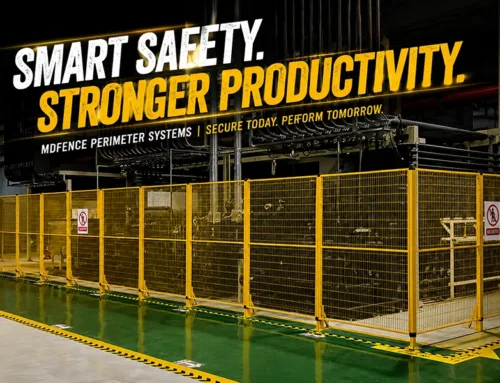
The standard solution for this constraint is the heavy-duty Sliding Door system. Our double sliding configurations can provide openings up to 4300mm wide without intruding into the aisle or the work cell. For even tighter spaces, our Cercas de segurança para máquinas line includes folding door options that collapse neatly, maximizing the clear opening width for equipment transfer.

Figure 4: Double sliding door system designed for wide equipment access in restricted spaces.
Frequently Asked Questions: Welding Cell Safety
1. Can Mdfence panels withstand direct welding spatter without degrading?
Yes. Our panels undergo a rigorous Powder Coating process (RAL 9005/1023) that is resistant to high temperatures and corrosion. For areas with intense spatter, we recommend replacing the mesh with solid steel sheet infills.
2. How do I calculate the safety distance for a welding robot?
Safety distances must be calculated based on ISO 13857 and the stopping time of your specific robot model. Our modular posts allow for flexible positioning to ensure you meet the calculated “Reach Over” and “Reach Through” requirements.
3. Are your interlock carriers compatible with non-contact safety switches?
Absolutely. While we offer standard kits for locking tongue switches (like Omron D4NL), we can provide custom mounting plates for RFID non-contact switches often used in high-vibration welding environments.
4. What is the impact rating of your fencing system?
Our framed system is TUV certified for high Impact Resistance. The combination of 60mm posts and framed panels is designed to withstand impacts typical of automated machinery, exceeding the requirements of ISO 14120.
5. Can the fencing be grounded for electrostatic discharge (ESD) or arc welding safety?
Yes. Since the system is all-steel construction, it can be easily integrated into the facility’s grounding grid. We recommend using serrated washers at connection points to ensure electrical continuity through the powder coat.