PT
PT  EN
EN  DE
DE  RU
RU  JA
JA  ES
ES  IT
IT 
A single forklift impact can halt your entire production line, jeopardizing cycle times and project deadlines. Standard guardrails simply won’t cut it when a multi-million dollar robotic cell is on the line. Are your critical assets truly protected, or are they just one mistake away from catastrophic downtime?
The Real Question Isn’t “If”, But “When” a Forklift Hits Your Guarding
In any high-speed manufacturing environment, especially in automotive assembly or system integration projects, the dance between material handling and automated cells is constant. Your team is pushing to meet takt time. A forklift driver, focused on feeding a line, cuts a corner a little too tight. The result? A bent, useless guardrail and, far worse, a misaligned robot, a shattered end-of-arm tool, or a severed pneumatic line.
The direct repair cost is bad enough. But the real damage is the hours—or shifts—of lost production while your maintenance team scrambles and a critical part of your Automated Production Line sits idle. Standard, lightweight fencing solutions are merely visual indicators; they offer zero meaningful resistance against a 5,000-lb vehicle. They are a compliance checkbox, not an asset protection strategy.
From Visual Barrier to Engineered Stop: The Mdfence Structural Difference
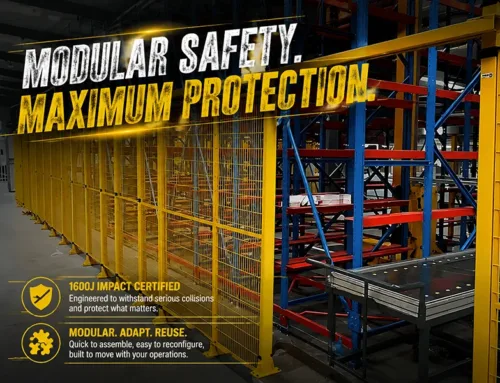
Protecting high-value assets like FANUC or ABB robots requires more than just a yellow line on the floor. It demands a physical barrier engineered specifically for impact resistance. The strength of a Cerca de proteção para máquinas isn’t just in the steel—it’s in the system’s design.
Here’s why Mdfence provides genuine forklift protection:
- The Backbone: 60mm Posts of Q235 Carbon Steel: Unlike the flimsy 40mm posts common in lighter systems, our standard is a robust 60 x 60mm (2.36″ x 2.36″) square post with a wall thickness up to 2.0mm. This isn’t just a fence post; it’s a structural column designed to absorb and transfer impact energy directly into the concrete floor.
- Engineered Anchoring: Each post is secured with four M10 x 70mm expansion bolts into a unique, reinforced baseplate. This wide stance prevents the post from tearing out of the concrete on impact, a common failure point for lesser systems.

The foundation of impact resistance: a 60x60mm Q235 steel post and a robust, four-bolt anchoring system.
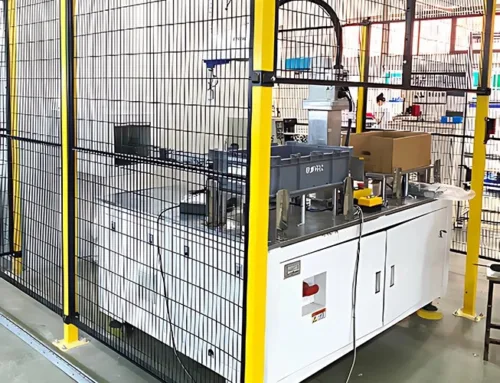
- Fully Welded Framed Panels: A mesh panel’s true strength comes from its frame. Our standard panels feature a 20 x 30mm tubular steel frame with the wire mesh fully welded at every contact point. This creates a rigid, drum-like structure that won’t buckle or deform under low-speed impacts, distributing the force across the entire panel and adjacent posts.

A framed panel acts as a single, rigid unit to resist deformation from impacts.
This TUV-certified system isn’t just about meeting ISO 14120 standards. It’s about providing a solution that survives the real-world chaos of a busy plant floor, transforming your Cerca de Segurança para Robôs from a suggestion into a command: Do Not Enter.
Beyond Brute Force: Smart Design for Seamless Operations
A strong barrier is useless if it impedes workflow or creates headaches for your maintenance and engineering teams. True value comes from combining strength with intelligent, modular design.
Access Without Compromise
Your team needs to get into these cells for tool changes, programming, and maintenance. Our modular door systems are built with the same robust components as our fixed panels, ensuring your access points aren’t weak points.
- Sliding Doors for Tight Footprints: In crowded layouts where a swing door would block a walkway, a heavy-duty sliding door provides a wide opening without consuming valuable floor space. Our top-hung designs with bearing rails ensure smooth operation even for massive, 14-foot openings.

Double sliding doors provide wide access for equipment without impeding traffic flow.
- Seamless Safety Integration: As a system integrator, your biggest challenge is often integrating third-party components. We’ve eliminated that headache. Our systems feature pre-engineered Safety Interlock Carriers designed specifically for common safety switches like the Omron D4NL or Pizzato FS series. This isn’t just a hole drilled in a post; it’s a dedicated mounting solution that saves you hours of on-site fabrication and ensures perfect alignment for tying into your PLC’s safety circuit.
Designed for Integrators, Built for the Plant Floor
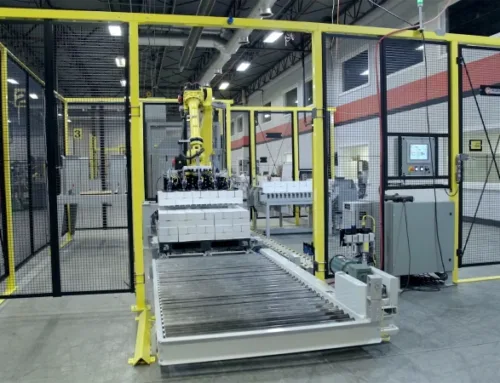
We understand that for system integrators, time is money. Our entire system is designed for rapid, predictable assembly. Based on your CAD drawings, we deliver a complete, kitted solution with every post, panel, and fastener accounted for. No on-site welding, no cutting, no surprises. Your team can erect hundreds of feet of guarding in a fraction of the time it would take to fabricate a custom solution, keeping your project on schedule and on budget.

A modular system based on your exact layout drawings means fast, predictable installation.
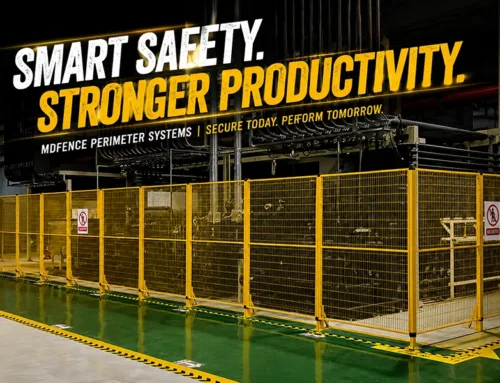
Stop replacing flimsy guardrails. Invest in an engineered Cerca de Segurança Industrial system that protects your most valuable assets from your most common threat. Protect your robots, protect your uptime, and protect your bottom line.
Perguntas Frequentes
1. How does this system integrate with our existing Siemens or Rockwell PLC safety circuits?
Easily. Our door systems are designed with pre-engineered mounting plates, what we call a Safety Interlock Carrier, for industry-standard safety switches (e.g., Omron, Pizzato, Allen-Bradley). You simply bolt your chosen interlock switch to our carrier, wire it to your safety relay or PLC input, and the fence door becomes a monitored access point in your E-Stop circuit. This eliminates custom fabrication and ensures reliable operation.
2. What is the typical impact rating? Can it really stop a forklift?
Our system is TUV-certified for high impact resistance according to ISO 14120. While specific ratings depend on the configuration, the system is engineered to withstand low-speed impacts typical in a plant environment from forklifts and other material handling equipment. The combination of 60mm steel posts, robust anchoring, and fully welded framed panels is designed to absorb and dissipate energy to protect the critical assets inside the cell.
3. Can your panels withstand weld spatter in a Body-in-White (BIW) shop?
Yes. For applications with welding, we offer panel variants beyond the standard wire mesh. We can provide panels made of solid sheet steel or polycarbonate (PC) that fully contain weld spatter and flash, protecting personnel and preventing fires. The standard powder coating on our steel components also provides a high degree of resistance to spatter adherence.
4. How quickly can a damaged panel be replaced by our on-site maintenance team?
Very quickly. Thanks to the modular design, replacing a panel is a simple, bolt-out/bolt-in process. A maintenance technician would only need to loosen the fixing rings on the two adjacent posts, remove the damaged panel, slot the new one in, and retighten the rings. The process can typically be completed in under 15 minutes with basic hand tools, minimizing downtime.
5. Do you provide CAD blocks for us to drop into our plant layout designs?
Absolutely. We support our system integration partners by providing a complete library of CAD models for our components (posts, panels, doors, etc.). This allows your engineers to easily incorporate our fencing system into your master plant or cell layouts in software like AutoCAD or SolidWorks, ensuring a perfect fit and streamlining the design and approval process.