PT
PT  EN
EN  DE
DE  RU
RU  JA
JA  ES
ES  IT
IT 
 |
Your robot integration project is on a tight deadline. The last thing you need is a safety fence that fails the end-customer’s EHS audit or requires days of on-site welding and fabrication. Stop gambling with compliance and project timelines. |
Compliance guide for robot safety fence standards.
For an automation system integrator, a Cerca de Segurança para Robôs is more than a barrier; it’s a critical component that can make or break a project’s timeline, budget, and final acceptance. Navigating standards like ANSI/RIA R15.06 and ISO 14120 isn’t just about checking a box. It’s about implementing a physical system that meets these requirements without introducing delays and on-site fabrication nightmares. This guide cuts through the theory and focuses on how specific engineering choices in your Proteção de Máquinas system directly translate to a compliant, efficient, and profitable robot cell deployment.
Beyond the Checklist: Proving Structural Integrity with ISO 14120
The Problem: Your risk assessment for a high-payload robot arm specifies that the guarding must withstand a significant impact. You’ve installed a generic fence that looks sturdy, but when the end-customer’s EHS manager asks for proof of its impact rating, you have no documentation. Your project is now on hold pending a costly and time-consuming third-party validation.
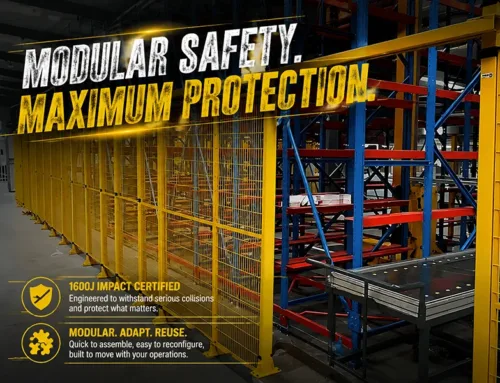
The Engineering Logic: True compliance with ISO 14120 (General requirements for the design and construction of fixed and movable guards) begins with the material science and structural engineering of the system. A compliant system isn’t just assembled; it’s engineered. It starts with high-tensile Q235 carbon steel for all load-bearing components and a fully welded 20x30mm tubular steel frame around every mesh panel. This architecture transforms the panel from a simple mesh sheet into a rigid structural component. This design is then subjected to physical testing to certify its performance.
The Result: When the EHS manager asks for compliance data, you provide a spec sheet showing the system is TUV-certified to withstand an impact energy of 1600 Joules—equivalent to stopping a 220 lbs (100 kg) object moving at 12.5 mph (20 km/h). The conversation ends. You’ve demonstrated due diligence with a system designed and validated to meet the forces calculated in your risk assessment, ensuring the project moves forward without delay.
The Space-Saving Standard: How ISO 13857 Impacts Your Footprint
The Problem: To save on costs, you used a standard fence with a large 50x50mm (2″x2″) mesh opening. During the safety audit, you’re told that according to ISO 13857 (Safety of machinery – Safety distances), the guard must be placed 850mm (nearly 3 feet) away from the nearest hazard to prevent reach-through. This unforeseen requirement balloons the robot cell’s footprint, congests traffic aisles, and forces a costly redesign of the entire floor plan.
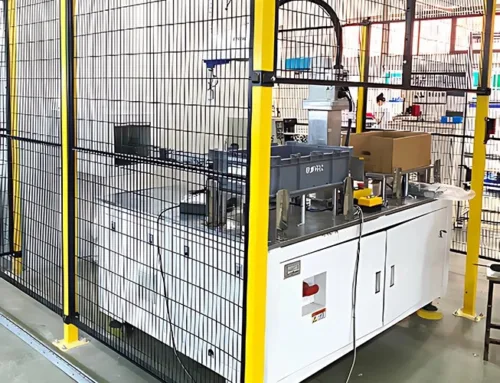
The Engineering Logic: The opening size in a mesh panel is a critical safety parameter, not an aesthetic choice. A smaller, “finger-safe” mesh opening of 20x100mm is specifically designed to prevent any part of the hand, beyond the fingertips, from passing through. According to the tables in ISO 13857, this physical limitation legally allows the guard to be installed as close as 120mm (4.7 inches) from the hazard zone.

The Result: By choosing the correct mesh from the start, you save over 0.7 square meters (about 7.5 sq. ft.) of floor space for every linear meter of fencing. On a 50-meter production line, that’s 35 square meters of high-value production space reclaimed. You deliver a more compact, efficient, and accessible layout that delights your client and avoids last-minute layout crises.
The Integration Imperative: ANSI/RIA R15.06 and Safety Interlocks
The Problem: The project specification requires an Omron D4NL or Pizzato safety interlock switch on all access doors. The fence system you ordered has no dedicated mounting points. Your technicians are now on-site with a hand drill and a can of spray paint, trying to fabricate a bracket. The result is misaligned, looks unprofessional, compromises the factory powder coat (inviting rust), and—worst of all—could lead to nuisance trips if the door sags over time.
The Engineering Logic: A modern robot safety fencing system is an active part of the machine’s control circuit. It must be designed as a stable mounting platform for safety components. Mdfence systems include pre-engineered, dedicated lock carriers and mounting plates for industry-standard switches from Omron, Pizzato, Schmersal, and others. These aren’t just holes drilled in a post; they are purpose-built components that ensure perfect alignment and long-term stability.

The Result: The specified safety switch bolts on perfectly in minutes using standard tools. The door and lock are perfectly aligned, ensuring the safety circuit is reliable. The system is commissioned faster, looks professional, and you’ve eliminated a major potential point of failure. You’ve delivered a true “turnkey” solution, not a series of on-site problems.
The True Cost of Compliance: Installation and Future-Proofing
The Problem: A locally welded fence seemed cheaper on the initial quote. But it required a hot work permit, forced a shutdown of nearby operations due to fumes and fire risk, and took days of skilled labor to install. Six months later, when the client needed to move a conveyor line, the entire fence had to be destroyed with an angle grinder and sent to the scrap heap. The initial “savings” were completely erased by labor, downtime, and zero asset retention.
The Engineering Logic: A modular, bolt-together system eliminates all on-site hot work. Installation is a clean, quiet “cold assembly” process using only basic hand tools. This means a system can be deployed up to 70% faster, often over a weekend or off-shift, with zero disruption to the client’s ongoing operations. Every component is a standardized, reusable asset.

The Result: You complete the installation ahead of schedule and under budget. When the client inevitably needs to reconfigure their line, the Mdfence system is simply unbolted and reassembled in the new layout. The fence is a capital asset with 95% reusability, not a disposable consumable. This demonstrates foresight and provides immense long-term value to your client, solidifying your position as a trusted partner.
Ultimately, achieving compliance for robot safety fencing isn’t about finding the cheapest panel. It’s about selecting an engineered system where every feature—from the steel grade to the mesh size to the bolt-on accessories—is purposefully designed to make your integration project faster, safer, and more profitable.
Perguntas Frequentes
1. What are the primary safety standards for robot guarding in the US?
The key standards are ANSI/RIA R15.06 (Safety Requirements for Industrial Robots and Robot Systems), which often references ISO 10218, and OSHA 29 CFR 1910.212 (General requirements for all machines). Core international standards like ISO 14120 (Guards) and ISO 13857 (Safety Distances) are also fundamental for proving due diligence.
2. How do I determine the required impact resistance for my robot fence?
The required impact resistance must be determined by your project-specific Risk Assessment (a requirement of ANSI/RIA R15.06). This assessment considers factors like the robot’s maximum payload, speed, and potential failure modes (e.g., dropping a part). An engineered system with a certified impact rating (like 1600 Joules) provides a validated baseline that meets or exceeds the requirements for most common industrial robot applications.
3. Can your fence system accommodate safety interlocks from different brands like Rockwell, Schmersal, or Omron?
Yes. A properly designed modular fencing system is built for this. Mdfence provides pre-engineered mounting plates and lock carriers specifically designed for the most common safety interlock switches in the industry, ensuring a clean, secure, and reliable installation without any on-site drilling or modification.
4. We have conveyors passing through the robot cell. How do we guard these openings?
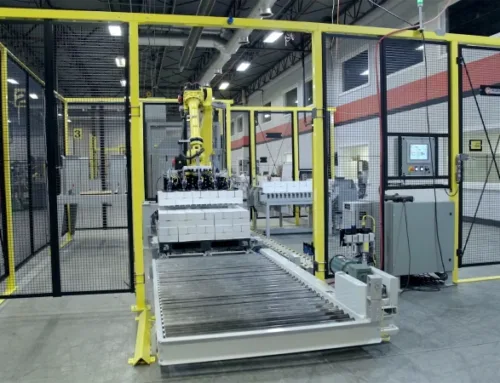
Openings for conveyors are protected using custom-sized “tunnel guards.” These are extensions of the fencing that create a tunnel around the conveyor, allowing product to pass through while maintaining the required safety distance based on the opening size, per ISO 13857, preventing personnel from reaching into the hazard zone.
5. Is a modular, bolt-together fence as strong as a permanently welded one?
Yes, when properly engineered. The strength of the Mdfence system comes from the combination of robust components: heavy-gauge Q235 steel posts, fully welded framed panels that resist deformation, and high-strength steel connection hardware. This creates a system that is not only certified to withstand high impacts but also retains its value through reusability, a key advantage over single-use welded barriers.