PT
PT  EN
EN  DE
DE  RU
RU  JA
JA  ES
ES  IT
IT 

|
Your new palletizing robot hits its cycle time targets, but the “safety” barrier around it is a liability waiting to happen. A single dropped case, a minor forklift tap, or a sagging gate causing nuisance trips can bring your entire end-of-line operation to a grinding halt. Standard fencing wasn’t engineered for the dynamic forces and operational demands of modern robotic palletizing. |
The High-Stakes Physics of a Palletizing Robot Cell
A palletizing robot is not just another machine. It’s a powerhouse of kinetic energy. An arm carrying a 50 lb (22.7 kg) payload at high speed can generate immense force. A dropped load or an unexpected motion path doesn’t just cause a mess; it turns that payload into a projectile. Traditional guarding solutions, often repurposed from perimeter fencing or fabricated in-house, simply aren’t designed to contain this level of specific, predictable risk.
This leads to two common, costly failure points:
- The “Hard but Brittle” Failure: Custom-welded barriers seem robust, but they have no give. A direct forklift impact doesn’t just dent them; it can shear welds or transmit shock straight to the floor anchors, creating a catastrophic failure. Repair means a “hot work” permit, grinders, welders, and hours—or even days—of production downtime.
- The “Soft but Useless” Failure: Chain-link or frameless “安平” style mesh offers minimal impact resistance. It sags under its own weight, deforms easily, and poses a snagging hazard. More critically, its wide mesh openings (e.g., 2×2 inches) force you to comply with large safety distances, pushing the entire work cell footprint outward and consuming valuable floor space.
An Engineered System: From Passive Barrier to Active Defense
A true Proteção de máquinas com cercas de segurança solution for palletizing robots must be engineered to solve these specific challenges. It’s not about just building a wall; it’s about creating a system that enhances safety, optimizes space, and improves operational efficiency.
1. Structure Engineered to Absorb, Not Shatter
The core of a robust robotic guard is its ability to manage energy. Our system is built from high-tensile Aço carbono Q235, but the real strength lies in the design. Every mesh panel is welded into a full 20x30mm tubular steel frame. This isn’t just a border; it’s a load-distributing structure.
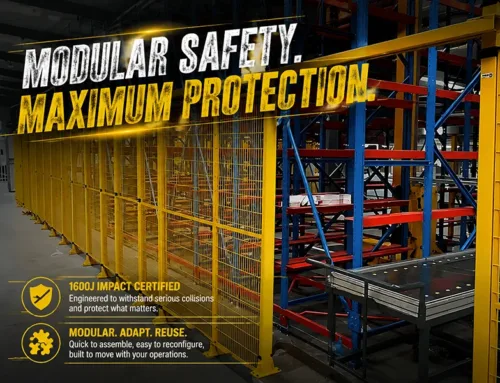
The Result (After): This architecture provides a certified impact resistance of 1600 Joules. In real-world terms, it can absorb the energy of a 100 kg (220 lb) object moving at 20 km/h (12.4 mph) without penetration. A dropped case from the robot’s end-of-arm-tooling is safely contained, protecting both personnel and the multi-million dollar automation asset itself.

2. Design That Gives You Back Your Floor Space
Plant floor space is one of your most valuable assets. According to safety standards like ISO 13857, the size of the openings in a guard dictates how close it can be to the hazard. Fencing with large 50x50mm mesh may require a safety distance of 200mm or more.
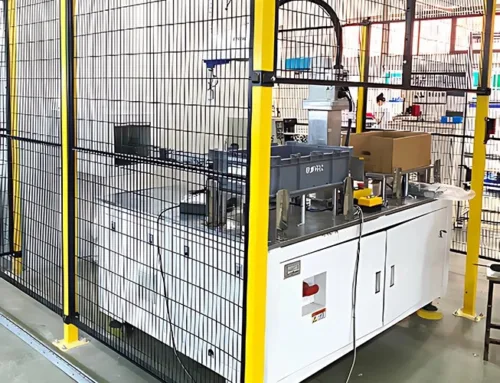
The Logic (Why it works): Our standard 20x100mm “finger-safe” mesh is the key. This narrow aperture prevents even a finger from reaching the hazard, legally allowing the Cerca de Segurança para Robôs to be installed as close as 120mm (~4.7 inches) from the robot’s operating envelope.
The Result (After): For a typical 20′ x 20′ palletizing cell, switching from a wide-mesh guard to our system can reclaim over 50 square feet of floor. That’s enough space for a wider forklift aisle, a QA inspection station, or staging for an extra pallet, directly impacting operational flow.
3. Modularity That Reduces Downtime
Your palletizing line isn’t static. You need access for maintenance, and layouts change. Welded guards turn these operational necessities into major projects. A minor forklift collision that damages a single panel can shut down a line for a full shift while you wait for cutting and welding.
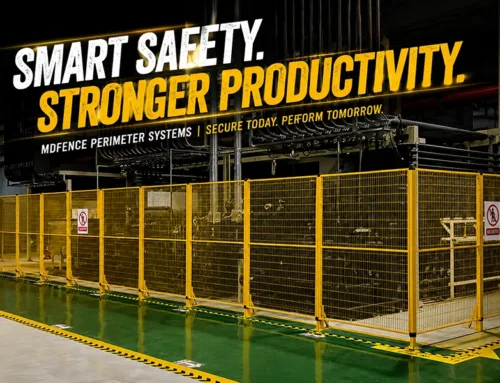
The Logic (Why it works): The Mdfence system is 100% modular. Panels, posts, and doors are assembled with high-strength steel brackets and bolts. No on-site welding is ever required. A damaged panel can be unbolted and replaced in under 15 minutes with a single hex wrench.
The Result (After): Mean Time To Repair (MTTR) plummets. Safe access for maintenance is achieved through pre-engineered, interlock-ready door systems, from standard hinged doors to wide-span sliding doors for forklift entry. When you re-layout the line in two years, your entire guarding system can be uninstalled and reconfigured at the new location, protecting your initial investment.

Case Study: Integrating a Complex, Multi-Conveyor Palletizing Line
An automation integrator was tasked with guarding a high-speed palletizing cell for a major CPG brand. The layout was complex, with multiple conveyor in-feeds and out-feeds. The end-client mandated the use of specific Omron safety interlocks and had a zero-tolerance policy for on-site fabrication that could damage the new epoxy floor.
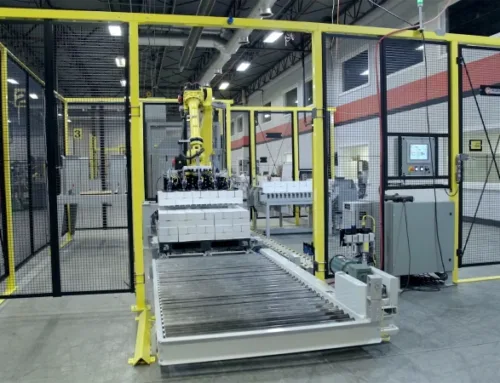
The Mdfence Solution (After): We delivered a complete, kitted solution based on their CAD drawings. This included pre-engineered “tunnel guards” that safely enclosed the conveyor pass-throughs to ISO 13857 standards. Critically, we provided pre-fabricated mounting plates specifically for the Omron D4NL switches, allowing for plug-and-play integration. The entire system was assembled in one day with no welding, grinding, or painting, helping the integrator deliver the project ahead of schedule and pass the end-user’s rigorous safety audit on the first try.

Investing in the right Proteção de Máquinas for your palletizing robots isn’t an expense; it’s an investment in uptime, compliance, and operational flexibility. Stop treating your safety system as an afterthought and start deploying an engineered solution designed for the reality of your production floor.
Perguntas Frequentes
1. How does your fencing system withstand direct impacts from a forklift?
Our system is designed to absorb energy. The robust 60x60mm Q235 steel posts are anchored directly to the concrete. In a collision, a single panel and post may deform (as they are designed to do, absorbing the impact), but the modular design allows for quick replacement of only the damaged components in minutes, preventing a full system collapse and minimizing downtime.
2. Can your system integrate with our plant’s standard safety components, like Allen-Bradley or Schmersal interlocks?
Absolutely. We offer a range of pre-engineered mounting plates and lock carriers for all major safety switch brands, including Omron, Pizzato, Schmersal, Allen-Bradley, and more. This eliminates the need for on-site drilling or welding, ensuring a clean, compliant, and reliable integration with your safety PLC.
3. What is the typical installation time for a standard 20′ x 20′ palletizing cell?
With our modular, bolt-together system, two trained installers can typically assemble a standard-sized cell in a single 8-hour shift. This is up to 70% faster than traditional welded solutions, which require additional time for fabrication, grinding, and painting.
4. How do you safely accommodate conveyor belts that need to pass through the fence line?
We design and provide custom “Tunnel Guards” or openings that are precisely calculated to comply with ISO 13857 safety standards. These tunnels allow your products and pallets to pass through freely while ensuring that an operator cannot reach the hazardous area, maintaining a fully compliant safety perimeter.
5. Does your standard 20x100mm mesh opening comply with North American safety standards like ANSI/RIA R15.06?
Yes. Our “finger-safe” mesh size is fully compliant with the stringent requirements of ANSI/RIA R15.06 (the US standard for robot safety) and OSHA regulations for machine guarding. The small opening is a key feature that allows for a reduced safety distance, which is a critical advantage in optimizing floor space while maintaining full compliance.