PT
PT  EN
EN  DE
DE  RU
RU  JA
JA  ES
ES  IT
IT 
 |
Your robotic cell design is flawless. Your PLC logic is tight. But the wrong choice in guarding panels can derail your project during commissioning and create a maintenance headache for your client. Before you default to T-slot aluminum, consider the hidden costs of a system not built for the rigors of modern manufacturing. |
As a system integrator, your choice of Painéis de cerca de proteção para máquinas is a critical engineering decision. It directly impacts project timelines, the long-term reliability of your automated system, and, most importantly, safety compliance. While T-slot aluminum framing is often seen as a modern, lightweight option, its real-world performance in demanding industrial environments frequently falls short. This article breaks down the physics and practicalities of why Q235 carbon steel is the superior choice for serious industrial automation.
The Hidden Flaws of Aluminum in High-Cycle Automation
T-slot aluminum guarding has an aesthetic appeal and seems flexible on paper. However, its physical properties create significant vulnerabilities in typical manufacturing settings, leading to issues that can jeopardize your project’s success and your client’s operational efficiency (OEE).
Vulnerability 1: Low Impact Resistance
The reality of a factory floor includes forklifts, parts carts, and AGVs. Aluminum’s low elastic modulus means that under a direct impact that would merely scratch or dent a steel post, an aluminum extrusion is likely to suffer permanent deformation—it bends and stays bent. This isn’t just a cosmetic issue. A deformed frame can compromise the entire cell’s integrity, necessitating a costly and time-consuming replacement that wasn’t in your project budget.
Vulnerability 2: Connection Loosening from Vibration
Consider the environment around a stamping press, a high-speed CNC machine, or even a six-axis robot making rapid, repetitive movements. This constant, low-amplitude vibration is the enemy of T-slot connections. Over time, T-nuts can work themselves loose. This leads to rattling panels, a loss of structural rigidity, and—most critically—the potential for safety interlock switches to become misaligned. These misalignments are a notorious source of nuisance faults, triggering machine stoppages that frustrate operators and kill productivity.
The Engineering Case for Q235 Carbon Steel Guarding
A properly engineered steel guarding system overcomes these weaknesses not just through material strength, but through a superior structural design philosophy. It’s built to withstand the realities of the industrial world.
Physics-Based Durability: Absorbing Energy, Not Failing
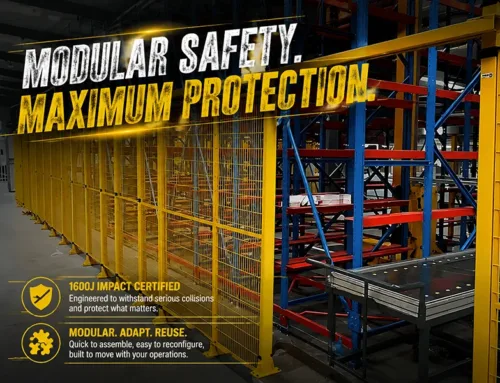
Mdfence systems are constructed from Q235 carbon steel. Unlike aluminum, which can be brittle and crack under extreme stress, Q235 steel is engineered for plastic deformation. In the event of a severe impact, like a forklift collision, the steel post is designed to bend and absorb the kinetic energy. It acts like a car’s crumple zone, containing the hazard without shattering into secondary projectiles. This is why our system is certified to withstand a 1600 Joule impact—equivalent to stopping a 220 lbs (100 kg) object moving at 12.5 mph (20 km/h).
Structure is Key: The Rigidity of the Welded Frame
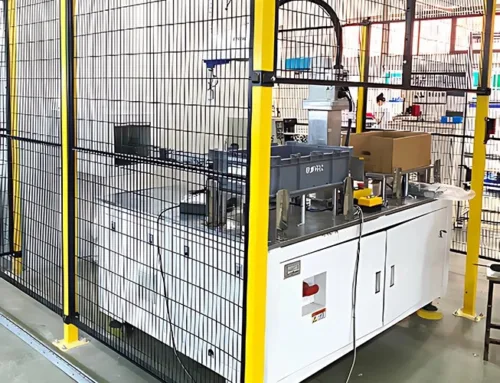
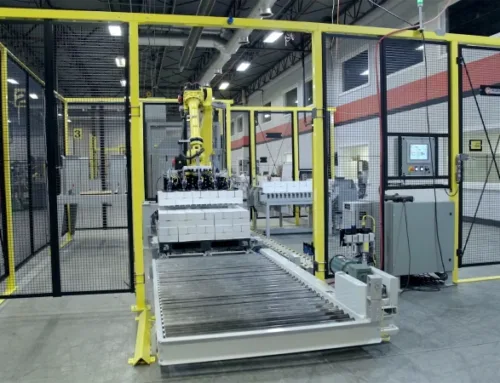
A key difference lies in the panel construction. Instead of an assembly of individual extrusions and brackets, our standard panels are fully-welded units featuring a robust 20x30mm tubular steel frame. This creates a monolithic structure with immense out-of-plane stiffness.

This inherent rigidity prevents the “trampoline effect” common in less robust systems. More importantly for automation, it provides an incredibly stable mounting surface for safety components. When you bolt an Omron D4NL or Pizzato interlock switch to our frame, it stays aligned, eliminating a major source of downtime and ensuring the integrity of your safety circuit.
Steel vs. Aluminum: A Head-to-Head Comparison for Integrators
| Feature | Mdfence Q235 Steel System | T-Slot Aluminum System |
|---|---|---|
| Resistência ao impacto | Excellent. Designed to deform and absorb energy (plastic deformation). Certified to 1600J. Minor impacts result in minimal damage. | Poor. Prone to permanent bending or cracking on impact. A minor collision can require replacement of entire sections. |
| Vibration Integrity | High. Bolted connections with high-strength fasteners and rigid welded frames maintain alignment of safety devices. | Low. T-nuts are susceptible to loosening under constant vibration, causing panel rattle and safety switch misalignment. |
| Installation & Commissioning | Rapid. Modular, pre-fabricated panels and posts allow for cold assembly with basic tools. Pre-engineered mounting plates for switches save hours of on-site fabrication. | Time-consuming. Requires precise on-site cutting of extrusions and tedious assembly of numerous small brackets, screws, and T-nuts. |
| Long-Term ROI | High. 95%+ of the system is reusable during line reconfiguration. Extreme durability minimizes repair costs. | Low. Reconfiguration often requires new, custom-cut extrusions, turning the initial investment into a sunk cost. High initial material price. |
| Safety Integration | Seamless. Purpose-built, pre-drilled mounting kits for industry-standard interlocks (Omron, Pizzato, Schmersal) ensure perfect fit and function. | Custom. Requires sourcing appropriate brackets or on-site drilling and tapping, which can be imprecise and time-consuming. |
The Real-World Payoff: Faster Commissioning, Happier Clients
The choice of steel directly translates into a smoother project execution and a more robust final product for your client.
Win the Race Against the Clock
During the critical commissioning phase, speed is everything. An Mdfence system arrives as a kit of finished parts. Your team isn’t cutting, welding, or grinding. They are simply bolting together pre-powder coated components using standard hand tools. This “cold assembly” process is up to 70% faster than traditional welding and significantly quicker than piecing together a complex T-slot frame. This means your team can focus on what they do best: programming robots and tuning the system, not building fences.

Deliver a Future-Proof Asset
Manufacturing layouts are not static. In 2-3 years, your client will likely retool or move the line. With an Mdfence Cerca de Segurança para Robôs system, they unbolt the modular sections and reconfigure them in the new layout. The guarding is a movable, reusable asset. An aluminum system, often cut to precise, application-specific lengths, frequently ends up in the scrap bin, forcing the client to purchase a new guarding system and eroding the value of their initial investment.
For system integrators whose reputation is built on delivering reliable, high-quality, and cost-effective automation, the choice is clear. While aluminum may look the part, a Q235 carbon steel guarding system is engineered to perform, endure, and deliver value for the entire lifecycle of the automated cell.
Frequently Asked Questions for Automation Professionals
1. How does your steel system accommodate specific safety switches like the Omron D4NL or a Schmersal interlock?
We offer a range of pre-engineered, laser-cut mounting plates and kits, what we call a Safety Interlock Carrier. These plates have the precise hole patterns for popular safety switches from Omron, Pizzato, Schmersal, and others. This eliminates any need for on-site drilling or fabrication, ensuring a perfect, compliant fit in minutes.
2. Our robotic cell has a complex footprint with non-90-degree angles. How does your system handle this?
Our modular system is designed for flexibility. We utilize adjustable angle connectors that allow panels to meet at virtually any angle required by your floor layout. For the design phase, we can work directly with your CAD files to create a bill of materials that perfectly matches your complex footprint.
3. What is the typical lead time? Our project schedules are extremely tight.
We maintain a significant inventory of all standard components—including posts, the most common panel sizes, and door kits—at our facility. For standard configurations, this allows us to ship material quickly to meet urgent project deadlines. Custom panel sizes or colors will have a longer lead time, which we will define clearly at the quoting stage.
4. How does the powder-coated steel finish stand up to industrial coolants and cutting fluids?
Our multi-stage surface treatment process is designed for harsh environments. The Q235 steel is pre-treated before receiving a durable electrostatic powder coating. This finish passes the ISO 9227 neutral salt spray test, demonstrating high resistance to corrosion from common industrial oils, solvents, and cleaning agents, preventing rust and ensuring a long service life.
5. If a panel is damaged by a major forklift collision, how difficult is the replacement process?
Replacement is fast and simple. Because it’s a bolted system, a damaged panel can be replaced by two technicians in under 15 minutes. They simply unbolt the four connection clips holding the panel, remove the damaged section, slot the new panel in, and re-tighten the bolts. There is no cutting, welding, or painting required, minimizing line downtime significantly.