PT
PT  EN
EN  DE
DE  RU
RU  JA
JA  ES
ES  IT
IT 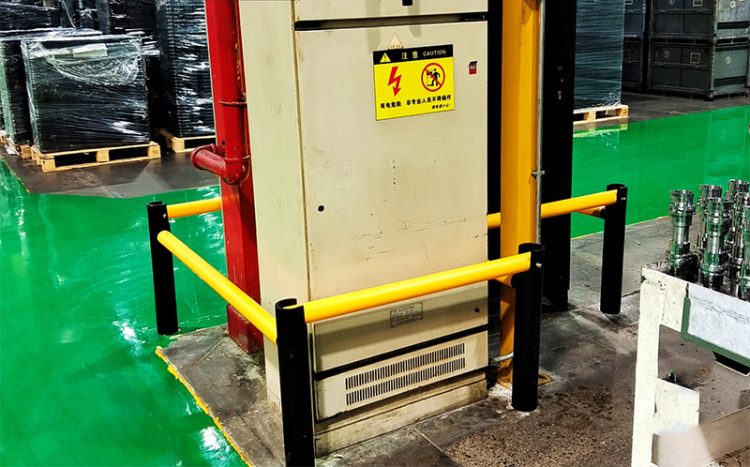
Choosing the right safety barrier system is a critical decision for any facility manager. It’s a long-term investment in the safety of your people, the integrity of your equipment, and the efficiency of your operation. For decades, the choice was simple: welded steel. It’s heavy, rigid, and feels strong. But modern material science has introduced a powerful alternative: advanced polymer flexible safety barriers.
The debate often gets stuck on one point: upfront cost. But a strategic decision requires looking beyond the initial price tag to compare how these systems perform under pressure and what they truly cost over their entire lifecycle.
Round 1: Initial Investment vs. Long-Term Value
On the surface, a standard steel guardrail typically has a lower initial purchase price than its polymer counterpart. Coupled with the perception of strength—the sheer weight of steel feels robust—it’s easy to see why it has been the default choice. If the decision were based solely on the upfront invoice, steel would appear to be the fiscally responsible option. But this overlooks the most important factor: what happens at the moment of impact?
Round 2: Performance Under Impact
The entire purpose of a safety barrier is to manage the energy of a collision. Here, the two materials operate on fundamentally different philosophies.
Steel Barrier: A Philosophy of Rigid Resistance
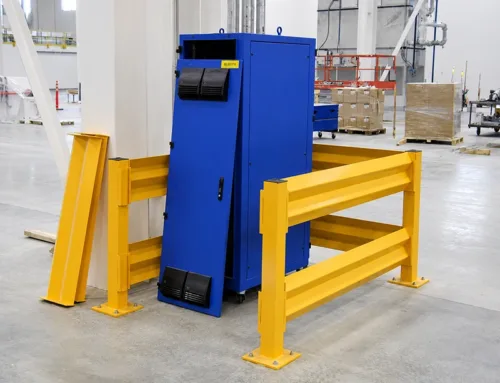
When a forklift impacts a steel guardrail, the barrier stops the vehicle through brute force. The steel is designed not to bend, meaning it transfers nearly 100% of the collision’s energy to two places: the floor and the vehicle. This results in cracked concrete, loosened anchors, and significant damage to the forklift. The steel barrier itself is permanently deformed, essentially a single-use device that must be expensively replaced.
Polymer Barrier: A Philosophy of Flexible Absorption
Advanced flexible safety barriers are engineered not just to stop an impact, but to manage it. They are designed to be shock absorbers for your facility. When a forklift makes contact, the polymer flexes and deforms, absorbing up to 80% of the impact forces within itself. This creates a “triple protection” effect: the barrier is protected, the floor is protected, and the vehicle is protected. After flexing, the barrier’s material memory allows it to return to its original shape, undamaged and ready for the next impact.
Round 3: The Financial Showdown – Total Cost of Ownership (TCO)
This is where the initial cost advantage of steel is proven to be an illusion. Let’s model the TCO for a single corner over three years, assuming two impacts per year.
| Cost Component | Year 1 | Year 2 | Year 3 | Total |
|---|---|---|---|---|
| Steel Barrier | ||||
| Initial Purchase & Install | $1,000 | $1,000 | ||
| Repair/Replace (2x/yr) | $1,500 | $1,500 | $1,500 | $4,500 |
| Hidden Floor Damage | Liability | Liability | Liability | High |
| 3-Year TCO | $5,500+ | |||
| Polymer Barrier | ||||
| Initial Purchase & Install | $2,000 | $2,000 | ||
| Repair/Replace (2x/yr) | $0 | $0 | $0 | $0 |
| Hidden Floor Damage | Protected | Protected | Protected | None |
| 3-Year TCO | $2,000 | |||
(Note: Costs are illustrative examples for comparison)
The Verdict: An Investment, Not an Expense
While a steel barrier may have a lower price tag, it creates hidden costs and liabilities with every impact. It is a recurring expense disguised as a safety device. A modern polymer barrier is a true one-time investment in a more resilient and cost-effective facility. When you look beyond the initial quote, the choice becomes clear.