PT
PT  EN
EN  DE
DE  RU
RU  JA
JA  ES
ES  IT
IT 

In high-throughput material handling facilities, the clash between heavy forklift traffic, fast-moving AGVs, and robotic palletizing cells is a daily operational hazard. A flimsy wire mesh won’t stop a 10,000 lb forklift, and complex welded barriers kill your layout flexibility when conveyor routes change. You need a physical perimeter that absorbs massive kinetic energy, integrates seamlessly with your safety interlocks, and keeps your sorting lines running at peak OEE.
The Reality of Material Handling: High Speeds, Heavy Payloads, and Zero Margin for Error
In automated warehouses and logistics centers, the environment is brutal. Robotic arms are swinging heavy payloads, pallet jacks are navigating tight aisles, and high-speed conveyors are moving thousands of units per hour. The traditional approach of hiring a local fabricator to weld some generic mesh around a robotic work cell is a recipe for disaster.
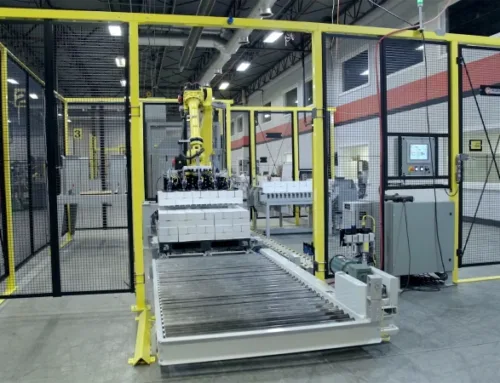
The Pain Point: When a forklift driver misjudges a turn and clips a standard frameless fence, the mesh deforms, pops out of its clips, and leaves your expensive robotic palletizer exposed. Worse, if a worker leans against a sagging fence near a conveyor pinch point, you are looking at immediate OSHA violations and catastrophic line shutdowns. To maintain throughput without compromising safety, system integrators require robust Sistemas de Cercas de Segurança para Robôs that act as an active, energy-absorbing shield.

The Engineered Solution: Absorbing 1600 Joules of Impact
To protect high-value automation assets, you must rely on physics, not guesswork. Our Cerca de Segurança Industrial is engineered from high-tensile Q235 carbon steel. Unlike brittle aluminum profiles that snap or cheap wire that bends, Q235 steel undergoes plastic deformation under extreme stress.
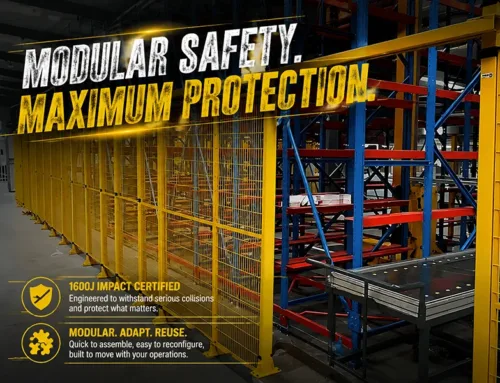
Why it works: The core of the system is the fully welded framed panel (20x30x1.5mm tubular frame). When an out-of-control pallet jack strikes the barrier, the point load is distributed across the entire frame and transferred to the 60x60mm mounting posts. This architecture is TUV certified to withstand 1600 Joules of impact energy—equivalent to stopping a 220 lb object moving at over 12 mph. It acts exactly like a crumple zone, preventing the fence from breaking into dangerous projectiles and ensuring your robotic assets remain untouched.
Reclaiming Floor Space for AGV/AMR Paths
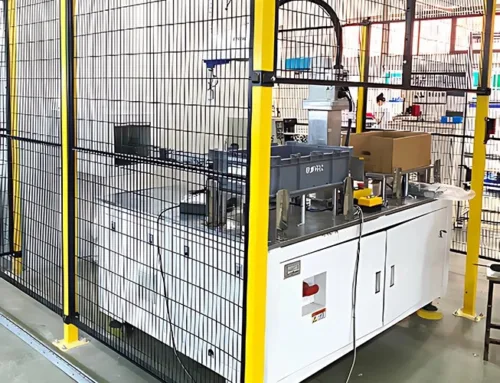
In a facility where every square foot is calculated into the ROI, you cannot afford dead space. Standard 2″x2″ (50x50mm) mesh requires a massive safety distance because fingers can easily reach through. We utilize a highly specific 0.78″ x 3.93″ (20x100mm) anti-climb mesh. According to ISO 13857 reach-through standards, this “finger-safe” aperture allows you to install the Sistemas de Proteção de Máquinas just 4.7 inches (120mm) away from the hazard. For a 150-foot sorting line, this reclaims hundreds of square feet of usable floor space, allowing you to widen your AGV navigation corridors and reduce traffic bottlenecks.
Seamless Integration with Conveyors and Safety Logic
Material handling isn’t static; it requires continuous flow. When your conveyor lines need to pass in and out of the robotic cell, you can’t just cut a hole in the fence. We design compliant “Tunnel Guards” that perfectly wrap around your conveyor belts—ensuring the product passes smoothly while preventing operators from reaching inside.

Furthermore, access doors must integrate with your facility’s LOTO (Lockout/Tagout) protocols. Sagging doors cause safety interlocks (like Omron or Pizzato switches) to misalign, creating ghost stops and killing your line’s OEE. Our modular doors utilize heavy-duty caster wheels and rigid overhead beams, ensuring perfect alignment for electronic interlocks over millions of cycles. When a maintenance tech opens the door to clear a jammed carton, the PLC immediately drops the safety torque off (STO), stopping the robot instantly.
Massive Clearance for Heavy Logistics
When you need to swap out a massive robotic end-effector or bring in a double-wide pallet, standard man-doors fail. Our modular system includes heavy-duty sliding and folding doors that provide up to 15.7 feet (4800mm) of unobstructed clearance, allowing your largest material handling equipment to enter the cell safely and efficiently.

Before vs. After: The Material Handling Advantage
| Operational Scenario | Traditional Welded/Frameless Mesh | Mdfence Modular Fencing System |
|---|---|---|
| Forklift Impact | Mesh deforms permanently, pops out of bindings. Requires hot-work (welding/grinding) on the warehouse floor to repair, causing hours of downtime. | 1600J impact resistance absorbs the blow. If a panel is pierced, a single technician can swap it out using a wrench in under 10 minutes (Low MTTR). |
| Layout Reconfiguration | When a conveyor line is moved, the old fence is cut down and scrapped. Asset recovery is 0%. New fencing must be purchased. | 100% modular bolt-together design. Panels and posts are disassembled and reassembled in the new layout like Lego bricks. 95%+ asset reuse. |
| Safety Interlocks & OEE | Doors sag over time. Safety switches misalign, causing the PLC to throw phantom errors and unexpectedly halt the sorting line. | Rigid framed doors with bearing rails and caster wheels ensure perfect, repeatable alignment for Omron/Pizzato switches. Zero false trips. |
Frequently Asked Questions in Material Handling Integration
1. How do we protect conveyor entry/exit points without tripping safety sensors?
We design custom ISO 13857 compliant “Tunnel Guards” that wrap exactly around the dimensions of your conveyor belt. This allows cartons and totes to pass through seamlessly while extending the safety distance far enough to prevent an operator from reaching the internal pinch points.
2. Can your sliding doors accommodate a standard 96-inch wide double-pallet load?
Yes. Our double sliding doors and folding door systems can provide clear opening widths of up to 4800mm (approx. 189 inches). They utilize heavy-duty top-hung bearing rails or bottom caster wheels to ensure smooth operation even at maximum widths.
3. What happens if an AMR (Autonomous Mobile Robot) bumps into the base of the fence?
Our posts feature specialized plastic base protective covers that completely shield the floor anchors. This not only protects the AMR’s sensitive bumper sensors from getting scratched by exposed bolts but also deflects minor low-level bumps without damaging the primary steel structure.
4. Do your panels meet OSHA and ANSI/RIA R15.06 standards for robotic palletizing cells?
Absolutely. The system is engineered to meet and exceed ISO 14120, ISO 13857, and ANSI/RIA R15.06 standards. The 20x100mm mesh prevents reach-through hazards, and the 1600J impact rating acts as a compliant physical barrier against robotic payload ejection.
5. How fast can we replace a damaged panel if a forklift’s tines pierce the mesh?
Our modular clip-and-bolt system ensures an incredibly low MTTR (Mean Time To Repair). A single maintenance technician can unbolt the four retaining clips, remove the damaged panel, and install a replacement from your spare inventory in under 10 minutes, requiring no hot-work permits.