PT
PT  EN
EN  DE
DE  RU
RU  JA
JA  ES
ES  IT
IT 
 |
Your robot cell integration is state-of-the-art. But what happens when the “cost-effective” guarding you specified requires on-site welding, delaying commissioning by a week and failing the end-client’s final EHS audit? There’s a smarter way to de-risk your integration projects. |
DIY machine guarding vs professional systems?
For an automation systems integrator, the choice of Proteção de Máquinas often feels like a simple line item on a complex bill of materials. The allure of a low quote from a local fabrication shop for a welded guard, or sourcing cheap “Anping-style” mesh, is tempting. However, this initial saving often evaporates on the shop floor, turning a simple component into a major project bottleneck that jeopardizes timelines, compliance, and your reputation with the end client.
The debate isn’t about saving a few dollars on steel; it’s about mitigating project risk and delivering a truly turnkey solution. Let’s break down the real-world implications of choosing between a DIY approach and an engineered, professional system.
The “DIY” Trap: A Cascade of Hidden Costs and Delays
The “Before” scenario for many integrators using locally fabricated or low-cost mesh guarding is a familiar story of unforeseen complications.
1. The Hot Work Permit Nightmare
A welded guarding solution instantly introduces “hot work” to your project site. This means navigating the end-client’s bureaucracy for permits, scheduling fire watches, and potentially shutting down adjacent production areas. What seemed like a simple installation becomes a logistical headache, adding days of non-productive time to your commissioning schedule.
2. The Agony of On-Site Modifications
Local fabrication rarely matches the precision of your CAD model. Panels arrive slightly out of square, mounting holes are misaligned, and gate posts aren’t perfectly plumb. This forces your technicians to become welders and fabricators, drilling into powder-coated surfaces (inviting rust), and shimming gates to get safety interlocks to align. Each modification is a compromise that looks unprofessional and introduces potential failure points.

3. The Failed EHS Audit
This is the integrator’s biggest fear. A common cost-cutting measure is using mesh with large 50x50mm openings. While cheap, it fails to meet the stringent “finger-safe” requirements of ISO 13857. An astute EHS manager from your client will flag this immediately, forcing a costly and embarrassing last-minute rework. The alternative—placing the fence further from the machine—wastes the client’s valuable floor space, a cardinal sin in modern manufacturing.
The Professional System: Pre-Engineered for Predictability and Compliance
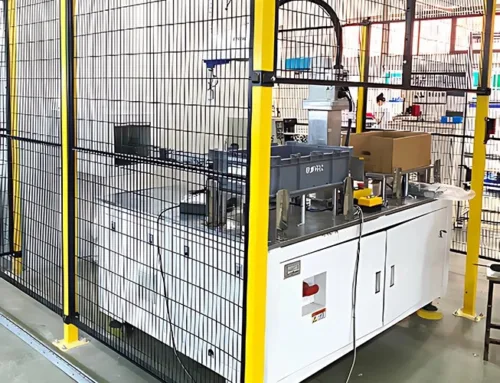
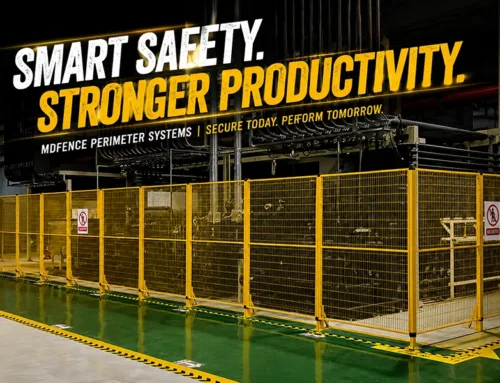
A professional Cerca de Segurança para Robôs system like Mdfence is designed to eliminate these variables. It’s not just a fence; it’s a “cold assembly” solution engineered for the realities of system integration.
1. From Hot Work to Hex Key Assembly
The entire Mdfence system is modular and bolts together. Installation is a clean, quiet, “cold” process requiring only standard hand tools. Our data shows this method is up to 40% faster than traditional welding and fabrication. Your team can install 50 meters of guarding in a single day, keeping your project on schedule without disrupting the client’s operations.
2. Guaranteed Compliance, Engineered In
Our standard 20x100mm mesh isn’t an arbitrary size. It’s specifically designed to exceed ISO 13857 standards, allowing the guard to be placed as close as 120mm from the hazard. This not only guarantees you’ll pass the EHS audit but also demonstrates your expertise by saving the client significant floor space—a tangible value-add. For a 50-meter production line, this can save over 35 square meters of high-value production area.

3. Seamless Integration with Your Control System
Your job is to make robots and PLCs communicate. Our job is to make the physical barrier a seamless part of that system. We provide pre-engineered mounting plates and kits for the industry-standard safety interlocks you already use, including Omron D4NL, Pizzato, and Schmersal. This “plug-and-play” approach eliminates on-site drilling, ensures perfect switch alignment, and prevents the nuisance trips that can plague a poorly fitted gate, directly improving the final system’s OEE (Overall Equipment Effectiveness).
The Payoff: From Sunk Cost to Future-Proof Asset
Ultimately, a professional Machine Guarding System transforms guarding from a risky, disposable expense into a value-added component of your solution. When your client needs to re-tool or modify the line in two years, a welded guard goes into the scrap bin. An Mdfence system, with its 95% asset reusability, can be unbolted and reconfigured like a Lego set. This long-term value is a powerful selling point that elevates your proposal above competitors who only compete on the initial price.
The final installation, with its perfect lines, durable powder-coat finish, and flawless gate operation, reflects the precision and quality of the automation cell it protects. It’s the finishing touch that ensures your project not only works perfectly but also looks the part, leading to a satisfied client and a smooth final sign-off.
Frequently Asked Questions for System Integrators
1. Do you provide 3D CAD models (e.g., STP files) for us to import into our layout software?
Absolutely. We provide a complete library of 3D models for all our components. This allows your engineers to design the guarding system directly into the overall cell layout, identify any potential interference issues early, and generate an accurate Bill of Materials (BOM) automatically, eliminating guesswork and ordering errors.
2. Our end-client has specified a particular brand of safety interlock (e.g., Pizzato, Schmersal). Can your system accommodate it?
Yes. This is one of our core strengths. We have pre-engineered, standardized mounting plates and “lock carrier” kits specifically designed for the most common safety switches in the industry, including Omron, Pizzato, Schmersal, and others. This ensures a clean, robust, and perfectly aligned installation without any on-site fabrication.
3. The robot cell layout includes a conveyor line that needs to pass through the guarded perimeter. How do you handle these openings?
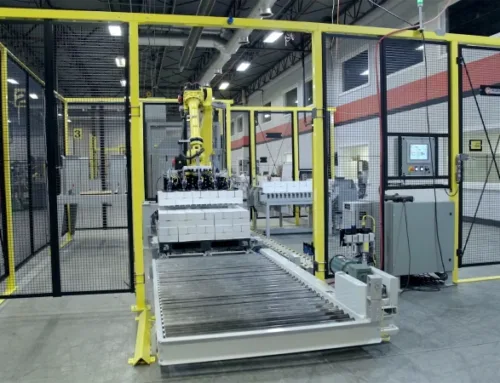
We design custom “tunnel guards” or pass-through openings directly into our panels. These openings are sized precisely to allow the product or conveyor to pass through while strictly adhering to the safety distance calculations of ISO 13857, ensuring that an operator’s limbs cannot reach the hazard zone. The solution is fully compliant and integrated into the modular system.
4. What is the typical lead time? Our project timelines are often very aggressive.
We maintain a significant inventory of all standard components (posts, panels, doors, and fasteners) in our most common sizes and colors (Safety Yellow/Black). For standard configurations, we can often ship within days to meet urgent project deadlines. For highly customized solutions, we work with your project manager to establish a clear production and delivery schedule that aligns with your commissioning timeline.
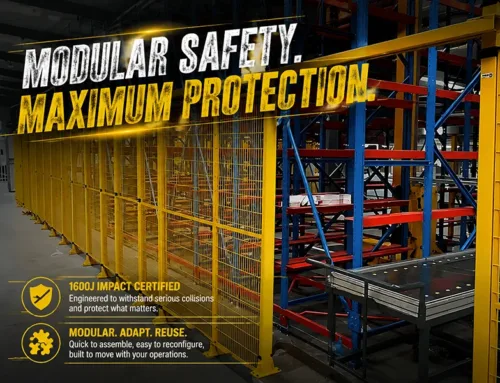
5. How does the Q235 steel system withstand impacts compared to cheaper alternatives or aluminum profiles?
Our system, built from heavy-gauge Q235 carbon steel with fully welded panel frames, is certified to withstand impacts of at least 1600 Joules. Unlike brittle cast iron or easily deformed aluminum, Q235 steel will plastically deform (bend) under extreme impact, like a forklift collision. This allows it to absorb the energy of the crash without shattering into secondary projectiles, offering superior protection for both personnel and the high-value equipment inside the cell.