PT
PT  EN
EN  DE
DE  RU
RU  JA
JA  ES
ES  IT
IT 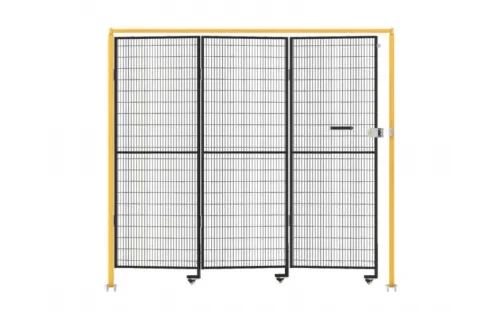

|
Your robot integration project is on a tight deadline. The last thing you need is a safety barrier that requires on-site welding, custom drilling, and last-minute fabrication, delaying commissioning and risking failure at the client’s EHS audit. Generic fencing isn’t a solution; it’s a project liability that creates more problems than it solves. |
For automation system integrators, specifying a Proteção de máquinas com cercas de segurança system is more than a line item on a Bill of Materials (BOM)—it’s a critical component that directly impacts project timelines, on-site safety, and your professional reputation. While meeting standards like ISO 14120 and ANSI/RIA R15.06 is mandatory, the *way* you achieve compliance separates a smooth, profitable integration from a costly, delay-ridden nightmare.
Too often, integrators are forced to deal with generic fencing or locally welded barriers that turn the final, critical phase of a project into a chaotic exercise in improvisation. This approach introduces unacceptable risks and hidden costs that far outweigh any initial savings.
The On-Site Nightmare: When “Cost-Effective” Guarding Derails Your Project
A poorly specified guarding system creates predictable—and preventable—headaches during commissioning. These aren’t just minor inconveniences; they are direct threats to your project’s success.
The Integration Bottleneck: Misaligned Interlocks and Nuisance Trips
Your safety PLC relies on precise inputs. But when you’re forced to drill and tap holes on-site to mount a sophisticated safety interlock, like an Omron D4NL or Pizzato FS series, perfect alignment is nearly impossible. The result? Doors that don’t close properly, switches that fail to engage, and constant, maddening nuisance trips that halt the entire line. Every hour your team spends troubleshooting a misaligned door latch is an hour of lost time and a blow to your client’s confidence.

The Compliance Gamble: Failing the Final EHS Audit
End-clients, especially in automotive and aerospace, have rigorous EHS standards. An inspector will immediately spot non-compliant features. A common failure point is using wide 50x50mm mesh. According to ISO 13857, this forces you to place the barrier far from the hazard (up to 850mm), wasting the client’s valuable floor space. Welded joints with sharp edges, rust from on-site cutting, and flimsy construction are all red flags that lead to a failed audit, forcing costly and time-consuming rework.
Engineered for Integration: A System Built for Automation Professionals
A true Cerca de Segurança para Robôs system is not just steel and wire; it’s an engineered solution designed to eliminate these bottlenecks. The Mdfence system is built on a foundation of compliance, modularity, and seamless integration.
Strength and Standards: The Core of Compliance
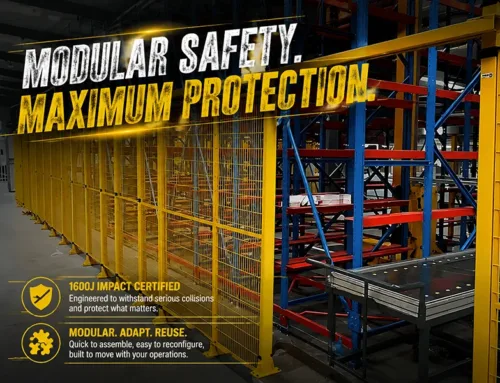
Our system is not just a barrier; it’s a certified safety component. Constructed from high-tensile Q235 carbon steel with a robust, fully welded 20x30mm frame on every panel, it is designed and tested to meet the stringent requirements of ISO 14120. This includes withstanding a 1600 Joule impact—equivalent to a 220 Lbs object hitting it at 12.5 mph. This certified performance gives you and your client documented proof that you have implemented state-of-the-art protection, satisfying the core demand of any risk assessment.

Smart Design That Saves Space
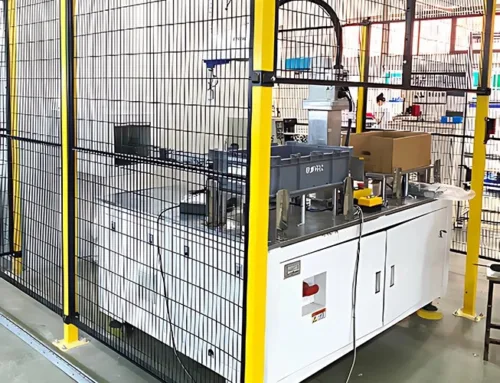
Our standard 20x100mm “finger-safe” mesh is a critical design feature. By preventing fingers from passing through, ISO 13857 allows the guard to be installed as close as 120mm (4.7 inches) from the hazard. Compared to the 850mm required for larger mesh, this can save over 0.7 square meters (7.5 sq ft) for every linear meter of fencing. For a typical robot cell, this reclaims significant, high-value production floor space for your client.
The Integrator’s Edge: Pre-Engineered for Your Components
This is where Mdfence transitions from a passive barrier to an active part of your control system. We’ve eliminated the need for on-site drilling and fabrication by creating a system of pre-engineered lock carriers and mounting plates. These components are designed to perfectly accommodate industry-standard safety interlocks from brands like Omron, Pizzato, and Schmersal. Your safety components bolt on cleanly, align perfectly, and integrate seamlessly into your safety circuit, turning hours of on-site fabrication into minutes of simple assembly.

From CAD to Commissioning: A Real-World Integration Scenario
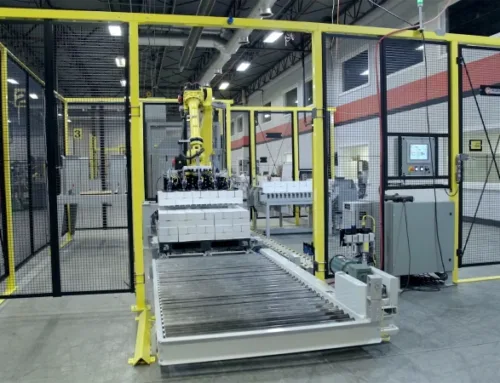
An automation integrator, GBM Automation, was tasked with guarding a complex, multi-station production line. The end-client specified the exact Omron and Pizzato safety interlocks to be used, and the EHS requirements were exceptionally strict. Instead of risking project delays with a generic solution, they chose Mdfence.
Using our provided CAD files, they designed the entire layout digitally, ensuring a perfect fit before a single component was ordered. The system arrived on-site flat-packed, and assembly was a “cold work” process—no welding, no grinding, no fire permits. The pre-engineered lock carriers allowed for the immediate and precise installation of the specified safety switches. The result? The physical guarding and safety circuit integration were completed 30% faster than their previous projects, and the system passed the client’s demanding EHS acceptance test on the first walkthrough.

Ultimately, compliant and well-engineered Sistemas de Proteção de Máquinas are not an expense; they are an investment in project efficiency and your reputation. By choosing a system designed for the realities of automation integration, you de-risk your project, accelerate your timeline, and deliver a final product that showcases your commitment to quality and safety.
Frequently Asked Questions for System Integrators
1. How does your system help me comply with ANSI/RIA R15.06 for robotic cells?
Our system directly supports ANSI/RIA R15.06 compliance by providing a certified, high-impact physical barrier (conforming to ISO 14120), offering mesh sizes that meet safe distance requirements (ISO 13857), and facilitating the seamless integration of required safety interlocks for access gates, turning the fence into an active part of the robot’s safety-rated control system.
2. Can I get 3D CAD/STP files for my layout design?
Absolutely. We provide a complete library of 3D CAD models for our components. This allows your engineering team to integrate our guarding system directly into your overall plant or cell layout, verify clearances, prevent interference, and generate an accurate Bill of Materials, saving significant design time.
3. Do you provide pre-engineered solutions for mounting safety interlocks from brands like Omron, Schmersal, or Pizzato?
Yes. This is one of our core advantages. We offer a range of pre-drilled mounting plates and “lock carriers” specifically designed for the most common safety interlocks in the automation industry. This eliminates on-site drilling, ensures perfect alignment, and dramatically speeds up the electrical integration and commissioning process.
4. What is the typical lead time for a standard system? Our project is urgent.
We maintain a significant inventory of standard components (posts, panels, and door hardware in our standard yellow/black colors) to support the urgent timelines common in automation projects. For standard configurations, we can often ship much faster than solutions requiring custom fabrication.
5. How does the modular design help if my client needs to change the production line layout in the future?
The fully modular, bolt-together design means the entire system is a reusable asset. Unlike welded guarding, which must be scrapped, our system can be easily disassembled, reconfigured, and reassembled to accommodate new equipment or a completely different layout. This provides a significantly lower total cost of ownership for your client.