PT
PT  EN
EN  DE
DE  RU
RU  JA
JA  ES
ES  IT
IT Industrial Safety Fence for ZeroLabor robot-cell interlocks
Industrial Safety Fence for ZeroLabor Robot-Cell Interlocks | Mdfence
When technicians must enter a robot cell for maintenance or insulation top-up, Mdfence gives electrical teams a pre-engineered Industrial Safety Fence platform with a standard lock carrier for fast electronic interlock integration.
Why this fence fits interlock-heavy robot cells
In a high-automation cell, the safety gate is not a separate accessory. It becomes part of the control logic. The old approach usually forces the electrical team to drill, cut, and adapt the gate on site, then spend time re-checking switch position, cable routing, and door repeatability. Mdfence is built to remove that friction by supplying a standardized lock carrier and a cleaner mounting path for mainstream electronic safety interlock switches such as Omron and Pizzato.
| Decision factor | What Mdfence changes |
|---|---|
| Interlock mounting | Pre-engineered lock carrier supports plug-and-play switch installation. |
| On-site modification | No manual drilling or cutting required for the standard safety interface. |
| Control-system handoff | Cleaner mechanical interface helps the gate close into the robot logic more predictably. |
| Integration workload | Less rework for electrical engineers during commissioning and retrofit. |
| Physical evidence | Welded frame, coated surface, base plates, clamp layout, and lock hardware are visible in the product set. |
Structure evidence behind the faster integration result
1. Robot-cell enclosure built for safe access control
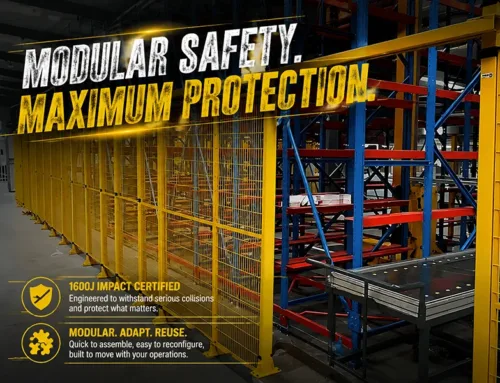
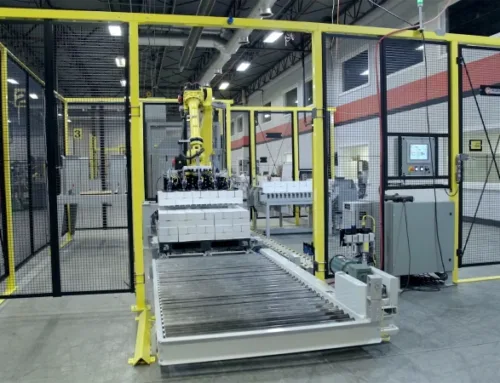
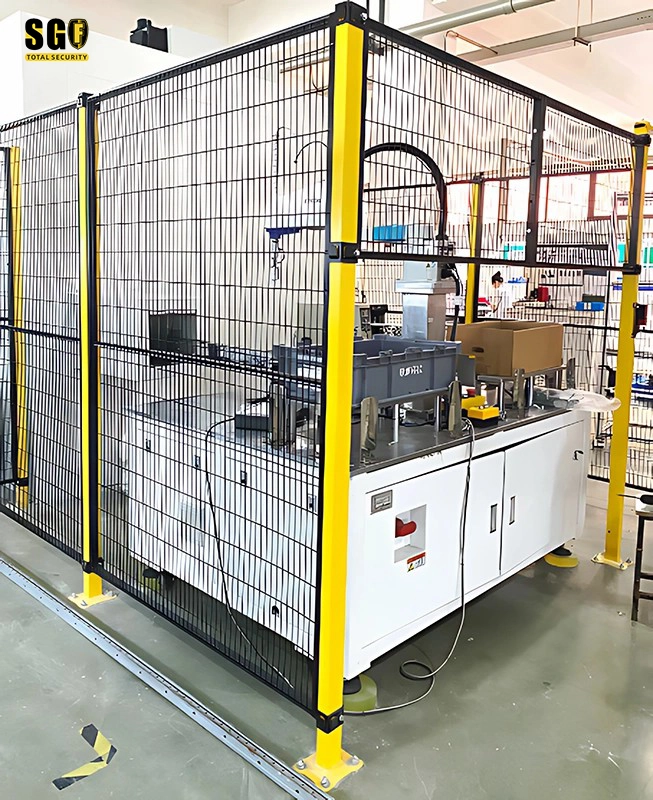
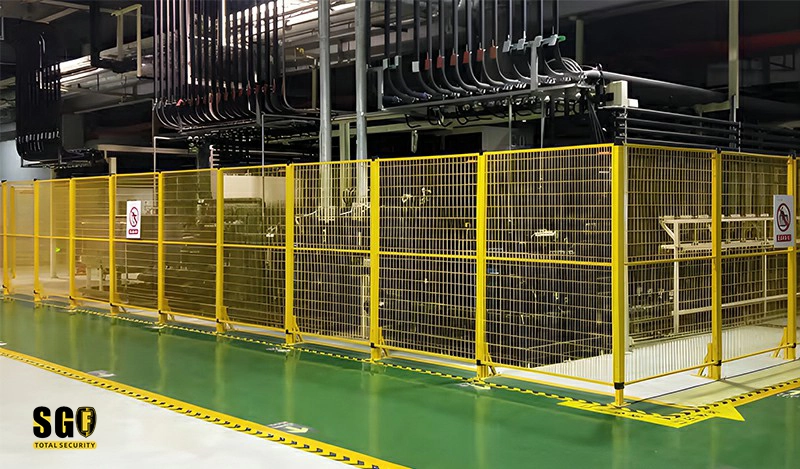
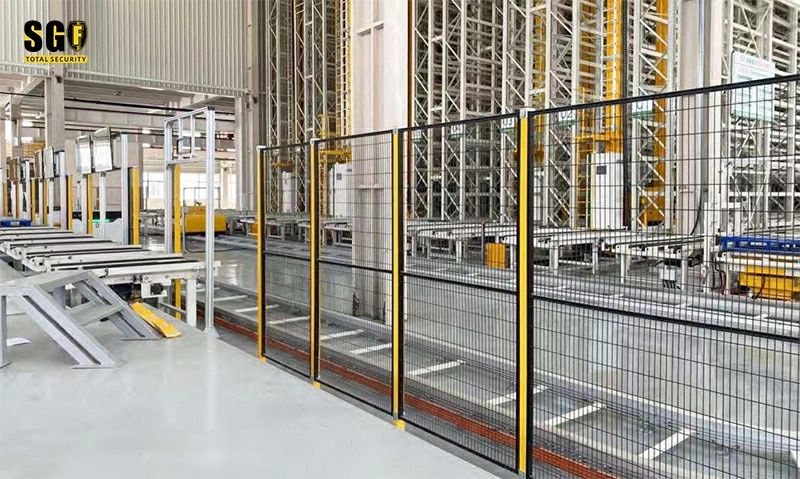
The wide robot-cell view shows the role Mdfence plays in a ZeroLabor-style automation zone: it is the physical boundary that keeps the cell closed during production and gives maintenance staff a controlled access point when the process must stop.
2. Standardized cell geometry for cleaner switch placement
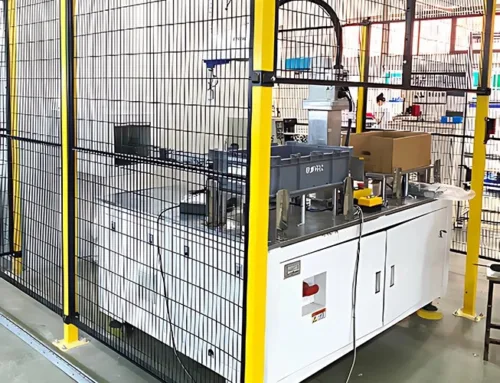
The framed cell image shows a repeatable post-and-panel layout. That matters because interlock switches work best when the door frame, latch area, and control side stay consistent from one project to the next.
3. Weld, coating, and base-plate details that support stable installation
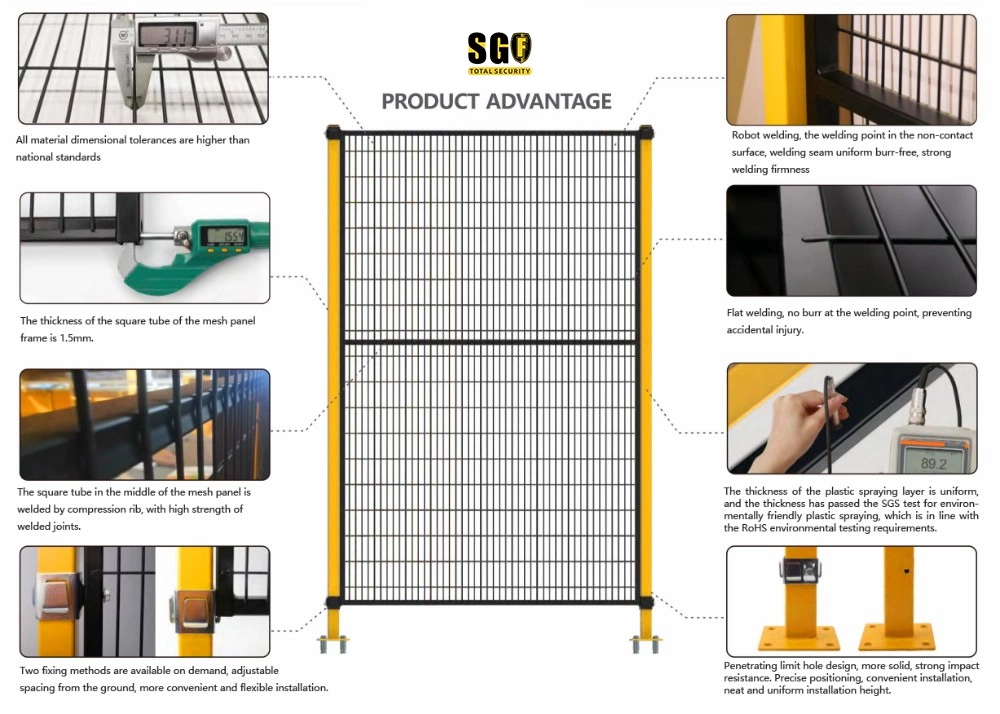
The specification board proves the fence is not just a visual barrier. Weld seams, coating finish, and base-plate details are exactly the kind of details electrical and mechanical teams need when they want a stable interlock base instead of a field-made patch job.
4. Installation path that avoids gate rework
Because the installation diagram shows base-plate drilling, expansion bolts, and retaining rings, the team gets a clearer mechanical sequence. That reduces the common retrofit problem where the interlock device is added only after the gate has already been roughly fitted.
5. Repeatable post, mesh, and clamp layout for interlock alignment
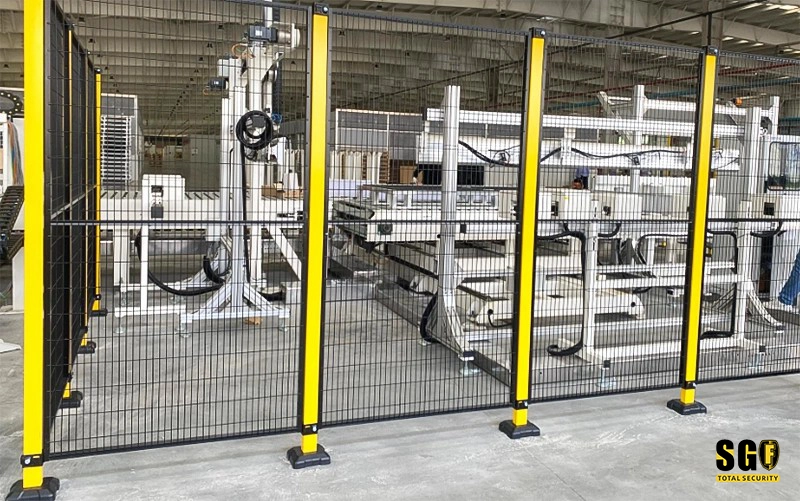
The technical front view is the cleanest proof of a standardized fence architecture. When the post spacing, panel position, and fixing clamp layout stay repeatable, the switch mounting point becomes easier to coordinate with the control cabinet and door logic.
6. Lock hardware ready for the final safety gate function
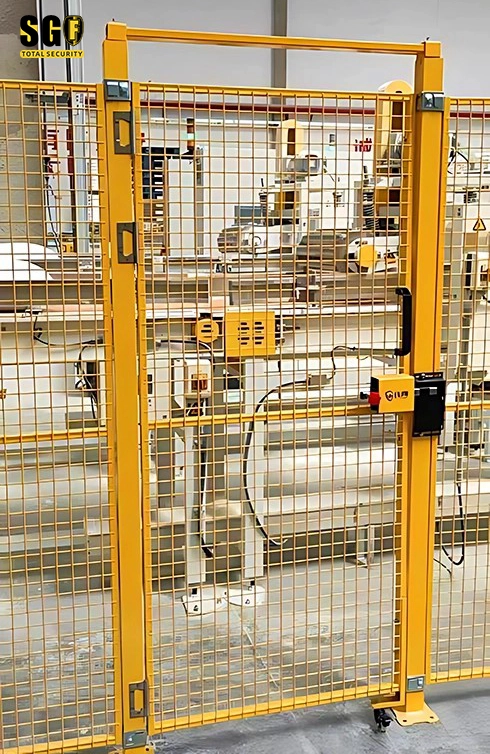
The close-up of the gate hardware shows the missing link in many retrofit projects: a properly prepared gate face. With the locking area already defined, the switch can be added as a system component instead of as a last-minute modification.
Where Mdfence solves the integration bottleneck
- Robot cells that need open-door power cut and controlled maintenance access.
- ZeroLabor-style automation islands where technicians must enter the enclosure for routine service.
- Retrofits where the electrical team wants to avoid drilling new interlock holes on site.
- Cells that must stay stable across repeated door cycles and frequent commissioning checks.
- Facilities that want a cleaner mechanical base for mainstream safety interlock switches.
The result is simple: the fence stops being an installation obstacle and becomes a repeatable part of the machine control architecture. That lowers field adjustment time, reduces integration risk, and helps the final gate behave like a true safety component instead of a custom workaround.
What the evidence says before you specify the gate
Look for a fence system that already anticipates the safety switch, not one that asks your team to redesign the door after delivery. Mdfence gives you the pre-set lock carrier, the standardized frame structure, and the installation logic needed to connect mechanical access control with the robot controller more cleanly.
Need an Industrial Safety Fence that is ready for interlock integration?
Send the cell layout, gate swing direction, and interlock brand preference. Mdfence can be configured as the fence platform your electrical team can integrate faster, with less site cutting and less debug time.