PT
PT  EN
EN  DE
DE  RU
RU  JA
JA  ES
ES  IT
IT ROBOT CELL GUARDING / WELDING CELL GUARDING
Physical separation for high-speed welding robots, access doors, and EHS review
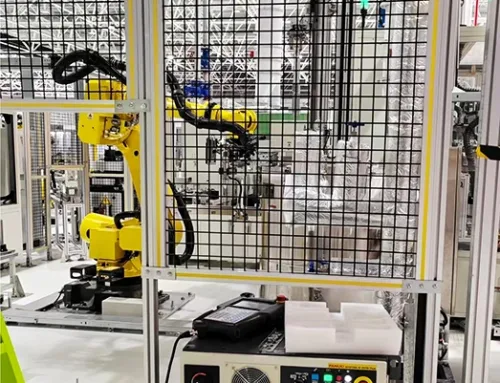
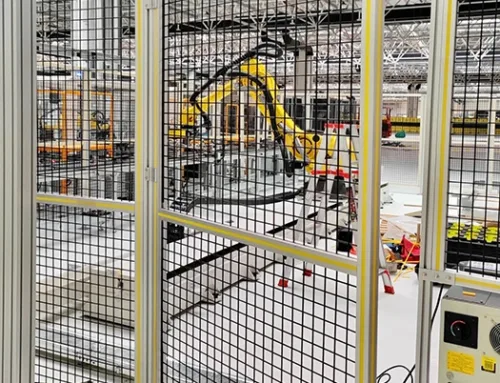
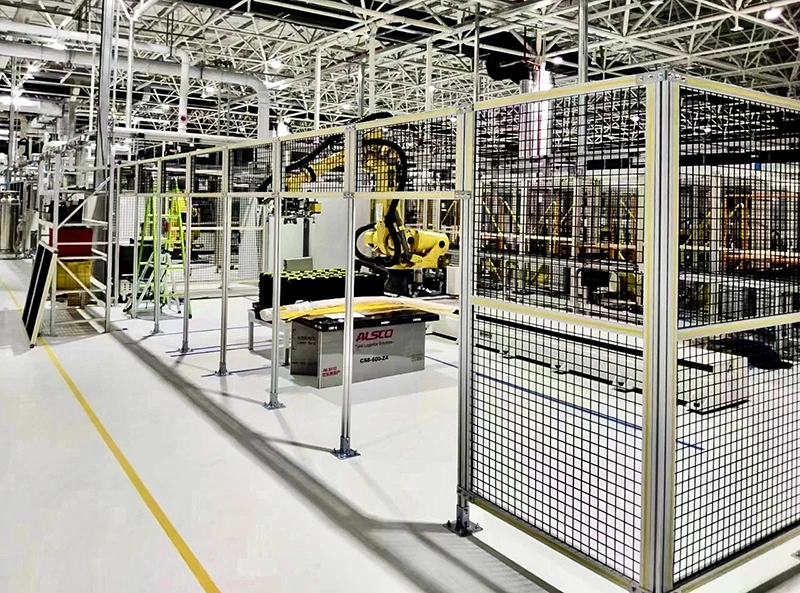
A high-speed robot welding cell combines fast motion, welding spatter, pinch points, and frequent operator access. Alfence is a modular safety fence and machine guarding system that uses a 20×100 mm welded wire mesh option, configurable doors, safety light curtains, and interlock-ready hardware to create a defined perimeter for indoor automation retrofit projects.
What the robot cell guarding specification must close
In a modern welding island, a painted line or improvised barrier does not control access to the robot envelope. A welded steel fence can provide a rigid boundary, but later changes normally mean cutting, re-welding, repainting, and extending downtime. Chain-link or temporary plastic barriers create an even larger gap between visual separation and a documented machine guarding design. The project still has to address the perimeter, maintenance opening, safe distance, door monitoring, and the way an operator is stopped from entering a hazardous cycle.
| Pergunta do projeto | Resposta de design da Alfence |
|---|---|
| How is access to the robot envelope physically controlled? | Use a post-and-panel modular safety fence with welded wire mesh or a project-selected panel, floor-mounted through foot connectors and anchors. |
| How is hand access and safe distance reviewed? | Specify the 20×100 mm mesh option and review the opening, hazard geometry, and approximately 120 mm layout target against EN ISO 13857 and the project risk assessment. |
| How are gates and protective devices connected to the control concept? | Configure hinged, sliding, folding, or lift-out access with a safety interlock switch; add a 150–1800 mm safety light curtain where an access or transfer point requires presence detection. |
| What hardware fits a compact retrofit? | 40×40 mm or 45×45 mm aluminum posts, including an AJM150 example with 1500 N locking force for 40×40 profiles, subject to the final component selection. |
Why Alfence fits a reconfigurable welding cell
1. A modular frame instead of a welded rebuild
Alfence uses aluminum extrusion posts and connectors that lock into the profile slot, so a panel or door can be removed without bringing welding work into the production area. The 40×40 mm or 45×45 mm post options keep the system light to handle while supporting a clean indoor plant installation. When a robot cell, conveyor, or fixture moves, the removable and reconfigurable panel concept helps the guarding follow the new perimeter instead of becoming scrap.
2. Visibility and maintenance access are designed together
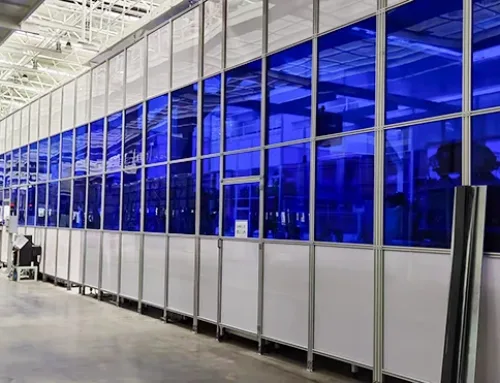
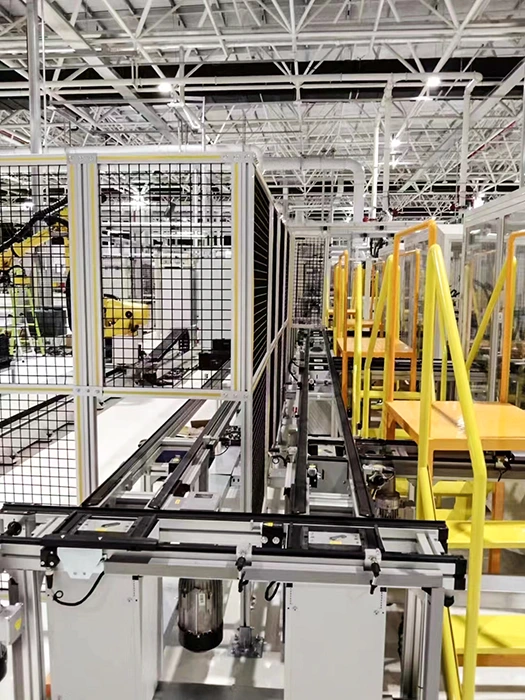
A robot cell needs a clear boundary without hiding every service point. Mesh panels provide visual access to the robot and conveyor, while PC, acrylic, or metal panels can be selected where visibility, splash control, or arc-flash screening needs a different treatment. The enclosure layout can include hinged or sliding safety doors, a magnetic handle, cable routes, and a light curtain at the operator interface. This keeps machine guarding, maintenance access, and line-of-sight decisions in one layout conversation.
3. Documentable components for the EHS handover
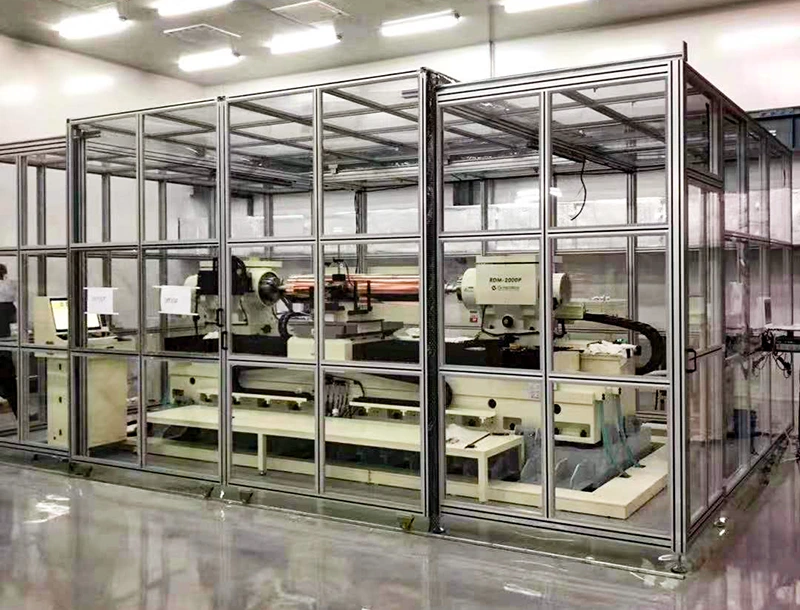
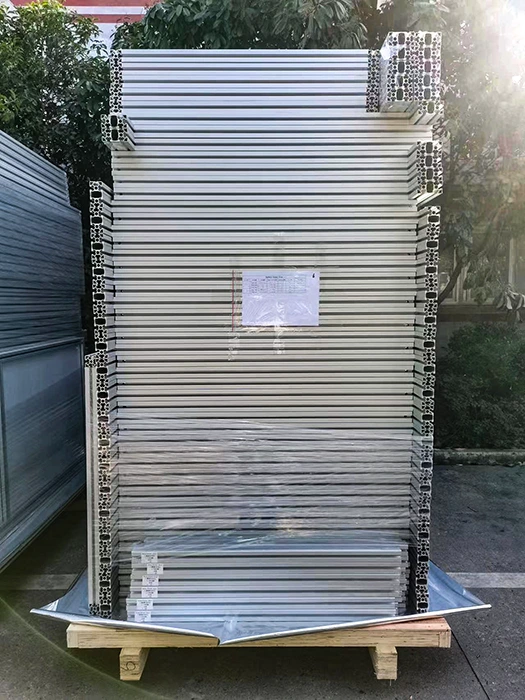
The system can be specified with the fence, safety door, interlock, and light curtain as one guarding boundary rather than as disconnected purchased items. Standardized aluminum profiles are extruded, shot-blasted, and powder-coated; the documented process includes approximately 480°C billet heating, about 3000 tonnes of extrusion pressure, and a 185°C cure for 15 minutes. The palletized component view also shows how a repeatable kit can be delivered for a retrofit or relocatable guarding project. CE and Machinery Directive 2006/42/EC documentation support can be provided for the project file; final conformity remains the responsibility of the complete machine and risk assessment.
Where this industrial safety fence is a practical fit
- Welding cell guarding: separate a robot envelope from operator aisles while leaving defined maintenance and material-transfer points.
- Robot cell guarding and automated production line guarding: combine mesh visibility with safety doors, interlocks, and light curtains.
- Proteção de máquinas CNC e proteção de máquinas-ferramenta: create a floor-mounted perimeter that can be adjusted when fixtures or service routes change.
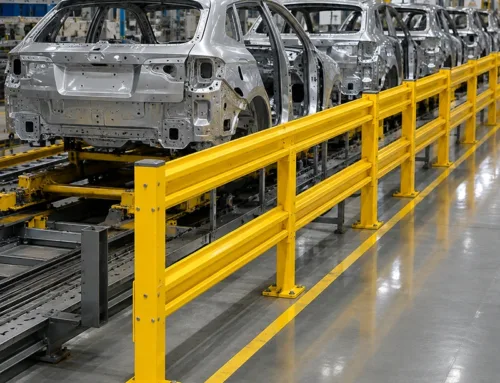
- Proteção de caminho AGV e proteção de transportadores: make the route boundary clear, with the final impact and traffic risk reviewed for the site.
- Indoor retrofit guarding: replace an old fence with bolt-free, reconfigurable panels where welding and long shutdowns are undesirable.
Alfence is intended for indoor automation, cleanroom, metal-processing, machine-tool, and light-corrosive environments where a modular aluminum safety fence is appropriate. It is not a claim of equivalence to a heavy-impact steel barrier; collision loads, outdoor exposure, and the complete safeguarding validation must be assessed for each installation.
Build the compliance file around the actual layout
For an EHS or system-integrator review, define the robot reach envelope, transfer openings, door type, light-curtain height, interlock logic, floor fixing, panel selection, and safe-distance calculation before finalizing the bill of materials. Alfence project documentation can support the review against EN ISO 14120:2015, EN ISO 13857, EN ISO 14119, EN ISO 10218-2, and ANSI/RIA R15.06. The references guide the design discussion; they do not replace the site-specific risk assessment, validation, or any certificate required for the complete machine.
Turn a high-speed welding island into a defined guarding perimeter
Share the robot-cell footprint, access points, required height, mesh or panel preference, door positions, and safety-device interface. SGF can then map the 20×100 mm grid, aluminum posts, modular doors, safety light curtain, and AJM150 interlock option into a machine guarding proposal that is easier to install, reconfigure, and review.