PT
PT  EN
EN  DE
DE  RU
RU  JA
JA  ES
ES  IT
IT Automotive production | reconfigurable machine guarding
Keep the Guarding in the Line When the Vehicle Program Changes
Vehicle model changeovers, annual variants, and incremental automation projects redraw robot cells and operator routes. Alfence is an industrial safety fence built around modular aluminum profile guarding, removable panels, and bolt-free assembly, so a plant can reorganize the perimeter instead of writing off a welded steel cage. The result is reusable robot cell guarding with less re-tooling disruption and a clearer path to the next layout.
Why a welded steel cage becomes a recurring re-tooling cost
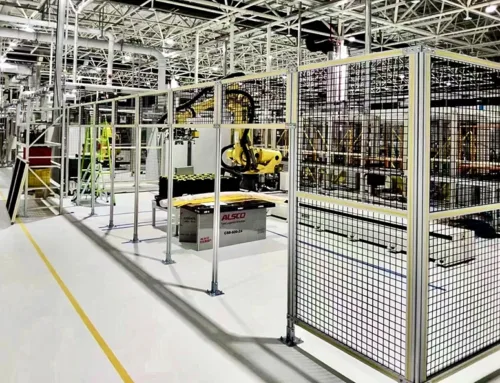
For an automotive plant, the difficult part is rarely the first fence installation. The cost appears when a model-year change moves a fixture, a new variant adds a robot, or an automation project extends the line. A welded steel fence then has to be cut, re-welded, ground, and repainted. Openings and corners no longer match the equipment, while usable panels may be treated as scrap. Alfence changes the unit of work from a permanent cage to a post-and-panel system that can be dismantled, re-planned, and reused.
| Changeover pressure | Resposta da Alfence |
|---|---|
| Model-year layouts, new variants, and added automation shift the hazard perimeter. | Removable, reconfigurable panels and modular frames can be taken down and rearranged rather than discarded. |
| Welded steel machine guarding requires hot work and site-specific rework. | T-slot aluminum posts, connectors, and floor hardware provide bolt-free mechanical assembly with no on-site welding. |
| A fixed cage can consume floor space or leave an unsuitable opening around a robot cell. | The 20 × 100 mm welded wire mesh option supports compact layout review; a typical approximately 120 mm position must still be validated by the project risk assessment. |
| New maintenance routes often mean cutting a new door into the fence. | Hinged, folding, sliding, and telescopic safety doors can be coordinated with interlock switches or safety light curtains. |
| Frequent handling makes heavy, corrosion-prone guarding expensive to move and standardize. | 40 × 40 mm or 45 × 45 mm aluminum posts, powder-coated aluminum, and reusable components suit indoor retrofit and relocatable guarding. |
How the modular safety fence supports the next line change
Set the perimeter around the future layout
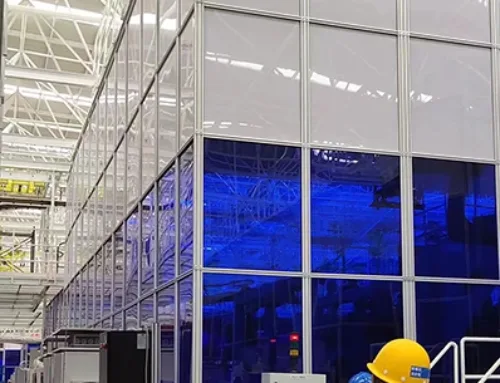
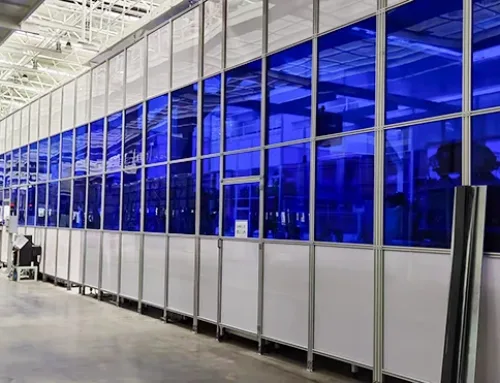
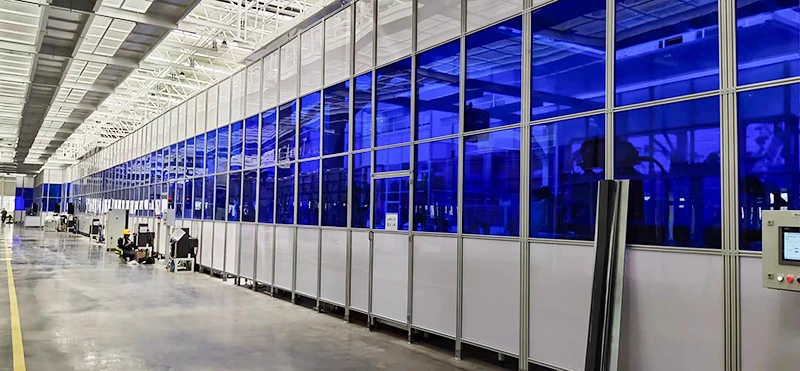
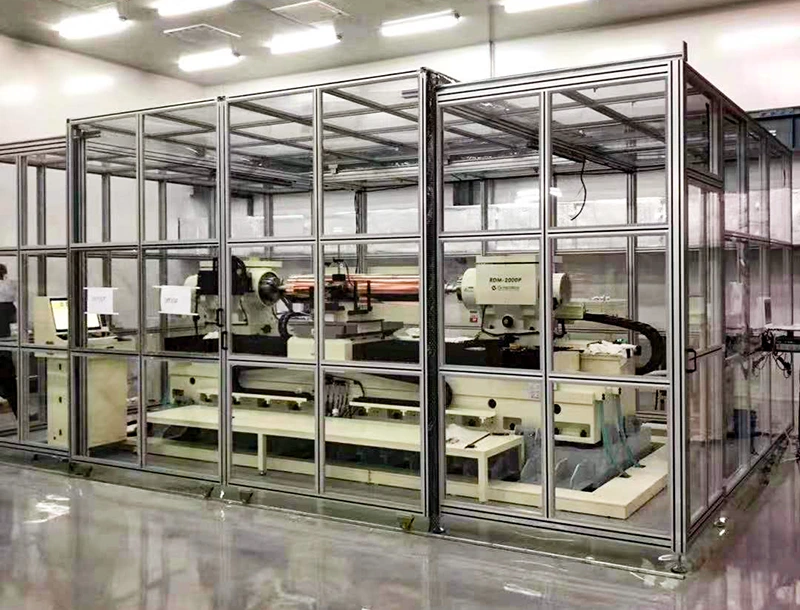
The transparent-panel enclosure shown here illustrates the planning advantage: the machine remains visible while the frame, panel zones, and maintenance openings are treated as separate modules. Alfence supports 40 × 40 mm or 45 × 45 mm aluminum profile posts, panel heights commonly listed as 1000, 1800, or 2000 mm, and panel widths from 200 to 1200 mm. Project drawings take priority where the line requires a different combination. This lets an automation engineer position a modular safety fence around the actual equipment envelope, then move sections when the next variant changes the route.
Make access part of the reconfiguration plan
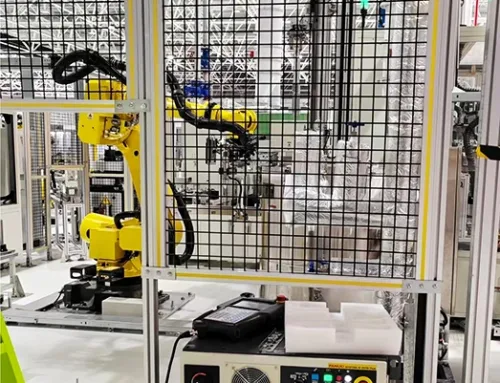
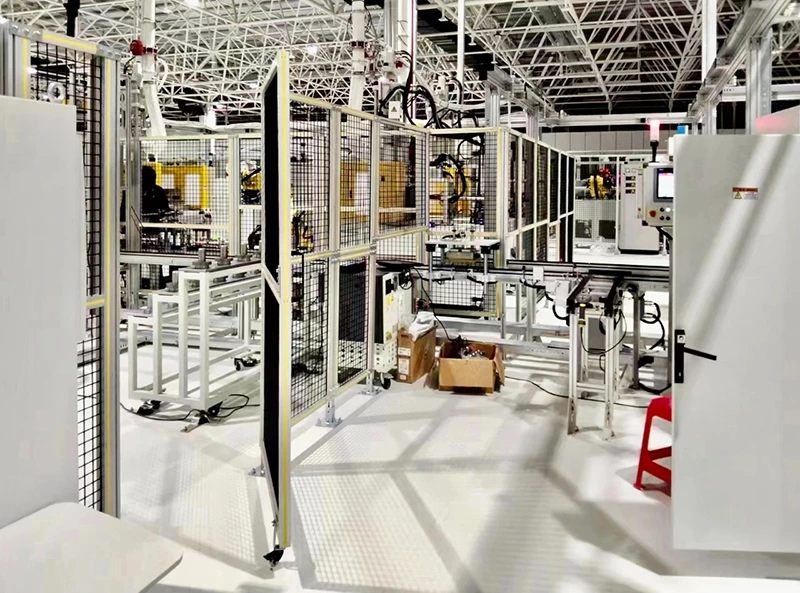
A robot cell is not finished when the mesh is in place. Operators, maintenance technicians, controls engineers, and material flow still need controlled access. The robot-cell image shows hinged access gates beside control equipment, a practical arrangement for reviewing service paths before installation. Reference door sizes include a hinged single door up to 1500 mm, a double hinged door up to 3000 mm, and larger sliding configurations up to 6000 mm; the final clear opening depends on the equipment and risk review. Safety interlock switches and light curtains can be specified with the door and panel layout instead of added after a cut-and-weld modification.
Reuse the physical asset through the next program
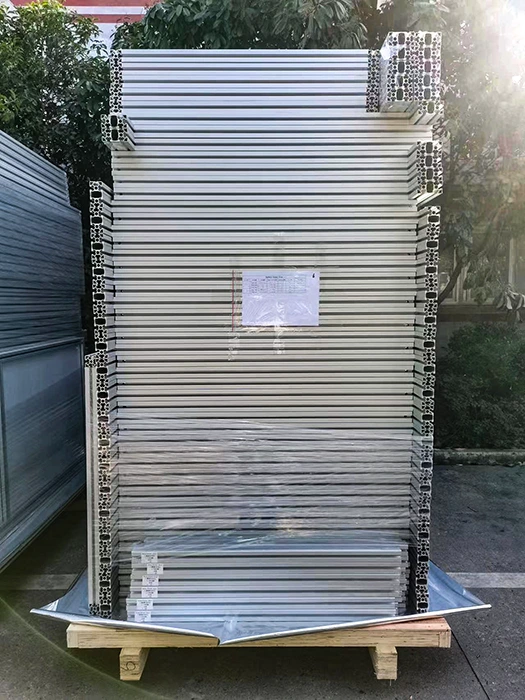
The palletized aluminum slats shown below are a component-delivery view, not an installed-fence photo. They still show why standard sections matter to a change program: parts can be identified, stored, moved, and issued to a revised line plan. Alfence profiles are formed by aluminum extrusion and can receive powder coating; the documented process references approximately 480 °C billet heating, roughly 3000 tons of extrusion pressure, and 185 °C curing for 15 minutes. The practical outcome is not a promised percentage saving. It is that panels, posts, connectors, doors, and floor hardware remain available for the next relocation instead of becoming welded scrap.
Where Alfence fits in a changing automotive plant
- Robot cell guarding and automated production line guarding for model-year or variant changeovers.
- Welding cell guarding, CNC machine guarding, and machine-tool perimeter guarding where access points move with the equipment.
- AGV path guarding, conveyor guarding, and material-handling robot guarding around revised traffic routes.
- Retrofit guarding, line extensions, and relocatable guarding that need reusable indoor components.
- Cleanroom or light-corrosion indoor areas where aluminum profile guarding, visibility, and a consistent finish matter.
Alfence is intended for indoor, light-to-medium isolation and frequent reconfiguration. It should not be presented as an automatic substitute for a high-impact steel guard or a certified perimeter without a project-specific assessment. EN ISO 14120 and EN ISO 13857 can guide the guarding review, but the mesh, distance, doors, interlocks, and operating conditions must be confirmed for the actual machine.
Specify the next change before ordering the first panel
A useful project brief includes the current and future equipment envelopes, hazard locations, required access frequency, panel visibility, floor fixing points, and the clear width of each service route. Alfence can then be configured as a post-and-panel layout with the appropriate 20 × 100 mm mesh or PC, acrylic, or metal panel, 1000/1800/2000 mm height reference, door type, and safety-device interface. Because the components are mechanically assembled, the approved drawing can serve both the initial installation and the next re-tooling plan.
Plan for model change without scrapping the guarding
Send the current cell layout and the expected variant or automation change. SGF can review the Alfence industrial safety fence configuration, access strategy, panel choice, and reusable component plan against the project requirements.