PT
PT  EN
EN  DE
DE  RU
RU  JA
JA  ES
ES  IT
IT Chain Retail · Multi-Site Safety Retrofit
Chain Retail Safety Retrofit: One Heavy Duty Guard Rail Spec for 100+ DCs and Store Back Rooms
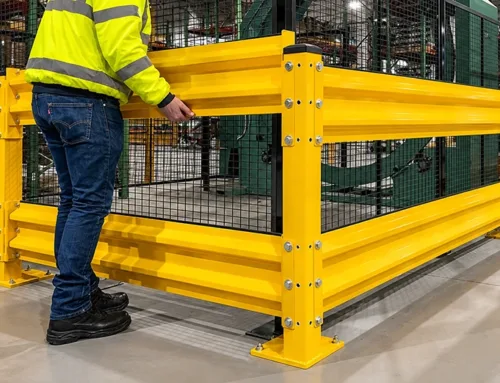
Rolling heavy duty guard rails across a retail network is a procurement problem before it is a safety problem. When 100+ distribution centres and thousands of store back rooms each buy their own protection, every site invents its own detail — and any solution that needs on-site welding, custom cutting or a specialist crew dies at project level. Hsafety warehouse guard rails ship as bolted, modular corrugated steel panels in project lengths, so one specification can be installed by the site team, reconfigured when a store changes its picking line, and lifted out when a truck or scrubber needs temporary access. Q235 steel construction keeps the per-metre cost low enough to replicate at network scale.
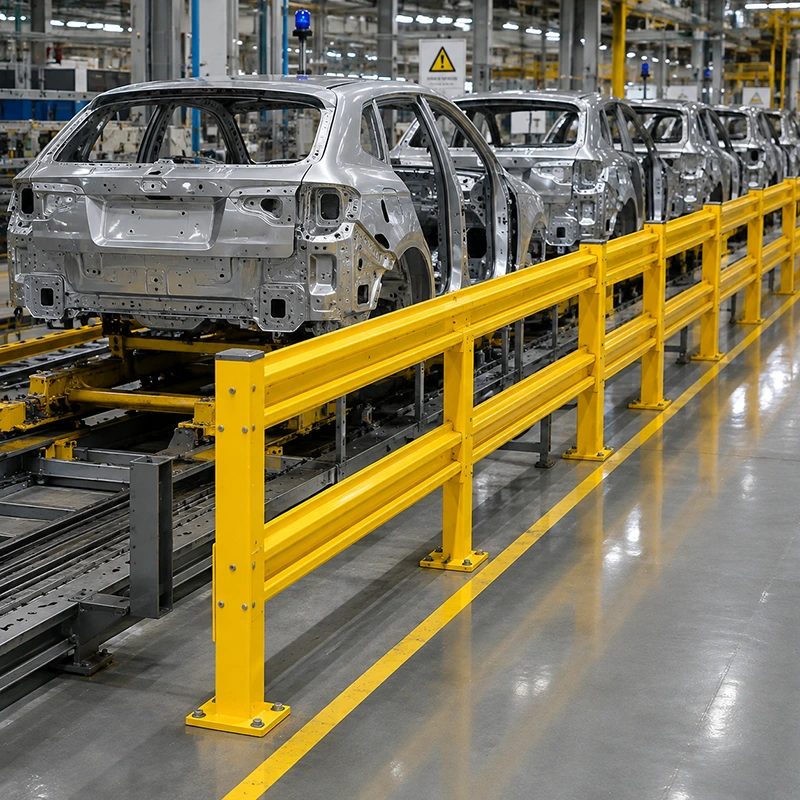
What a Standardised Hsafety Guard Rail Package Contains
A network standard only holds up if the same drawing produces the same result in a 40,000 m² DC in one region and a 600 m² store back room in another. Every Hsafety run is built from the same family of parts: a corrugated steel beam bolted to a square post, and the post anchored to the concrete slab with a base plate. Lengths change per site; the components, connection method and tooling do not.
| Item | Especificação |
|---|---|
| material | Q235 carbon steel guard rail |
| Rail profile | 2-rib (W-beam) or 3-rib (thrie beam) corrugated guard rail |
| Wave geometry | 85 mm wave height; 194 mm pitch; rail width approx. 310 mm |
| Rail thickness | 3 mm or 4 mm |
| Standard module | 1,500 mm panel; special panels from 680 mm to 1,140 mm close a measured run |
| Custom length | Full runs built to project length, e.g. four zones of 17,100 / 17,000 / 12,000 / 11,900 mm |
| Configuration | single rail guardrail or double rail guardrail (two beams per bay) |
| Post | 80 x 80 x 6 mm square steel post, 1,000 mm high |
| Base plate | 160 x 160 x 16 mm with 4 expansion bolts per post |
| Lower beam height | 100 + 6 mm above the finished floor |
| Substrate | Concrete slab, typically min. 150 mm — confirm per site before anchoring |
| Finish | powder coated guardrail (colour to order) or hot-dip galvanized |
| Options | reflective tape, post caps, blockouts, brackets, end caps, lift-out sections |
Why This Configuration Survives a Network Rollout
Bolted Panels Replace the Site-Welded Rail That Stalls Rollouts
The usual incumbent method is a steel pipe railing or an Armco-style barrier fabricated on site: measure, cut, weld, repaint, then wait for a hot-work permit. On a single site that is tolerable. Across a rollout it is fatal, because weld quality, paint match and finished height drift from crew to crew. Hsafety is a bolted guard rail system — panels are lifted into the post connection and fixed with mechanical fasteners, and posts are anchored to the slab with expansion bolts. The same 4-bolt base plate detail is repeated at every station, so an in-house maintenance team in one region produces the same physical boundary as a contractor in another. No hot-work permit, no grinding dust, no repainting of burned coating.
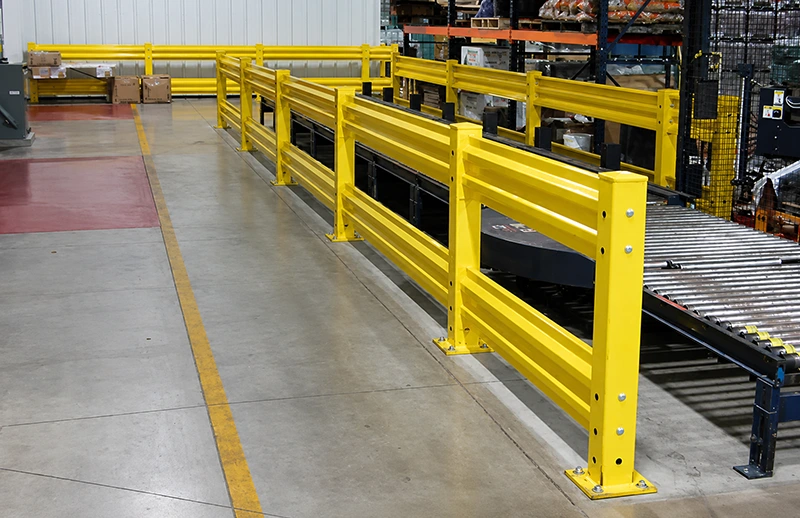
Custom Lengths, Because No Two Sites Measure the Same
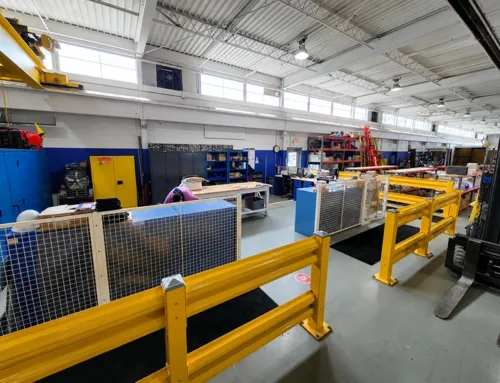
Rack rows, charging bays, conveyor lines and store back-room pallet zones never produce a round number. A 1,500 mm module alone leaves gaps that get filled with welded scrap — the exact practice a network standard is meant to eliminate. Hsafety closes the run with special-length corrugated panels: a documented project used four separate zones of 17,000 mm, 17,100 mm, 12,000 mm and 11,900 mm, resolved with 64 standard 1,500 mm panels plus 8 short panels between 680 mm and 1,140 mm, and 42 posts in total. The double-rail configuration shown here runs the same bolted detail along a conveyor line and around its turn, so the protection follows the equipment rather than forcing the equipment to suit a catalogue length.
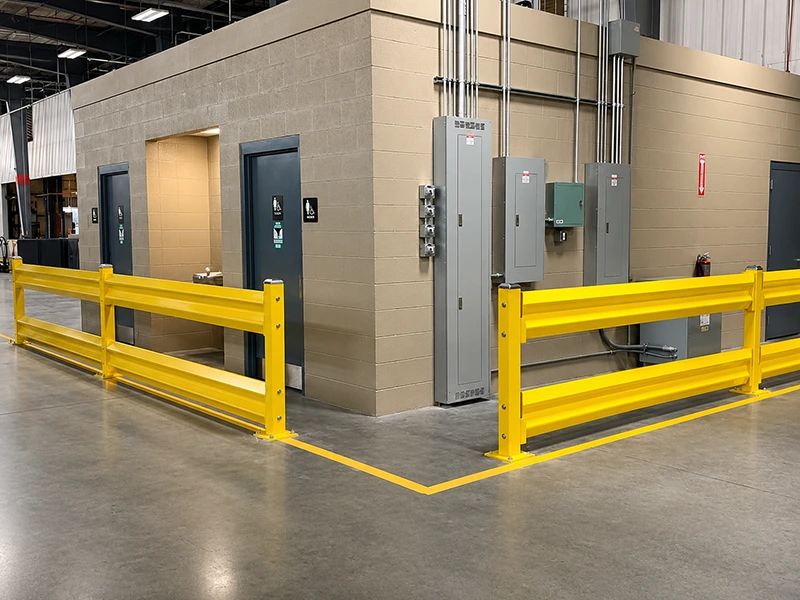
Corners, Equipment and Lift-Out Access Without Rework
Electrical rooms, switchgear, conveyor motors and pallet-stacking areas sit at the awkward end of a store or DC, where a straight run of barrier would block service access. Because panels bolt individually to the posts, the same system turns a corner, terminates against a wall and stops short of a door without shop fabrication. Where a scrubber, tug or delivery vehicle needs to pass, a lift-out section is lifted clear of the post connection by hand and dropped back afterwards — the protection and the circulation route coexist instead of one displacing the other. Yellow safety coating keeps the boundary legible under warehouse lighting, and reflective tape or a hot-dip galvanized finish can be specified for low-light or damp zones.
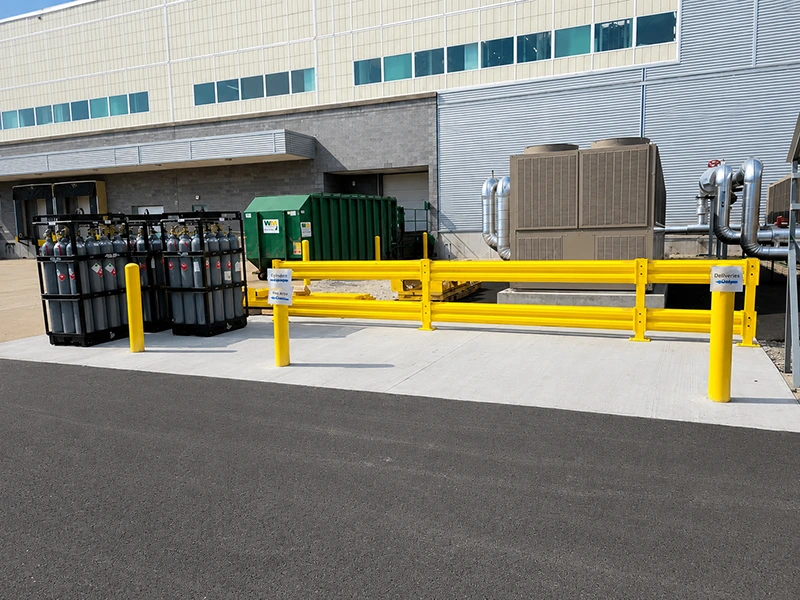
Where One Specification Gets Reused Across the Estate
- Rack end protection at DC pick faces and store back-room racking, where mast tips and pallet corners make contact most often.
- Loading dock protection along dock aprons and leveller edges, where trailers, tugs and forklifts converge.
- Aisle protection and pedestrian vehicle separation in picking aisles, keeping walking routes physically distinct from pallet-truck traffic.
- Asset protection for conveyor lines, sorters, control panels and electrical rooms on the DC floor, and for walls where a layout change moves the aisle closer to the wall.
- Store back-room pallet zones and cold-store aisles, where the same post-and-beam family is re-cut to the shorter runs a shop unit allows.
Because the runs are bolted and not welded, protection moves with the operation: when a store re-merchandises a back room or a DC shifts a pick face, panels and posts are unbolted, re-laid along the new line and re-anchored. That reuse is what keeps a network-level retrofit affordable — the steel is bought once and re-deployed, instead of being scrapped each time a layout changes.
Plan the Rollout Before the First Site Order
Send the run lengths, floor slab thickness and the vehicles using each zone, and we will return a per-site layout with standard and special panel counts, post positions, base plate and anchor details, finish options and a packed weight per zone. Load targets for a specific site — for example a 3-tonne forklift at 10 km/h — are handled as project design conditions and confirmed against the agreed drawing, not assumed from a catalogue.
Standardise the Standard
If your retail or 3PL network is still buying forklift impact protection site by site, one bolted specification is usually cheaper to install and far cheaper to live with. Tell us how many DCs and store back rooms are in scope and we will structure the package for repeat deployment.