
 PT
 EN
 DE
 RU
 JA
 ES
 IT
FORKLIFT IMPACT PROTECTION / Q235 CARBON STEEL GUARDING
After a forklift hit, the question is whether the post bent or broke
Steel coil and sheet handling puts forklifts close to the perimeter every shift. With an unframed screen, a scrape can pull the whole panel out of its fixings; a brittle post can fracture and throw fragments into the aisle, turning one impact into a second injury and a longer shutdown. Q235 carbon steel guarding behaves differently. With a yield strength of about 235 MPa, a low-carbon Q235 post bends plastically under an overload and absorbs energy as deformation instead of failing suddenly. Q235 60×60 mm posts and a 20×30 mm tube border spread a point load through the frame, and the standard system configuration has been tested to 1600 J. That figure reduces the consequence of an impact; it does not make impacts acceptable.
Send your vehicle routes and impact exposure for a guarding review
Plastic deformation, brittle fracture, and what the test covers
The difference is not a marketing adjective. A ductile low-carbon steel yields over a measurable strain, so the visible bend is energy that did not go into a crack or a flying fragment. A brittle or poorly connected assembly has no such reserve.
| Ponto | What is stated on the drawing |
|---|---|
| Material behaviour | Q235 low-carbon steel has a yield strength of about 235 MPa. Beyond yield it deforms plastically rather than fracturing suddenly, so an overloaded post bends and stays in one piece. |
| Load path | The 60×60 mm post and the 20×30 mm rectangular tube border spread a local impact across the framed mesh panel, its fixing rings and the base plate instead of concentrating it in the wire. |
| Tested configuration | A 1600 J impact figure is quoted for the tested standard system configuration. It does not automatically transfer to custom widths, taller guards, door openings or a specific forklift mass and speed, and is confirmed against the actual build. |
| What it does not do | It does not prevent the collision, does not replace vehicle route separation or traffic management, and does not remove the need for a post-impact inspection. Guard design remains an ISO 14120 review with the local risk assessment. |
Why the frame decides what happens at the moment of contact
A welded border holds the panel in the assembly
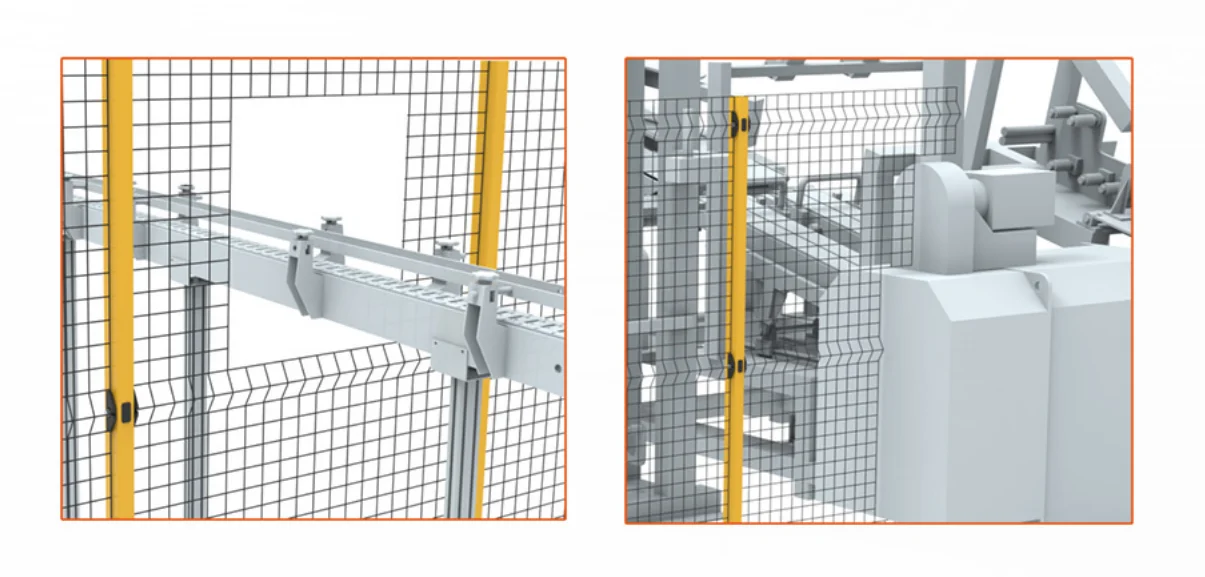
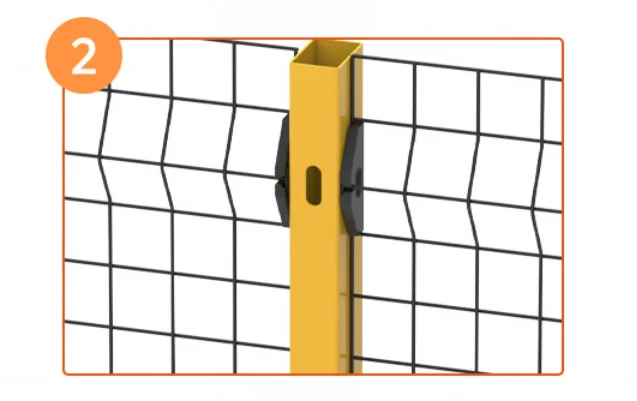
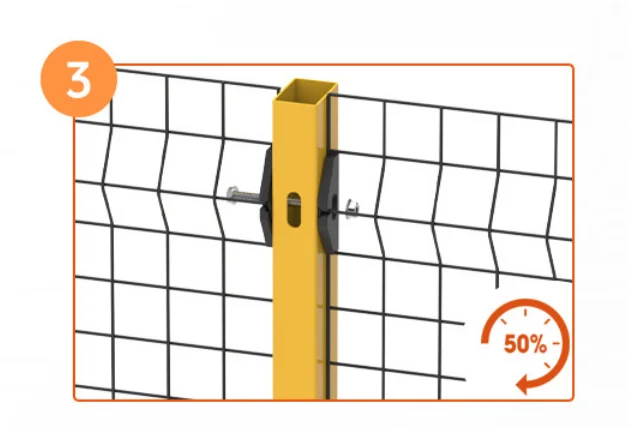
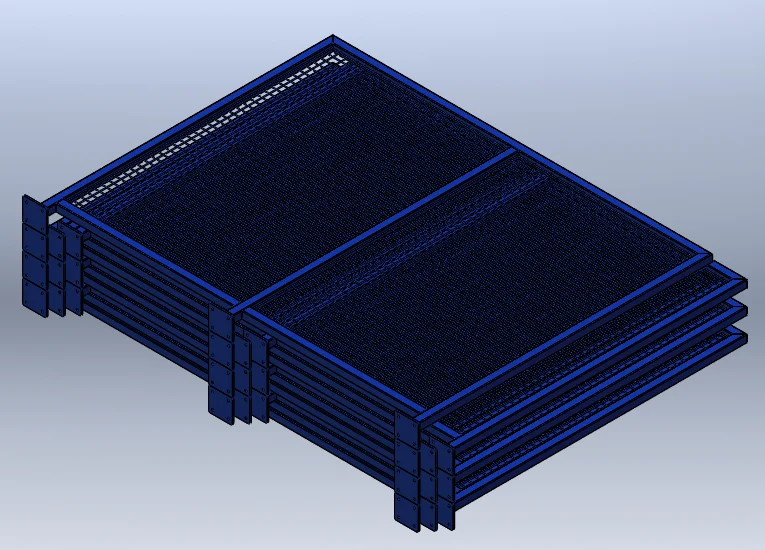
Framed mesh panels weld 3.0 or 4.0 mm wire into a 20x30x1.5 mm tube border with flat full welds and burr-free joints. The frame carries out-of-plane load as a beam, so a contact that would tear an unframed sheet out of its clips is distributed into the posts. M8 fixing rings hold each panel to its post and four M10 expansion anchors hold each base plate to the concrete. RAL1023 posts and RAL9005 panels keep the boundary visible to drivers in a busy aisle.
The post-impact inspection and replacement rule
After any vehicle contact, isolate the zone and record the post number, base plate condition, anchor heads, panel flatness, weld condition and any visible bend. A deformed post must be replaced, not straightened and reused: plastic deformation has already consumed its yield reserve, and cold straightening can introduce cracks at the anchor region. Panels with a torn weld, opened tube or broken coating are replaced as units. Re-measure post verticality and the gate alignment before the line restarts, because a bent post near a gate also moves the interlock actuator off its switch.
Where the 1600 J figure stops
The tested value belongs to a defined standard configuration with a specific post, panel, fixing and anchor arrangement. Custom widths, taller guards, door leaves, corner infills and vehicle impact cases are re-specified per project; a forklift mass, speed and angle of approach are plant data, not catalogue data. Where traffic is heavy, physical separation, bollards or a revised route are layout decisions made with the plant engineer. This system is not intended for pure pedestrian guidance, and the safety circuit, restart inhibit and LOTO procedure remain with the integrator and the plant.
Aisles where the deformation behaviour matters
- Steel coil and sheet handling: repeated low-speed scrapes plus the occasional full impact.
- Heavy machining and press shop safety fence boundaries: a fractured post would add fragments to an already hazardous zone.
- Warehouse automation safety and AGV handover points: vehicle routes sit close to the fence outer edge.
- Conveyor line safety guarding shared with forklifts: the gate bay and interlock carrier need re-checking after any contact.
Specifying Q235 carbon steel guarding is a consequence-reduction decision, and a written post-impact replacement rule is what makes it work.
What to send for an impact-exposed perimeter
Provide the vehicle type, mass and speed, route and turning sweep, distance from the fence outer edge, floor and anchor conditions, hazard heights and opening sizes, gate positions and the project’s impact requirement. The returned pack carries the general arrangement with vehicle routes, the panel and post BOM, the fixing and anchor schedule, the post-impact inspection and replacement record sheet and the acceptance checklist. The 1600 J value is quoted only where the tested standard configuration is actually supplied.
Plan for the hit, then prevent it
A post that bends and stays in one piece gives the site a visible, inspectable failure instead of a scattered one. Replace it, re-check the gate, and fix the traffic layout that caused the contact.

