PT
 EN
 DE
 RU
 JA
 ES
 IT
SAFETY INTERLOCK MOUNTING CARRIER / PLUG-AND-PLAY GUARDING
A hand drill on a powder-coated post is the start of a corrosion failure
Integrators and precision manufacturers often receive a machine guarding fence with no prepared switch holes. The site team then drills the already-coated 60×60 mm post with a hand drill: swarf lands in the weld seams, the hole drifts a few millimetres off the actuator line, bare steel shows at the cut edge, and rust appears within days. At acceptance the enclosure fails on appearance before anyone tests the interlock. A safety interlock mounting carrier moves that operation into the factory. Hole centres are prepared for the named switch series, and plug-and-play guarding becomes a screw-fastening step on site rather than a fabrication step. One project record covers five customer CAD drawings, with carriers supplied separately for Omron D4NL and Pizzato FS series devices.
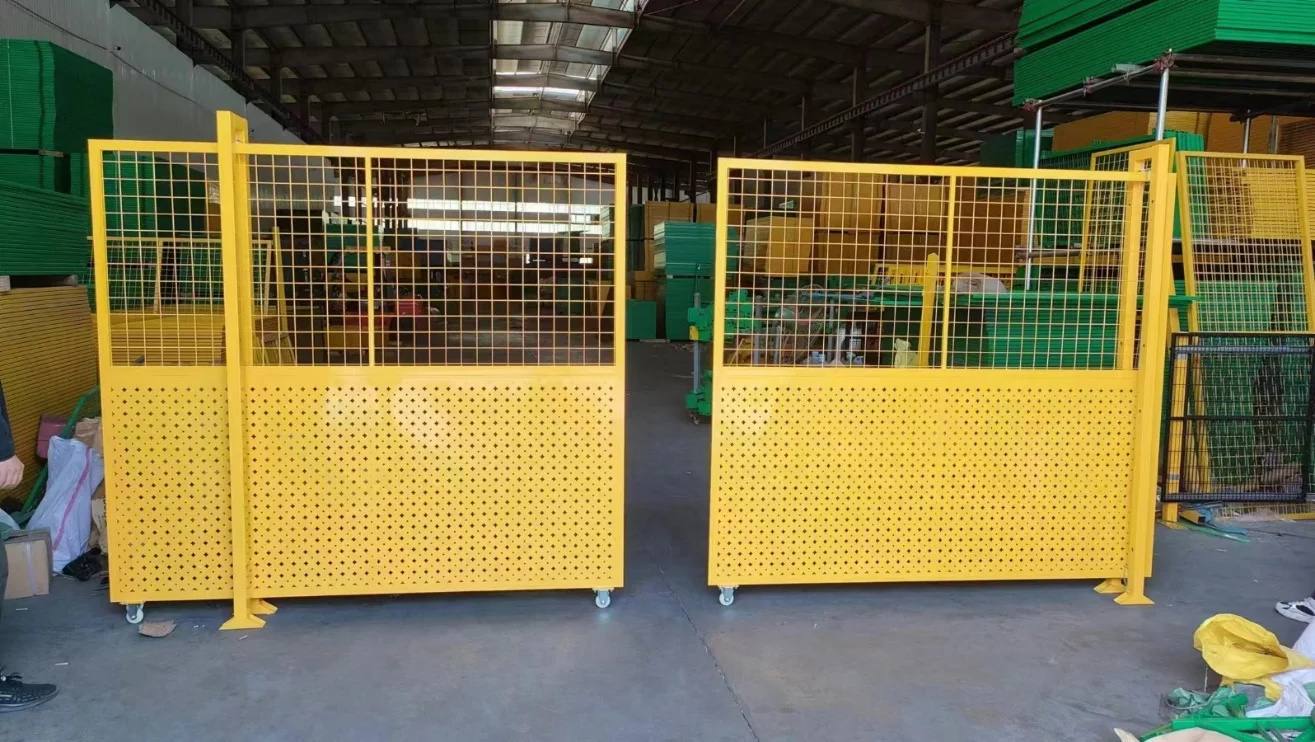
Send your switch model and actuator key for a carrier drawing
What site drilling removes from the fence
A drilled hole is not just a missing patch of coating. It changes the load path through the tube, introduces a stress concentration at a point that already carries the gate reaction, and leaves an exposed edge that no touch-up paint fully seals. On a post that also carries the switch body, a drifting hole becomes an alignment problem that maintenance will chase as an electrical fault.
| Ponto de decisão | What the drawing has to state |
|---|---|
| Coating integrity | Framed mesh panels and Q235 posts are finished with electrostatic powder coating. Cutting the tube in the field exposes bare steel and breaks the coating continuity at the fixing point, so corrosion starts at the hole rather than at a weld. |
| Post stress continuity | The gate leaf, hinge and switch reaction all land on the same tube. An unplanned hole weakens that section locally; a factory carrier spreads the fixing load across prepared positions instead. |
| Hole position confirmation | The carrier hole pattern is issued as a drawing for approval before manufacture: switch body model, actuator key model, gate handing and swing, and the mounting face are confirmed in writing, then the plate is cut and drilled in the factory. |
| Order information | Both the safety switch model and the matching actuator key model must be supplied at order stage. Without them the hole centres cannot be fixed, and the site is back to drilling a coated post. |
How a prepared carrier changes the installation sequence
From five CAD drawings to two matched carrier sets
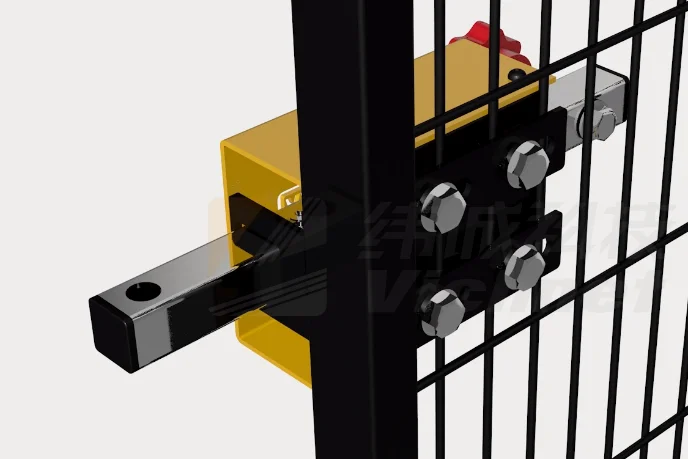
One recorded project supplied five sets of customer CAD drawings covering the gate, post and switch interface. Carriers were drawn and manufactured separately for Omron D4NL switches and for Pizzato FS series devices, so each crate arrived with the hole pattern already matched to its switch family. That is a single project record for a specific machine perimeter guarding configuration, not a claim that every switch model is held in stock. Custom carrier plates and door widths are re-drawn per order against the customer’s own drawings.
What the carrier is, and what it is not
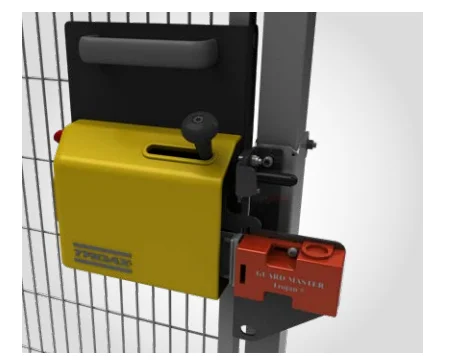
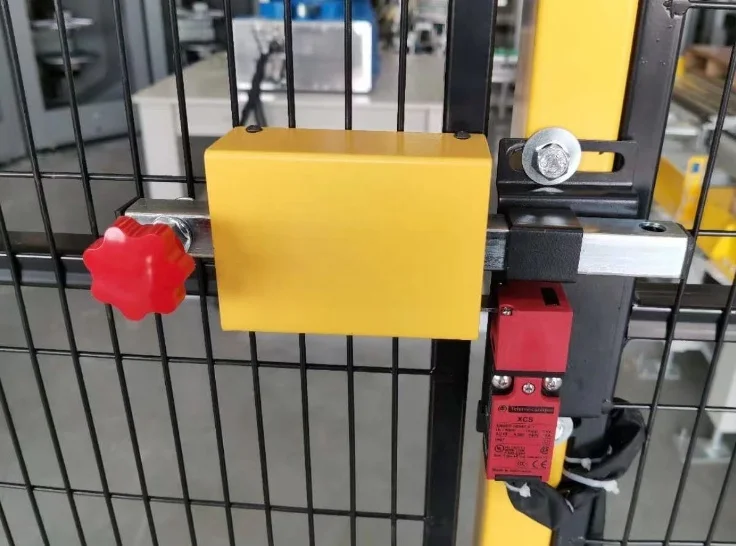
A safety lock mounting carrier is a prepared plate with hole centres sized to mainstream switch bodies, plus a universal mounting plate where the post face needs a flat datum. It accepts screw fastening and keeps the switch body on a repeatable position relative to the gate leaf. It contains no safety logic, does not set the performance level and does not validate the circuit. The switch, its wiring, the safety relay or safety PLC input and the achieved rating stay with the controls integrator under ISO 14120 and ISO 13849-1 as applicable.
Alignment still needs proving at handover
Factory preparation removes the drilling error, not the geometry check. Record the key-to-switch alignment with the gate closed, cycle the leaf three to five times and re-measure, then check post verticality, panel flatness and fastener counts. A 20x30x1.5 mm tube border with flat full welds keeps the leaf rigid, while the door header beam holds both posts parallel. A 1600 J impact figure quoted for the standard configuration applies only to that tested build and is confirmed per project. This system is not intended for pure pedestrian guidance.
Projects where preparing the holes pays for itself
- Robot cell guarding and palletizer safety guarding: frequent access makes switch alignment a maintenance item that must start from a fixed datum.
- Proteção de segurança para linhas de transportadores: gate interlocks and transfer light curtains share one safety circuit with different owners.
- Precision manufacturing cells: swarf from site drilling and visible rust at the fixing point are rejected at appearance acceptance.
- Multi-site rollouts: the same carrier drawing repeats across plants, so spare gates arrive with matching hole positions.
Plug-and-play guarding is therefore a manufacturing decision: the hole is made where the coating, the flatness and the part code can all be controlled.
What to supply before the carrier is cut
Provide the safety switch model and the actuator key model, the gate type, leaf width, handing and swing, the mounting face condition, the target safety rating, the number of access points, the CAD drawing of the gate and post interface, floor and anchor conditions, and the safety circuit owner. The returned pack carries the carrier hole-position drawing, the general arrangement with the gate bay and header beam, the panel and post BOM, the alignment and gate-cycling checklist and the acceptance records. Electrical schematics and circuit validation remain with the integrator.
Move the drilling off the site
Once the hole centres are approved on a drawing, installation is a screw-fastening step on a coated post that stays intact. The interlock then starts its life on a datum it can keep.