PT
PT  EN
EN  DE
DE  RU
RU  JA
JA  ES
ES  IT
IT INDUSTRIAL SAFETY FENCING | FOOD & BEVERAGE PLANTS
Food & Beverage Line Reconfiguration: Turn Mefence Safety Fencing into a Reusable Plant Asset
When seasonal SKUs, co-branded products, and pilot runs repeatedly change a production layout, Mefence Safety Fencing replaces welded-in zoning with a frameless, modular barrier that can be dismantled, cut on site, and reused at the next line position.
Why Fixed Welded Zoning Becomes a Cost Problem
In a food and beverage plant, production engineering may need to move a packaging cell, alter a conveyor route, or separate a new trial area within a short retrofit window. A welded square tube fence is tied to the first layout: moving it means cutting the structure, disposing of usable steel, then purchasing and installing a replacement. The result is a recurring sunk cost rather than a controllable plant asset.
| Requisito de layout | Mefence Safety Fencing response |
|---|---|
| Frequent SKU and line changes | Plastic clip and self-tapping screw assembly supports non-destructive dismantling, relocation, and reuse. |
| Irregular pipe runs and corners | Frameless welded mesh can be cut on site; panel widths are 200–1400 mm and heights are 200–3000 mm. |
| Visible separation without a solid wall | 3D welded mesh creates a clear boundary for warehouse zoning, machine guarding, and pedestrian-vehicle separation. |
| Retrofitting around equipment | Base plate posts, expansion bolts, and clip fixing reduce dependence on welding and factory-made return drawings. |
| Direct high-impact containment | Mefence is for non-high-impact demarcation; specify the higher-spec Machine Fence line when impact containment is required. |
Structure That Moves with the Production Layout
Clip-fixed modules make relocation practical
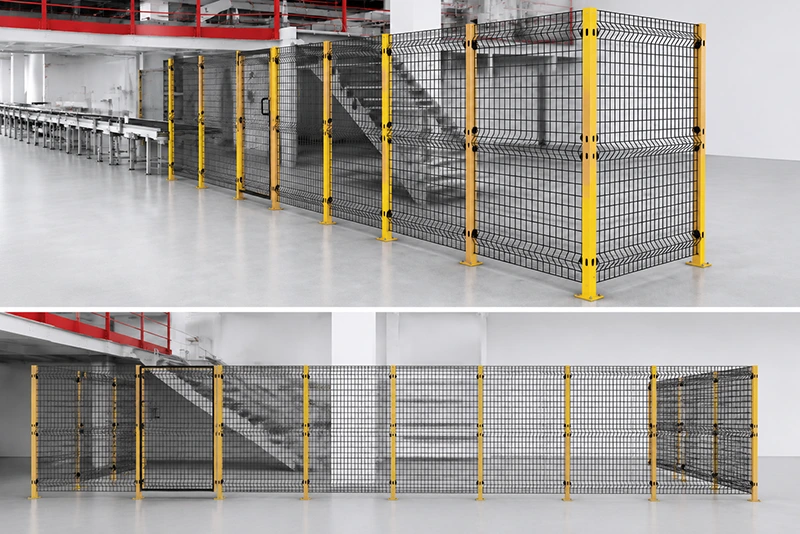
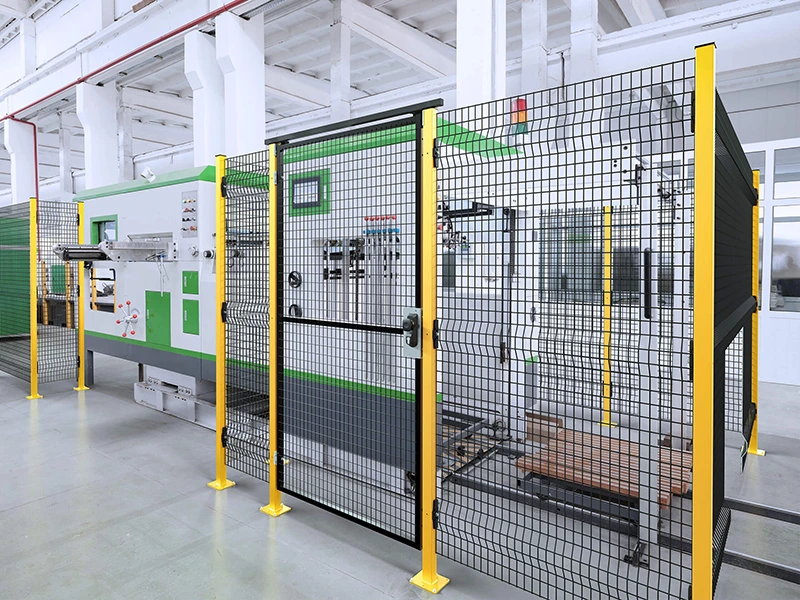
Mefence uses a frameless welded wire mesh panel rather than a perimeter frame. Plastic clips and self-tapping screws hold the panel to the posts, so a team can remove modules without cutting through welded joints. The same sections can follow a new robotic workstation perimeter, workshop isolation plan, or AGV lane separation layout. The close-up shows the clamp connector, bolt hardware, and post adjustment slots that make the system modular rather than permanently embedded in one floor plan.

On-site cutting handles real plant constraints
Food plants rarely offer a perfectly open rectangle. Pipes, columns, conveyors, drains, and temporary equipment can interrupt the intended line. Mefence’s frameless design supports on-site cutting and cold-work installation instead of waiting for a new factory drawing. The documented options include 3 mm or 4 mm wire, 20×100 mm or 50×50 mm mesh openings, Q235 carbon steel, and electrostatic powder coating. Posts are available in 40×60 mm or 60×60 mm sizes, with 140 mm ground clearance.

One barrier can separate, route, and control access
The 3D bending pattern forms repeated horizontal T-shaped ridges. Besides adding shape to the mesh panel, the raised profile can provide a route for cables and accept wood slat inserts where visual shielding is needed. In an automated equipment guarding area, the panel remains visually open for supervision while a gate defines controlled access. This supports pedestrian vehicle separation, forklift path barriers, conveyor belt isolation, and line-side cable management without turning every change into a construction project.
Where Reusable Safety Fencing Delivers the Most Value
- Seasonal production cells: move a machine guard fence when a short-life SKU leaves the schedule and another product enters the line.
- Robot workstation retrofit: define a robotic cell safety perimeter without committing the plant to a welded frame at the commissioning stage.
- Zoneamento de armazém: separate storage areas, tool cribs, pedestrian routes, and forklift paths while keeping the floor plan readable.
- Trial and temporary partitions: create workshop isolation or site demarcation during an expansion, line trial, or equipment relocation.
Because panels and posts can be reconfigured, a shutdown or plant transfer does not automatically turn the fence into scrap. The investment can move with the operating model.
Specification Points to Confirm Before Reconfiguration
Start with the hazard boundary, traffic flow, access points, floor fixing method, and any cable or visual-shielding requirement. Then confirm panel height and width, mesh opening, wire diameter, post size, color, and whether base plate posts or expansion bolts fit the floor. Mefence can support OSHA, ANSI B11.19, ISO 14120, ISO 14119, ISO 13857, and ISO 13855 comparisons as design references; project teams should validate the applicable guarding requirements for the specific machine and risk assessment.
Make the Next Line Change a Layout Task, Not a Fence Replacement
Mefence Safety Fencing changes the financial logic of plant separation: clip-fixed modules can be dismantled and reused, while on-site cutting adapts the frameless 3D mesh to the next layout. For food and beverage groups optimizing capacity across multiple sites, that means less demolition, less waiting, and more of the original fence investment retained as a reusable plant asset.