PT
PT  EN
EN  DE
DE  RU
RU  JA
JA  ES
ES  IT
IT SEGURANÇA EM ARMAZÉM | HSAFETY
Guarda-corpo de Aço para Separação de Pedestres e Veículos em Armazéns: Prevenindo Lesões por Empilhadeira na Origem
A steel guard rail creates a visible, floor-mounted boundary between forklifts and pedestrians when training, attention, or IoT alerts are not enough. Hsafety warehouse guard rails add passive forklift impact protection to an active monitoring stack, helping logistics and production sites protect people, racks, conveyors, and other fixed assets.
When mixed traffic turns a warehouse aisle into a life-safety risk
In a distribution center, pedestrians cross picking aisles, forklifts approach loading dock areas, and vehicles pass close to racks, conveyors, electrical cabinets, and walls. A painted line or rope barrier marks intent, but it does not physically stop a vehicle. Even a well-designed training program depends on memory, visibility, and consistent behavior. When those controls fail, the consequence can be a serious injury, fatality, damaged equipment, or accident downtime.
Many facilities add IoT sensors and active alerts to detect proximity or abnormal movement. That is useful for warning and intervention, but an alert is not a physical separation system. Hsafety works as the passive bottom layer: a bolted guard rail remains in place when a worker is distracted, a driver misjudges a turn, or an alert is missed. The result is an integrated approach—active monitoring for awareness, plus a warehouse safety barrier for physical control.
| Design item | Hsafety reference and application meaning |
|---|---|
| Guard rail type | Q235 carbon steel guard rail with double-rail, 2-rib/W-beam or 3-rib/thrie-beam configurations discussed by risk area. |
| Beam geometry | Reference data lists approximately 310 mm rail width, 85 mm wave height, and 3 mm or 4 mm thickness; confirm the selected drawing before order. |
| Poste e base | Project reference: 80×80×6 mm square posts, 160×160×16 mm base plates, and expansion anchors on concrete. |
| Layout | Modular bolted sections support straight runs, corners, rack-end protection, conveyor guarding, and custom-length guard rail zones. |
| Project design condition | For one recorded multi-zone project, a 3-ton forklift at 10 km/h and approximately 16,680 N was a design input—not a universal impact certification. |
Why a steel guard rail fits the physical risk
1. Make pedestrian-vehicle separation physically visible
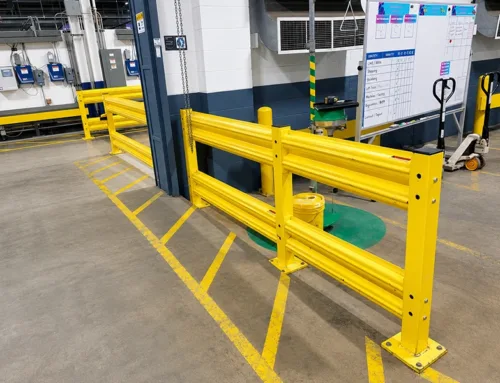
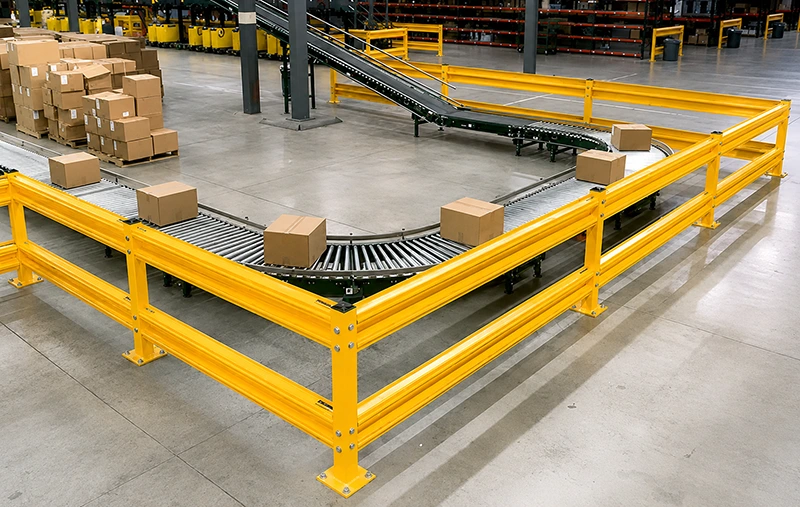
The warehouse conveyor scene shows a continuous double-rail barrier following both straight and turning sections. That arrangement gives operators a clear boundary before the vehicle reaches the protected zone. In a loading dock, aisle, or distribution center, the same modular guard rail can define the edge of a pedestrian route without relying on a driver to remember a painted line.
2. Use corrugated beams and anchored posts as one system
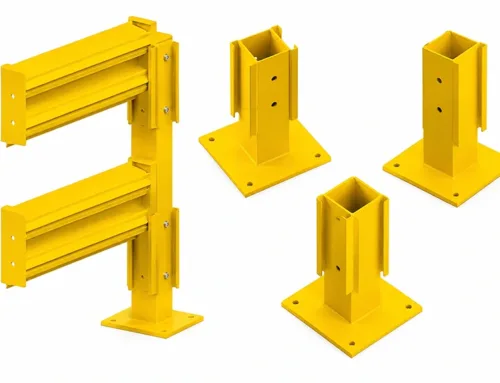
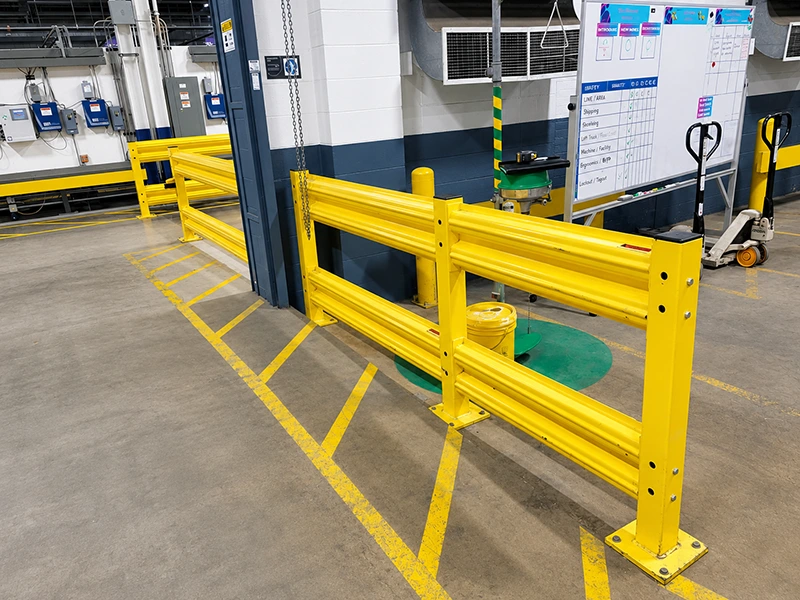
The corrugated steel beam is not a flat strip: its wave profile adds formed geometry across the rail. The close-up evidence shows the twin panels, square post, side connection, fasteners, and four-hole base plate working together. Hsafety uses bolted guard rail system construction so sections can be assembled, inspected, replaced, or configured for a project-specific length. The base and anchor selection still needs to match the concrete floor and the engineer’s loading assumptions.
3. Protect equipment while separating the route
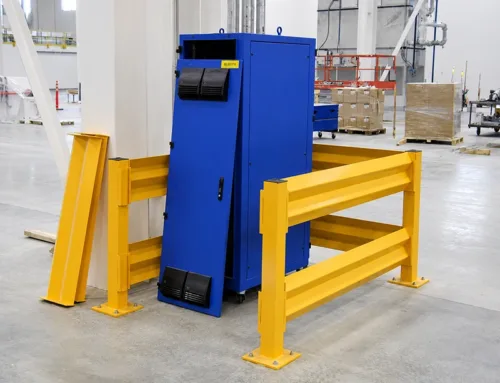
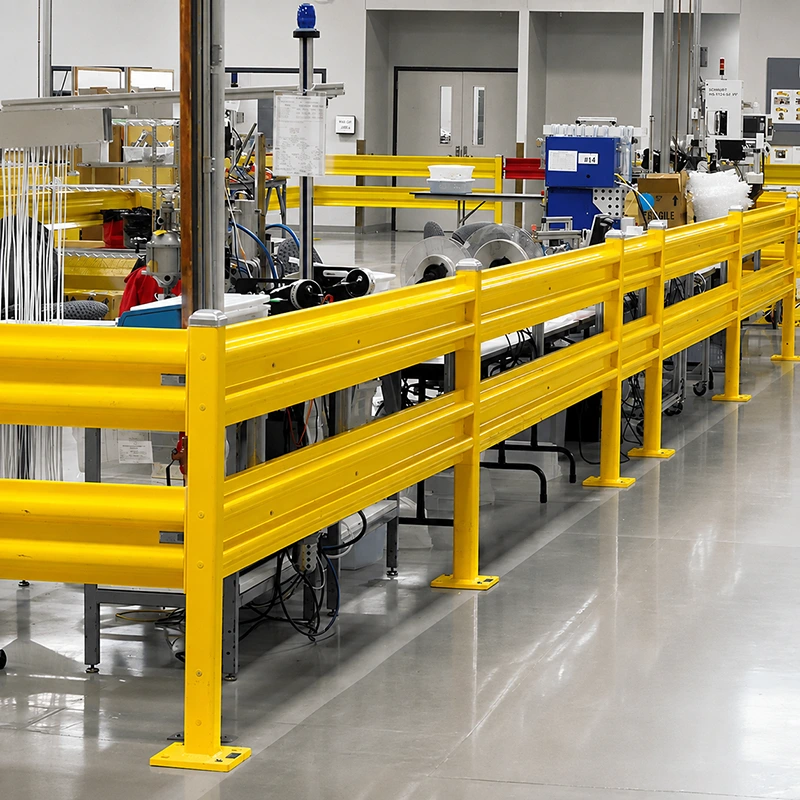
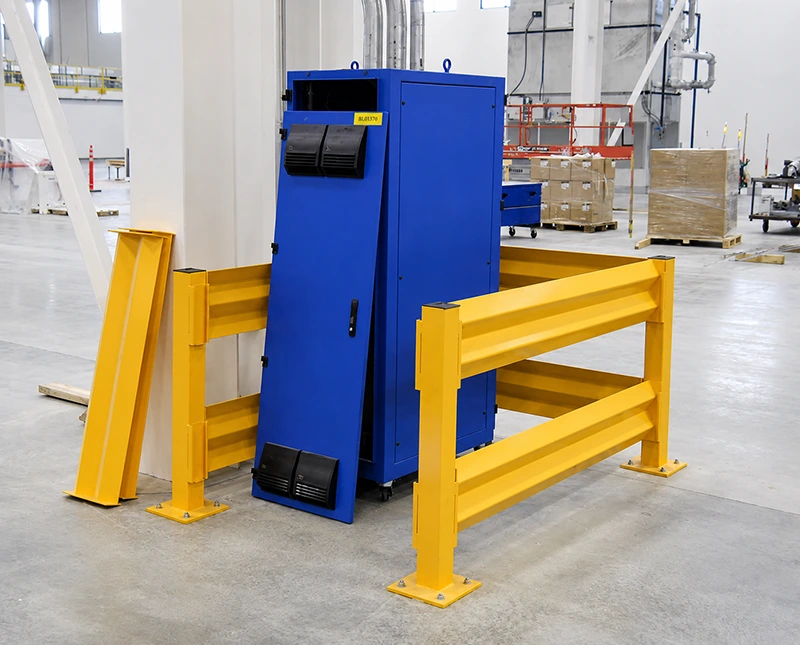
At an automated line, people are not the only exposure. A collision can damage a control cabinet, conveyor, robot cell, pipe run, or rack upright and create repair work and unplanned downtime. The equipment-cabinet installation shown here uses a yellow double-rail steel guard rail around a fixed asset. A high-visibility powder-coated finish supports visual recognition; hot-dip galvanized steel and reflective tape are available options to review for different environments and lighting conditions.
Apply the barrier where vehicle paths meet people or assets
- Forklift area barrier: separate pedestrian routes from truck aisles and staging areas.
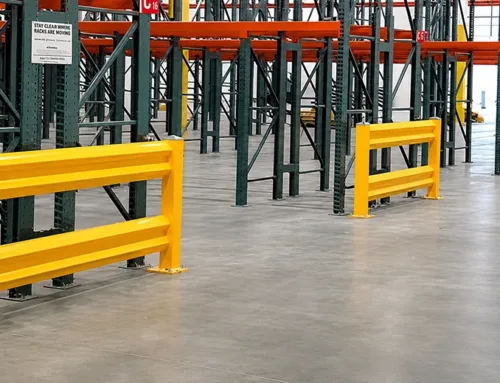
- Proteção de extremidade de rack: shield pallet-rack uprights and stored inventory from turning vehicles.
- Proteção de transportadores e máquinas: isolate conveyors, robot cells, electrical rooms, and production-line equipment.
- Proteção de docas de carga: establish a physical edge around walls, doors, dock equipment, and access routes.
- Custom length guard rail: combine 1,500 mm modules with special panels where four warehouse zones have different measured lengths.
Hsafety is a floor-mounted industrial guard rail for warehouse and factory environments. It is not a highway guardrail and should not be selected as an unverified substitute for a certified road or high-energy crash system. Final rail profile, thickness, post spacing, anchors, and concrete condition should be confirmed against the actual vehicle, speed, approach angle, and protected asset.
Specify the risk before specifying the rail
Start with a marked layout: pedestrian-vehicle routes, forklift type and mass, travel speed, turning points, rack or equipment offsets, concrete thickness, and required access points. Then select single-rail or double-rail, 2-rib or 3-rib, standard or custom lengths, and the required finish. This sequence connects the physical problem to the structure instead of treating a safety barrier as a generic line of steel.
Build the passive layer into your warehouse safety plan
IoT monitoring can warn people about a developing conflict. A steel guard rail gives the site a permanent physical boundary when warning, training, or attention is insufficient. Share your aisle, loading dock, rack, or conveyor layout with SGF to review Hsafety dimensions, anchor conditions, custom lengths, and the appropriate collision-protection configuration.