EN
EN  DE
DE  RU
RU  PT
PT  JA
JA  ES
ES  IT
IT Mefence Industrial Safety Fencing | Food & Beverage Plant Retrofit
Food & Beverage Line Reconfiguration: How Mefence Frameless Safety Fencing Turns Plant Zoning into a Reusable Asset
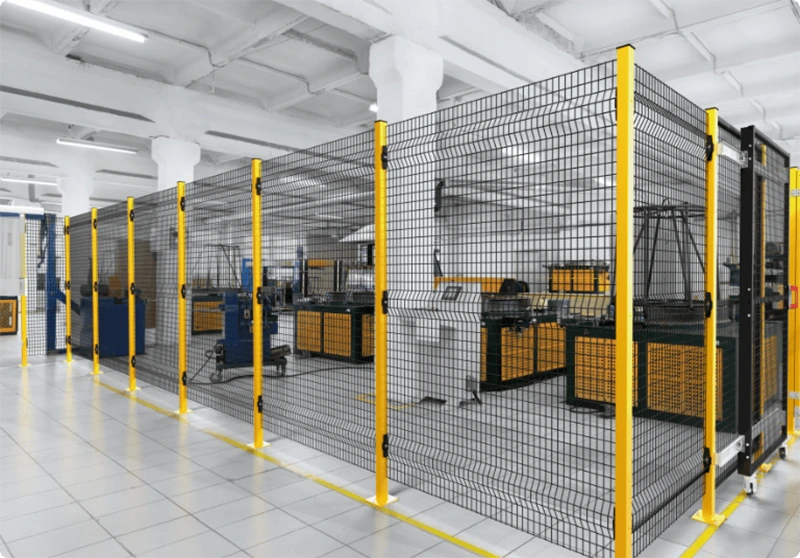
Short SKU lifecycles, seasonal production and frequent line changes make welded partitions expensive to abandon. Mefence frameless 3D safety fencing supports warehouse zoning, machine guarding and pedestrian-vehicle separation with clip-fixed modules that can be dismantled, moved and reused instead of cut out and scrapped.
When Production Changes, a Fixed Partition Becomes a Cost Problem
Food and beverage plants increasingly rearrange equipment for seasonal products, co-branded launches, trial batches and capacity optimization. A welded square tube fence may look permanent, but that permanence becomes a liability when the line moves: the old area must be cut apart, new fencing must be purchased, and installation work starts again. Chain link, barrier tape and rope barriers do not provide the same visible workplace safety barrier or controlled access around equipment and traffic routes.
The financial issue is not only replacement material. Cutting, removing and rebuilding fencing consumes maintenance labor, extends the retrofit window and leaves usable steel attached to a layout that no longer exists. For a plant operating several sites, a fence that cannot travel with the process is a sunk cost rather than a facility asset.
| Mefence design point | How it supports a changing plant |
|---|---|
| Frameless 3D welded mesh | Provides a slim, visible boundary for area demarcation without a perimeter frame that complicates on-site adjustment. |
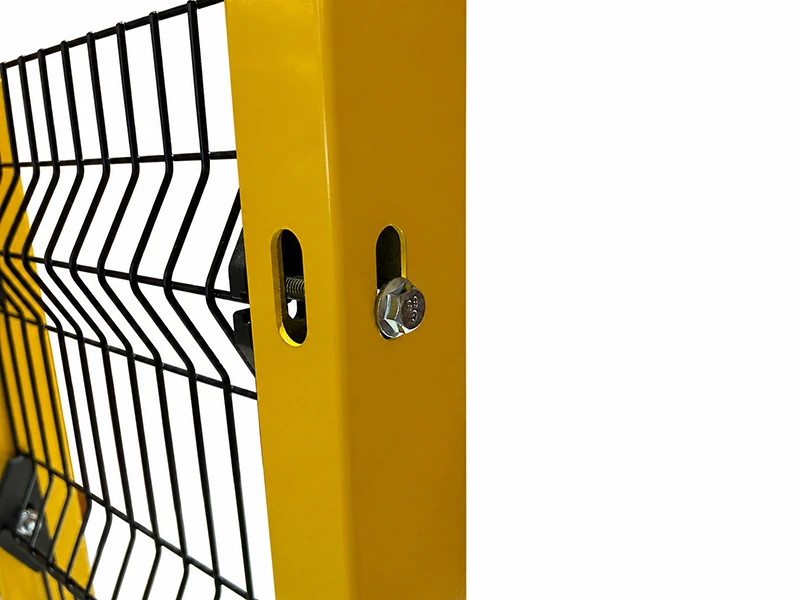
| Clip-fixed assembly | Plastic clips and self-tapping screws allow cold-work installation and non-destructive dismantling; modules can be relocated and reused. |
| On-site cutting | Panel widths from 200–1400 mm and heights from 200–3000 mm can be adapted to irregular corners, posts and pipe runs at the retrofit site. |
| 3D bent profile | Multiple horizontal T-shaped ridges create useful space for cable management and can accept wood slat inserts for visual shielding. |
| Material and finish | Q235 carbon steel with electrostatic powder coating; standard yellow and black finish, with custom colors available. |
Why Mefence Fits Reconfigurable Food and Beverage Production Areas
1. Dismantle the boundary without turning it into scrap
Mefence uses a frameless welded wire mesh panel, plastic clip and self-tapping screw connection rather than a welded site-built frame. During a line move, the fence can be taken down section by section, stored as identifiable modules and installed around the next workstation or process zone. This supports a modular reconfigurable fence strategy: the plant can move the boundary with the production asset, while reducing repeated welding and demolition work. The documented installation method is one-person, three-step assembly, with video facts indicating 50%+ installation-time savings.
2. Adapt the panel to the actual retrofit footprint
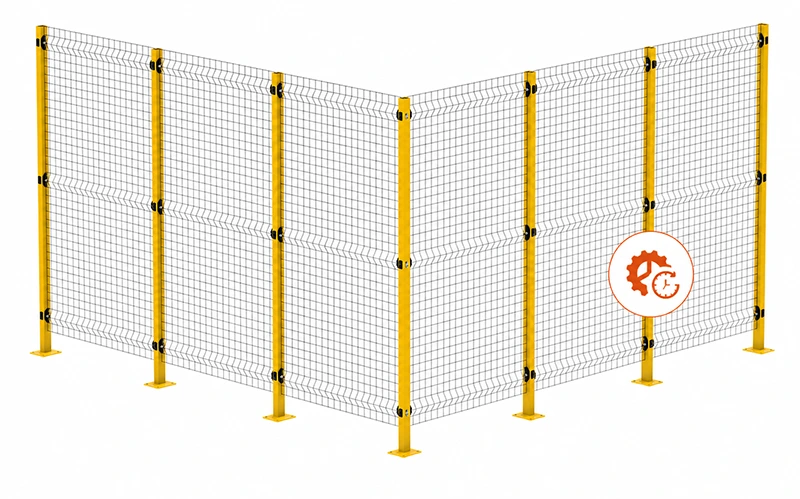
Food plants rarely offer a clean rectangular envelope after conveyors, utilities and columns are in place. Mefence supports on-site cutting, so installers can work around pipework, existing posts and irregular wall corners without waiting for a factory-redrawn frame. The available wire diameters are 3 mm and 4 mm, with mesh openings of 20×100 mm or 50×50 mm. Posts are available in 40×60 mm or 60×60 mm sizes, with base plate posts and expansion-bolt fixing for floor-mounted layouts. These choices help define a workplace safety barrier while preserving floor space and keeping the route visually readable.
3. Combine zoning, access and line-side services
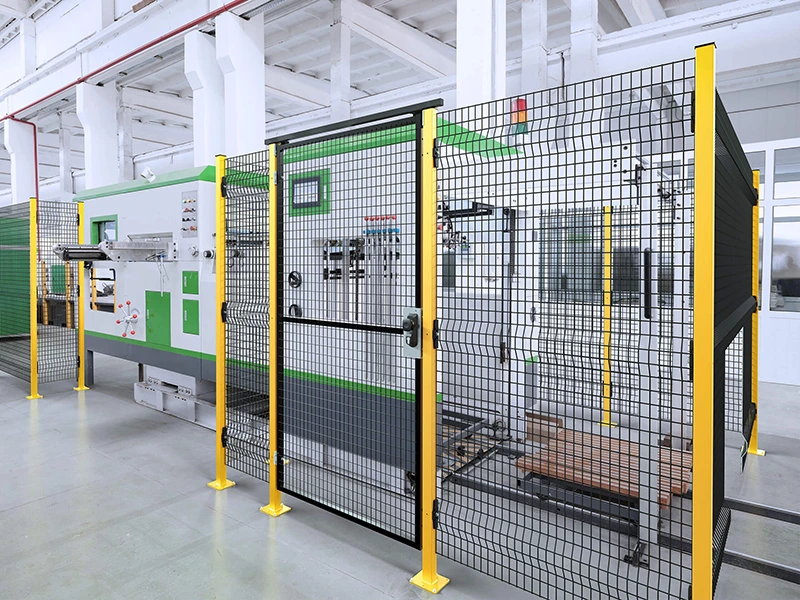
A production-area fence often has to do more than mark a perimeter. It may separate pedestrians from forklift paths, protect an automated equipment perimeter, control entry to a robot workstation, and keep cables from hanging into an aisle. The 3D welded mesh and raised T-shaped ridge provide a practical route for cables and can take wood slat inserts where visual shielding is required. Access gates make the boundary usable rather than symbolic. Mefence is intended for non-high-impact demarcation and traffic control, not certified anti-collision containment; where direct impact protection is required, specify the higher-spec Machine Fence line instead.
Where a Reusable Industrial Safety Fence Creates the Most Value
- Production-line reconfiguration: move machine guarding and workshop isolation with a relocated conveyor, filler or packaging cell.
- Warehouse zoning: establish storage area separation, forklift path barriers and pedestrian-vehicle separation without building a permanent wall.
- Robot and automation retrofits: create a robot safety fence or automated equipment guarding perimeter around a newly commissioned cell.
- AGV and AMR traffic planning: make lanes and controlled access points visible while avoiding a blind solid barrier.
- Multi-site asset transfer: dismantle modules during a factory shutdown and redeploy them at another plant with a different footprint.
For engineering and finance teams, the result is a different asset profile. Instead of purchasing a welded partition for one fixed drawing, the plant invests in a relocatable reusable fence system that can support several layouts over its service life. That reduces the exposure created by frequent SKU changes and makes line-side safety zoning part of the site’s reconfiguration plan.
Specify the Boundary Before the Layout Moves
Share the plant layout, expected relocation points, floor-fixing conditions, traffic routes and any cable or visual-shielding requirements. The Mefence team can match panel dimensions, wire diameter, mesh opening, post size, base-plate fixing and access-gate needs to the intended area demarcation. For machine guarding, AGV lane separation or warehouse partition projects, this step keeps the fence specification aligned with the actual retrofit sequence.
Turn a Sunk-Cost Partition into a Reusable Plant Asset
Mefence Industrial Safety Fencing gives food and beverage manufacturers a practical route from welded, layout-specific barriers to clip-fixed, on-site-cut and relocatable zoning. Contact SGF to review the next production change and plan a reusable frameless safety fence around it.