RU
RU  EN
EN  DE
DE  PT
PT  JA
JA  ES
ES  IT
IT AUTOMOTIVE PLANT MACHINE GUARDING
Automotive Plant Industrial Safety Fence: Keep the Robot Cell Close to the Hazard
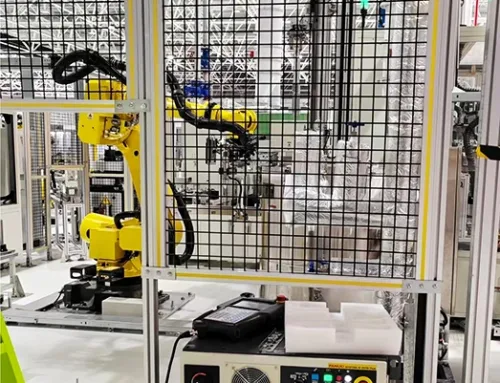
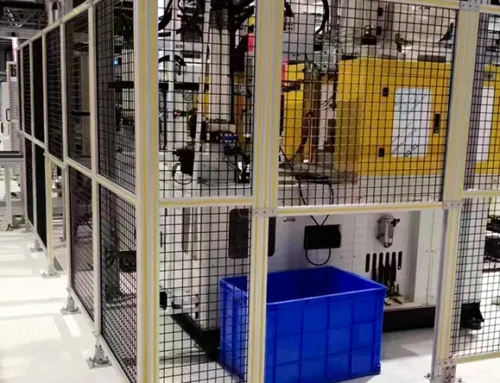
In an automotive factory, floor area is production capacity. Alfence combines a 20×100 mm welded wire mesh with slim 40×40 mm or 45×45 mm aluminum profile posts, helping engineering teams plan a modular safety fence close to the guarded equipment—around 120 mm where the project risk assessment and EN ISO 13857 review allow it. The result is a visible machine guarding boundary without automatically giving up useful aisle or cell space.
Which Alfence dimensions protect usable floor area?
The space-saving argument is not a promise to move every fence to one fixed distance. It is a layout method: use the narrow mesh and slim posts to reduce unnecessary envelope around the hazard, then confirm the final separation, access, doors and safety functions against the machine risk assessment and project drawing.
| Alfence element | What it contributes to the layout |
|---|---|
| 20×100 mm welded wire mesh | Supports a closer-to-hazard perimeter concept; approximately 120 mm is a project planning reference, not a universal clearance. |
| 40×40 mm or 45×45 mm aluminum posts | Keeps the post-and-panel boundary slim while providing a modular T-slot frame for panels, doors and connectors. |
| Panel formats | Typical documented heights include 1000, 1800 and 2000 mm; widths include 200–1200 mm. Final panel schedule follows the project drawing. |
| Connector and floor fixing | Panels connect into the aluminum profile system; foot connectors and expansion-bolt or equivalent floor fixing keep the boundary defined without site welding. |
| Safety review boundary | EN ISO 14120 and EN ISO 13857 can frame the guarding review. The installation still needs project-specific risk assessment and verification; no certificate is implied here. |
How the structure turns a tight floor plan into a workable perimeter
1. Start with the mesh opening, not an oversized stand-off
A conventional welded steel fence or chain-link barrier may be selected as a generic perimeter and then pushed farther out than the equipment envelope requires. In a vehicle plant, that lost strip repeats along robot cells, conveyors and service aisles. Alfence’s 20×100 mm grid gives the layout team a defined machine guarding fence format to check against reach and access requirements. When the assessment supports it, the perimeter can be planned close to the hazard—around 120 mm as a working reference—rather than treating unused clearance as free space. The grid helps define the boundary; it does not replace the safety calculation.
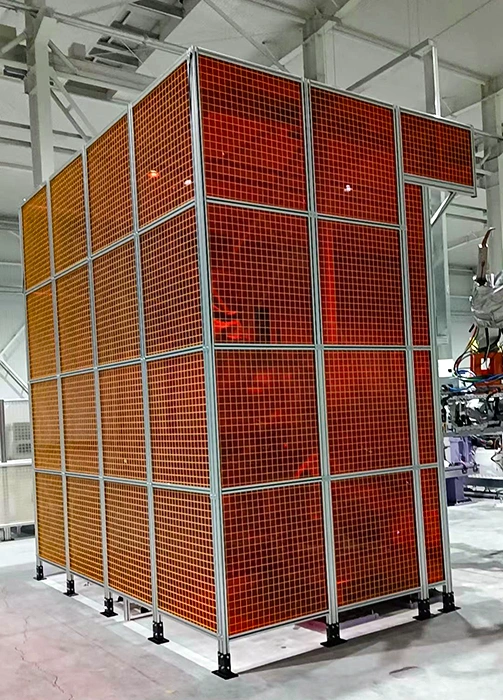
2. Use slim aluminum posts where the cell geometry is already dense
The 40×40 mm and 45×45 mm aluminum profile options reduce the visual and physical bulk of the post line compared with a heavy, overbuilt boundary. T-slot posts accept removable panels, corner connections and access-door hardware, so the system can follow a robot cell, CNC machine, assembly line or conveyor without turning every adjustment into a fabrication job. The documented system is intended for indoor machine guarding and light-corrosive environments, with the final post, panel and anchoring selection confirmed for the application.
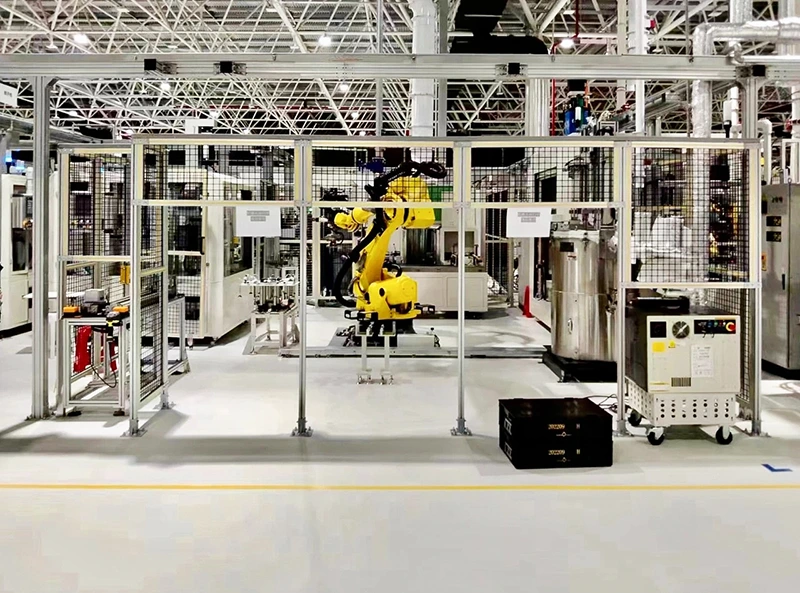
3. Preserve the next layout change instead of rebuilding the fence
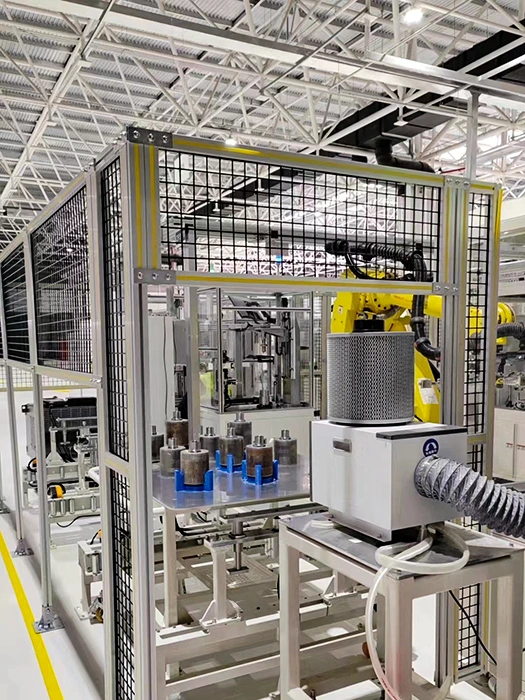
Automotive production rarely stays still: a model change, new tooling or a relocated inspection point can move a door and alter the perimeter. Alfence uses connector-based, bolt-free assembly rather than on-site welding, allowing panels and posts to be removed, reconfigured and reused when the approved layout changes. The palletized aluminum components shown here are evidence of standardized component handling—not proof of an installed 120 mm distance—but they illustrate why a modular aluminum safety fence is easier to plan as reusable plant equipment.
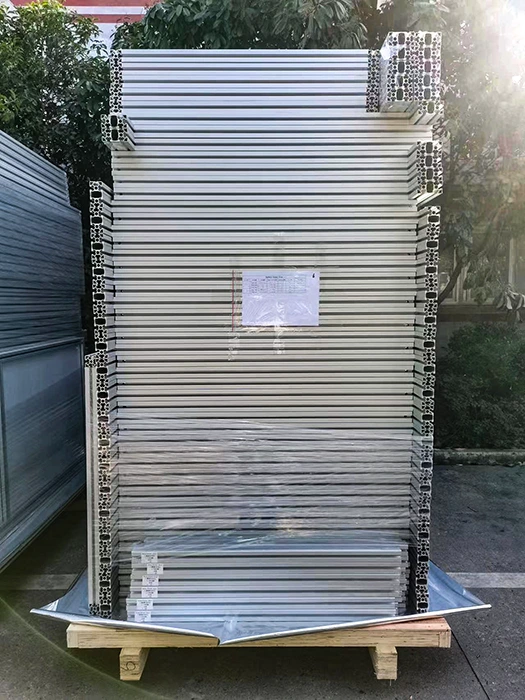
Where this close-layout approach fits
- Automotive robot cell guarding: separate robotic workstations and operator routes while keeping the perimeter aligned with the equipment envelope.
- Ограждение маршрутов AGV: review the fence line beside an AGV or conveyor route so protection does not consume avoidable aisle width.
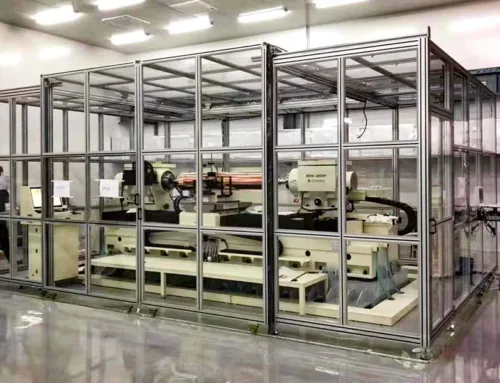
- Ограждение станков с ЧПУ и металлорежущего оборудования: combine welded mesh with access doors, safety interlock switches or light curtains where the risk assessment requires controlled entry.
- Retrofit and line changes: replace or extend an old fence with removable, reconfigurable panels rather than cutting and rewelding the complete boundary.
For each scenario, the useful result is measurable: less unnecessary floor taken by the perimeter, clearer separation from the hazard, and a guarding system that can be adapted when the production line changes. Alfence is not a substitute for a high-impact steel barrier where the project requires one; it is a modular aluminum profile safety fence for suitable indoor machine guarding applications.
Bring the floor plan to the guarding review
Share the robot or machine footprint, required access points, AGV or forklift routes, target panel height and the applicable safety review with the project team. SGF can then check the 20×100 mm mesh, 40×40 mm or 45×45 mm posts, panel widths, door type, floor fixing and any light-curtain or interlock positions against the drawing. That is the step that turns a close-layout concept into a buildable machine guarding fence.
Protect the hazard without surrendering production floor
Ask for an Alfence layout review for your automotive plant, robot cell, CNC area or AGV path. Confirm the project-specific clearance first; then use the modular system to keep the approved boundary compact and reconfigurable.