RU
RU  EN
EN  DE
DE  PT
PT  JA
JA  ES
ES  IT
IT 3PL & Contract Logistics
Industrial Safety Fencing That Respects a 3PL P&L
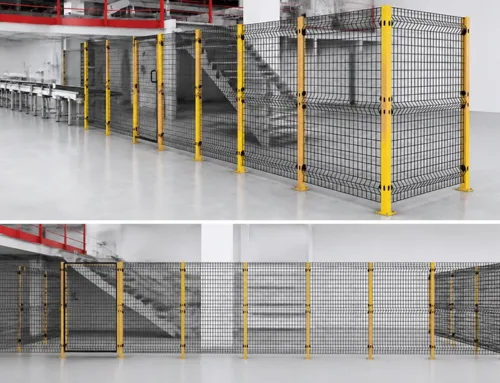
Third-party logistics runs on square-foot economics. Every facility line item has to earn its place, and a fence that only marks a boundary has to do it cheaply, fast, and without burning install hours. Here is how frameless welded mesh fencing lets operators zone more aisles for less, while keeping AGV lanes and storage zones readable.
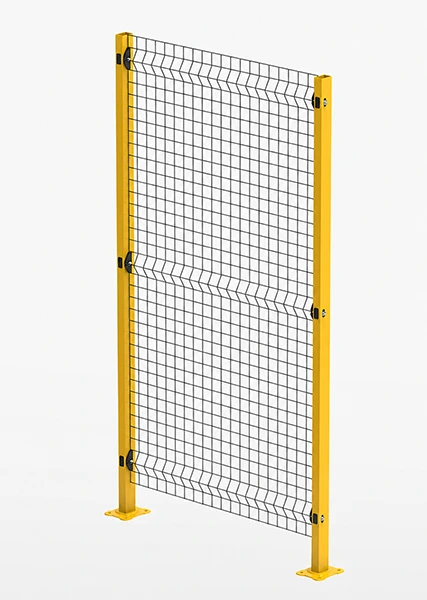
Engineering Specs for Warehouse Demarcation
Specs below come straight from the Mefence product sheet and installation video. They are the numbers a 3PL facilities team needs to lock in a quote and a layout in one pass.
| Спец | Mefence Value |
|---|---|
| Материал | Q235 carbon steel, electrostatic powder coating |
| Диаметр проволоки | 3.0 mm or 4.0 mm |
| Размер ячейки сетки | 20×100 mm or 50×50 mm |
| Ширина панели | 200–1400 mm (cut on site) |
| Высота панели | 200–3000 mm |
| Размер поста | 40×60 mm or 60×60 mm |
| Ground clearance | 140 mm |
| Соединение | Plastic clip + self-tapping screw (no on-site welding) |
| Base fix | Base plate post with expansion bolts |
| Standard color | Yellow + black (custom colors available, including orange) |
| Installer footprint | 1 person, 3 steps, 50%+ install time saved |
Why a Frameless 3D Mesh Fence Fits a Thin-Margin Operation
Cut Per-Meter Cost to a Fifth of Premium Brands
A perimeter fence is a non-revenue line item. Mefence ships factory-direct from China at roughly $10–$32 per meter, while European and North American modular brands such as Troax or Axelent land at roughly $105–$213 per meter for comparable mesh panels. On a 1,000-meter layout, that delta is the difference between fencing the whole building and fencing the storage zone only. Operators using Mefence typically fence 3–5× more linear footage on the same facilities budget, and the savings land directly on the cost-per-square-foot line that 3PL clients audit every quarter.
Rezone Without Calling the Welder Back
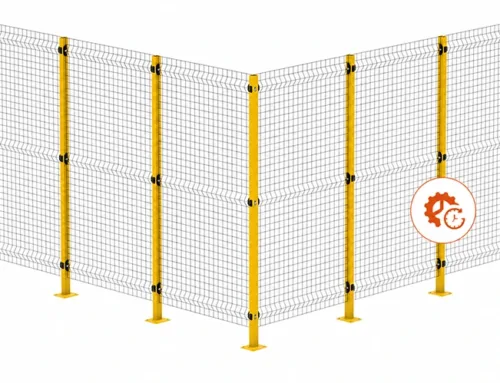
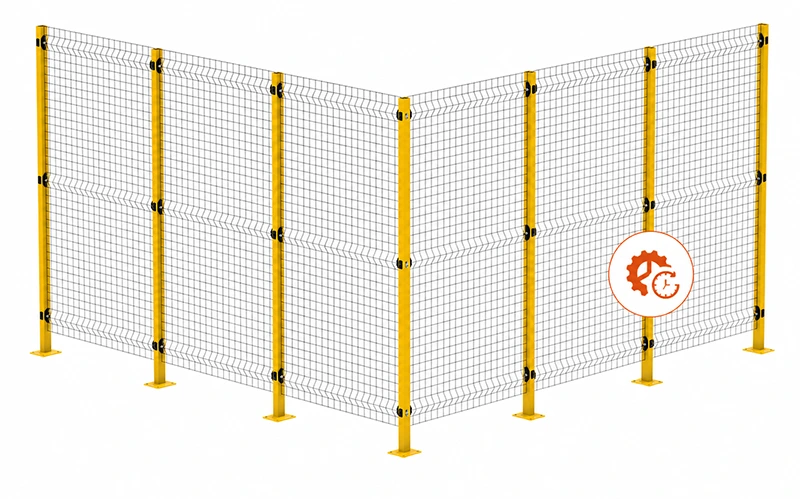
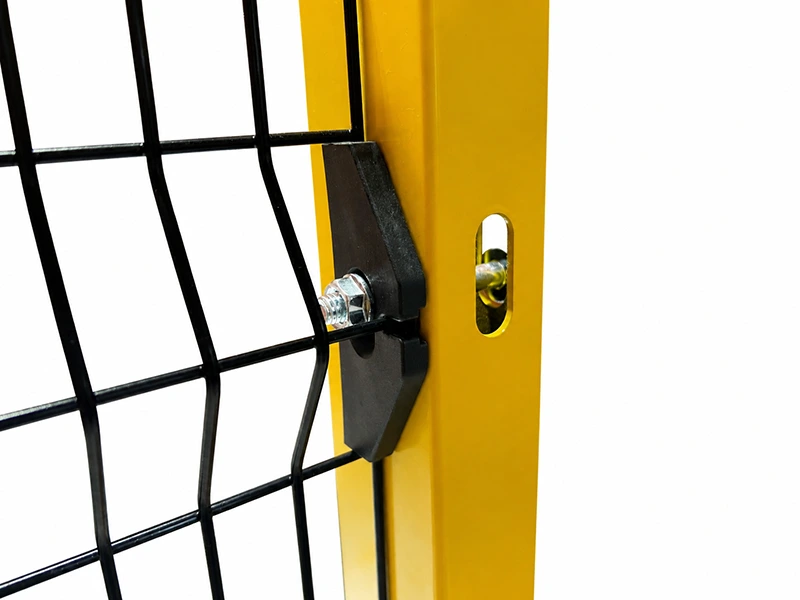
A frameless mesh panel is cut with standard tools on site, which matters the first time a tenant changes racking footprints or an integrator swaps a pick module. Width runs from 200 mm to 1400 mm and height from 200 mm to 3000 mm, so the same SKU covers a single AGV lane gate, a 3-meter mezzanine drop, and a partial-height cart corral. Plastic clips plus self-tapping screws lock the panel to 40×60 or 60×60 posts. No square-tube welding step on the shop floor and no welding crew on site, which keeps retrofit windows inside a weekend.
Keep AGV Lanes Readable and Cable Runs Clean
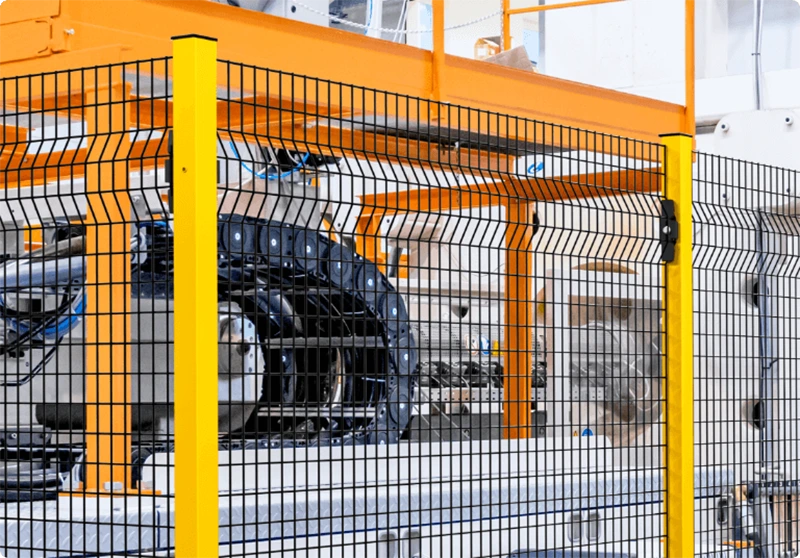
The 3D bent profile adds horizontal T-shaped ridges across the mesh. That ridge is a routing channel for low-voltage cables and signal lines, so light-curtain wiring, scanners, and stack-light cables run inside the fence line instead of draped across aisles. AGV and AMR lanes stay visually clear to the vehicle sensors, and pedestrian crossings stop snagging on loose cabling. Wood slats can also slide into the ridge for visual shielding where tenant clients prefer a closed wall look without committing to a permanent partition.
Where 3PL Operators Drop This Fence First
- AGV and AMR lane separation inside the pick face
- Forklift path barriers between rack rows and staging lanes
- Pedestrian-vehicle crossing points at column lines
- Storage zone partitioning for multi-tenant buildings
- Tenant demising walls inside shared warehouses
- Mezzanine edge protection at pallet drop points
- Cart and tote corral per work cell
- Charging-station enclosures for electric pallet jacks
- Tool crib and consumables cage perimeter
- Tenant-specific outbound staging cages
Each use case is demarcation, not impact containment. Where forklifts or AGVs can directly strike a panel, spec the heavier Machine Fence line from the same manufacturer and reuse Mefence for everything else. That split lets facilities teams protect capital equipment without overpaying for the 80% of fencing that only needs to be visible.
Pre-Purchase Checklist for Warehouse Facilities Teams
Before you sign a PO, confirm the fence matches the layout instead of forcing the layout to match the fence. Verify panel width and height ranges (200–1400 mm wide, 200–3000 mm tall) cover your tallest rack row and your narrowest AGV lane in one cut, with no welded frame to fight. Confirm wire diameter (3 mm for low-impact demarcation, 4 mm where small electric pallet jacks can clip a panel) and mesh opening (20×100 for human exclusion zones, 50×50 for general zoning). Lock the connection method as plastic clip plus self-tapping screw on 40×60 or 60×60 posts with 140 mm ground clearance for forklift sweep, and base-plate posts with expansion bolts for any hard floor or wall foundation point. Specify the standard yellow-and-black finish for high-visibility hazard separation, or a custom color (orange is common for temporary or construction-zoned areas). Confirm the supplier can ship cut-to-size panels direct from factory at roughly $10–$32 per meter so the line item beats the $105–$213 per meter of premium modular brands, and the savings can be redeployed into more racking or more camera coverage on the same capital approval.
Send Your Floor Plan, Get a Cut Sheet Back
Send us a simple layout with the zoning lines you want drawn. We will return a per-meter cut sheet using the frameless 3D mesh spec above, with a factory-direct price that lets you fence the full building on the same budget.