RU
RU  EN
EN  DE
DE  PT
PT  JA
JA  ES
ES  IT
IT VEHICLE VARIANT CHANGEOVER | RECONFIGURABLE MACHINE GUARDING
Re-tool a robot cell without scrapping the guarding
When annual vehicle variants, model changeovers, and incremental automation redraw an indoor production line, Alfence industrial safety fence keeps the perimeter modular. Its aluminum profile safety fence uses removable panels, connector-based assembly, and configurable access points so machine guarding can be rearranged instead of cut apart and discarded.
Why a welded steel cage becomes an expensive changeover item
A welded steel fence can be appropriate where the layout is stable and impact duty governs the design. It becomes a sunk cost when a vehicle plant adds a new variant, moves a robot, or inserts another automated station. Cutting posts, rewelding corners, and rebuilding maintenance openings consumes shutdown time; the old cage may not fit the next perimeter. Alfence is specified for the different requirement: indoor machine guarding that can be dismantled, re-planned, and reused, while the engineering team still defines the hazard distance and access controls for each new layout.
| Changeover requirement | Alfence design evidence |
|---|---|
| Move the perimeter with the robot cell | 40×40 mm or 45×45 mm aluminum profile posts, T-slot framing, removable panels, and connector-based assembly support reconfigurable guarding without on-site welding. |
| Keep the boundary close to the hazard | 20×100 mm welded wire mesh is a documented grid option; the final layout must still verify the applicable EN ISO 13857 safety distance for the machine. |
| Match different station footprints | Reference panel heights include 1000, 1800, and 2000 mm, with widths from 200 to 1200 mm in the product data. Project drawings take priority where versions differ. |
| Open the right maintenance route | Hinged, folding, telescopic, sliding, and linear door arrangements can be planned with safety interlock switches or light curtains where the risk assessment requires them. |
| Fix the system to the plant floor | Foot connectors and base plates work with expansion bolts or anchor bolts. The floor anchor remains a project installation item; it does not turn every panel change into a welded rebuild. |
How the modular safety fence follows the next production layout
1. Replace welding with a reusable perimeter
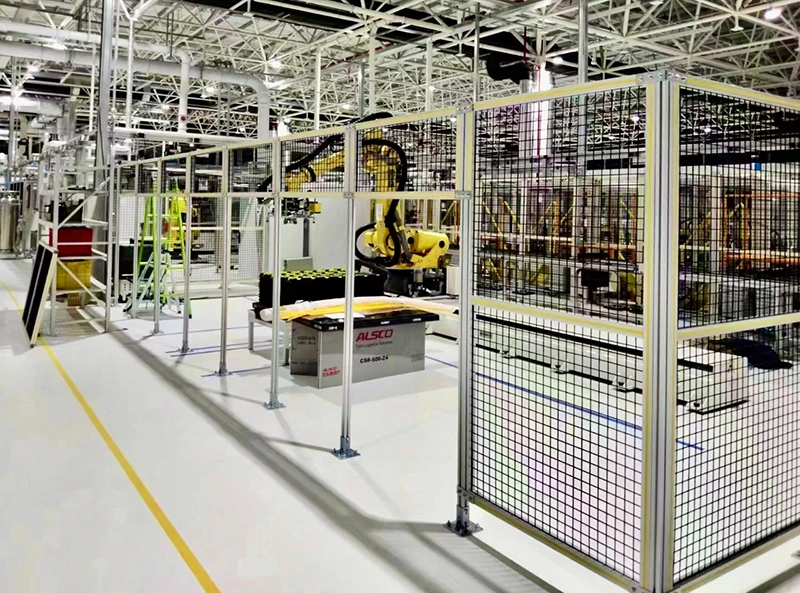
The practical difference is at the joint. Alfence panels and aluminum profile framing are assembled through the profile groove and connectors, so a panel run can be released, moved, and locked into a new position without hot work at the cell. The indexed installation scene shows segmented mesh panels, posts, and adjustable floor feet working as separate modules. That makes the fence a reusable plant asset: a change in robot reach or conveyor position calls for a new arrangement, not a new welded cage. The aluminum profile also keeps the system lightweight for controlled relocation inside the plant.
2. Keep robot cell guarding aligned with the hazard review
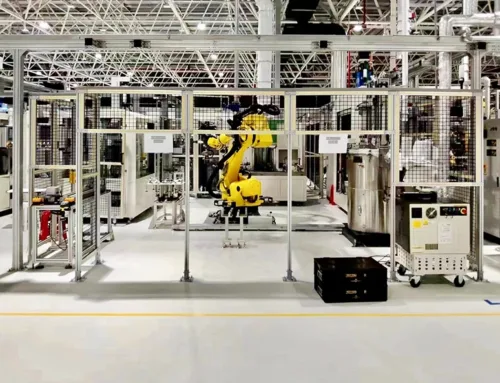
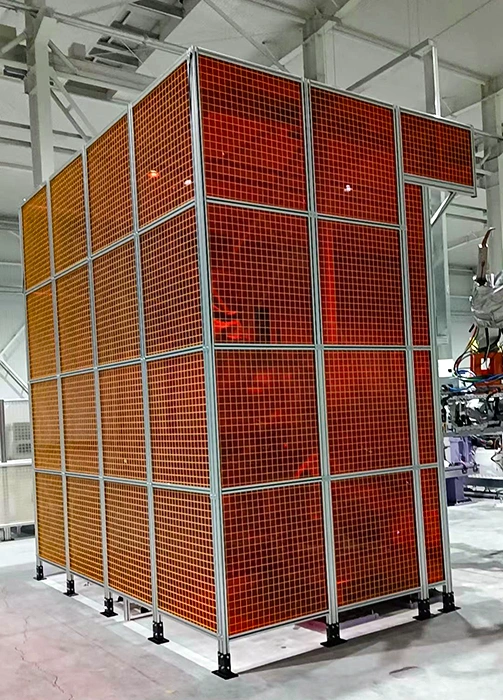
Reconfigurable guarding is not just a procurement feature. When an automation project changes the robot envelope, transfer point, or operator route, the machine guarding fence must be redrawn around the new hazard. Alfence provides a post-and-panel system that can be re-spaced and combined with mesh, PC, acrylic, or metal panels according to visibility and process needs. The robot-cell image shows an anchored mesh enclosure that preserves a clear physical boundary around automated equipment. Engineers can then check the revised access points, safety distance, and interlock logic against the applicable EN ISO 14120 and EN ISO 13857 design requirements instead of assuming the old perimeter still works.
3. Plan access around service, loading, and the next variant
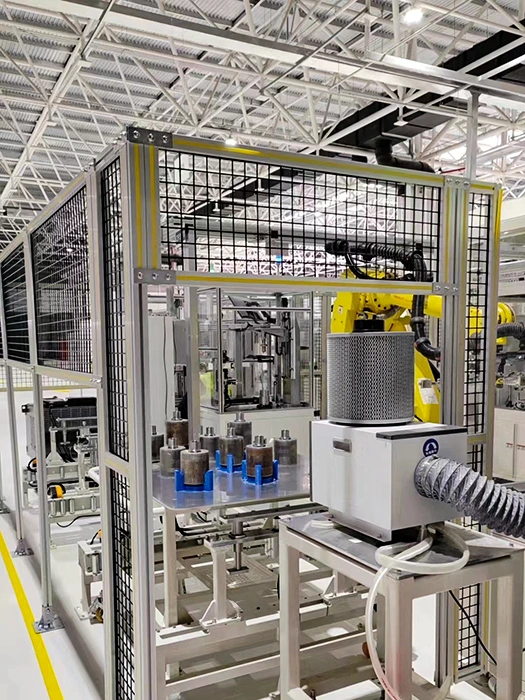
A changeover often fails at the door rather than in the straight panel run. A new fixture can move the maintenance side; a conveyor can require a wider material opening; a robot service route can need a controlled interlocked gate. Alfence supports hinged and sliding safety doors and can integrate safety interlock switches or light curtains into the access concept. The indexed robot workcell image shows a double mesh gate, fixtures, equipment, and a flexible extraction duct, illustrating why the opening, utilities, and operator path must be designed together. When the station moves, the access module can move with it instead of being cut out of a welded frame.
Where this approach pays back during model and line changes
- Automotive assembly and robot cells: move a guarding run with a new body style, robot reach, or fixture position rather than writing off welded steel.
- Welding and machine-tool areas: combine welded wire mesh with a specified PC, acrylic, or metal panel where visibility, spatter, or arc-light control calls for a different infill. Panel heat resistance and process conditions require project confirmation.
- AGV paths, conveyors, and ASRS zones: use a visible perimeter that can be relocated when routes, transfer points, or storage interfaces change.
- Модернизация ограждений: replace an old fence in an indoor plant with a modular frame, new access doors, and floor-mounted anchor points without making site welding the default installation method.
Alfence is intended for indoor, light-corrosive, and frequently modified machine guarding. It is not a blanket substitute for an engineered high-impact steel barrier or an outdoor security fence; the hazard assessment, impact duty, environment, and project drawings determine the correct specification.
What to confirm before issuing the changeover layout
Give the guarding engineer the robot envelope, operator and AGV routes, planned maintenance openings, required panel visibility, floor fixing condition, and target heights and widths. Confirm the mesh or solid-panel selection, door type, interlock or light-curtain interface, and the safety distances for the revised cell. Alfence data provides a starting range—40×40 or 45×45 mm posts, 20×100 mm mesh, 1000/1800/2000 mm reference heights, and panel widths up to 1200 mm—but the project drawing governs the final combination. This keeps the product advantage concrete: only the layout changes; reusable posts, panels, connectors, and access modules remain in the plant’s guarding inventory.
Make the next vehicle variant a layout change—not a fence replacement
Share the current cell perimeter and the expected model or automation change with SGF. We can review a modular safety fence arrangement around the machine envelope, access routes, panel type, and floor fixing points so the next re-tooling cycle is planned for reuse.