RU
RU  EN
EN  DE
DE  PT
PT  JA
JA  ES
ES  IT
IT Container terminal & yard operations
Container Yard Guard Rails: A Physical Line Between Heavy Equipment and People
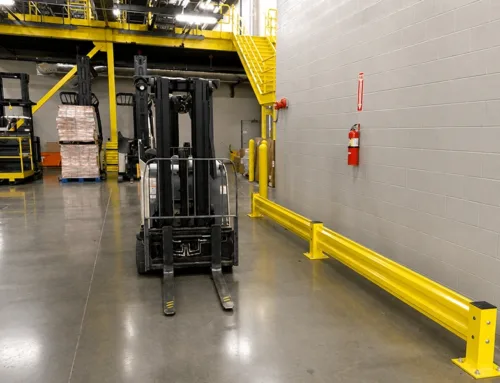
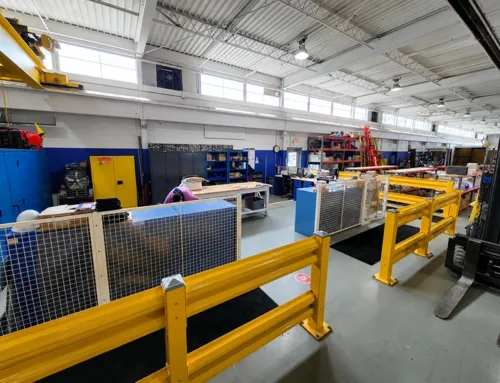
A container yard runs 24/7 with straddle carriers, RTGs, reach stackers, terminal tractors, AGVs, external hauliers and three or four different employers all sharing the same ground. Straddle carriers in particular combine huge mass, poor visibility and a habit of coming together in the same lane. Hsafety heavy duty guardrails give the yard a passive, floor-anchored steel boundary between vehicle trunk routes and the places people stand to tally, lash or walk — a barrier that keeps working at night, with a contractor crew, or on the day attention and training fail. It does not replace the terminal’s cameras and proximity sensors; it is the layer underneath them.
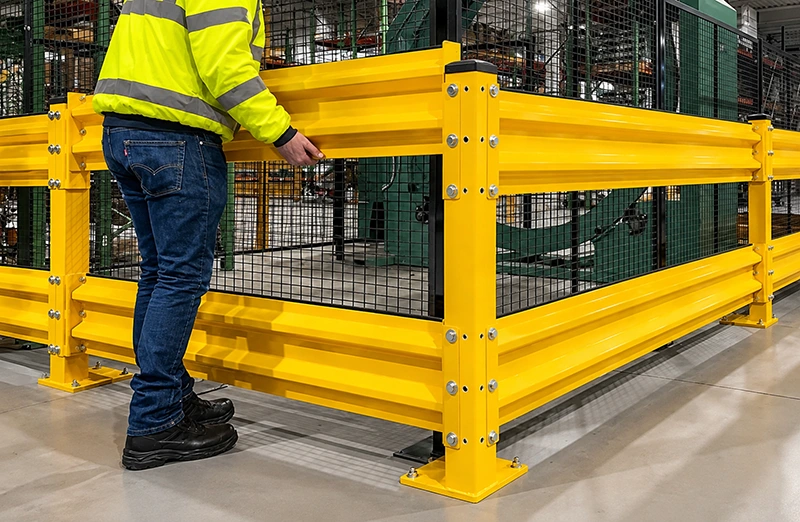
What the Yard Boundary Is Actually Built From
Most yard separation fails for a boring reason: it is drawn as paint on the ground or as a temporary cone line, and neither stops anything. A corrugated guard rail system changes the physics of the boundary — it is a bolted, anchored steel structure that a vehicle has to physically defeat. The table below is the specification an Hsafety industrial guard rail is quoted from; it is a warehouse-grade guardrail, so every dimension that matters to your terminal engineer is stated openly rather than buried.
| Parameter | Hsafety guard rail detail |
|---|---|
| Основной материал | Q235 carbon steel, welded post-and-rail construction |
| Rail profile | Corrugated W-beam (2-rib) or thrie-beam (3-rib); approx. 310 mm rail width, 85 mm wave height, 194 mm wave pitch |
| Rail thickness | 3 mm or 4 mm, selected per impact zone |
| Высота | 1,000 mm nominal, with the lower rail set slightly above finished floor level |
| Modules and length | 1,500 mm standard modules; custom length guardrail panels to close a run that does not divide into modules |
| Post and base plate | 80 × 80 × 6 mm square tube post on a 160 × 160 × 16 mm base plate, expansion-bolted into concrete (typically a slab of at least 150 mm) |
| Отделка | Powder-coated yellow safety coating (other colours available) or hot-dip galvanised; optional reflective tape, end caps, blockouts and brackets |
| Configuration | Single-rail or double-rail runs, straight sections and corners, with optional lift-out panels |
Three Reasons This Holds Up in a Working Yard
Passive protection does not depend on who is on shift
At 03:00 the yard is not the yard the day-shift induction described. Lashing crews, contractors and drivers arrive under different employers, with different briefings and different levels of familiarity with your internal routes. A steel guard rail does not need a toolbox talk to work: a bolted guard rail system closes a lane permanently, in the same place, every night. That is what makes it the bottom layer of the protection stack. Active warnings — RTG and straddle carrier proximity systems, cab cameras, pedestrian tags — tell people a conflict is coming. A corrugated guard rail means the conflict cannot reach the person in the first place.
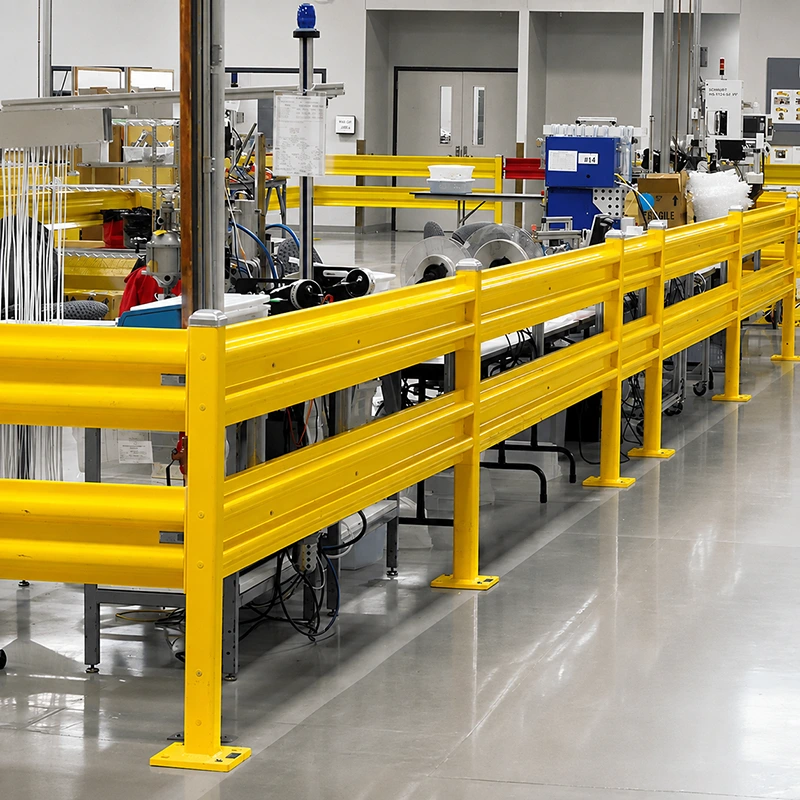
Corrugated rail and a bolted base take the hit, not the slab
The W-beam profile is not a flat plate. The wave does the same job a folded sheet does in any steel structure: it stiffens the section so the rail resists bending rather than folding flat on contact. The rail is expected to deform locally after a real impact; the run behind it is designed to stay standing and serviceable. That matters in a yard, because a struck rail can then be unbolted panel by panel and replaced without cutting out an entire section or shutting a route for a welding crew. Load transfer is spread through the 160 × 160 mm guardrail base plate into multiple expansion anchors, so the demand is not concentrated on one bolt at the point of impact.
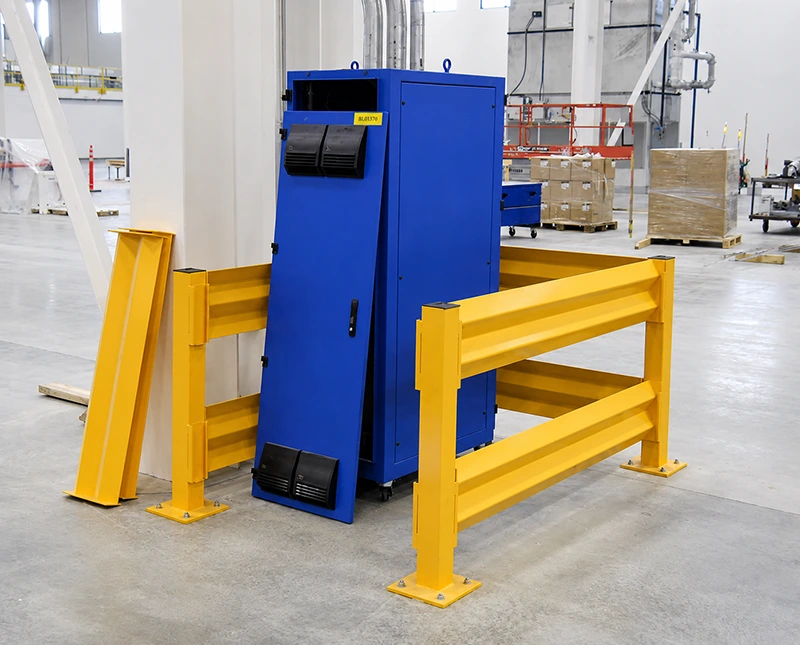
Lift-out panels keep access from becoming a hole
The fastest way to get a barrier removed is to block a route that operations genuinely needs — a reefer plug point, a lashing gang position, a maintenance gate or a temporary crane access. Because the system is assembled from discrete components — post, base plate, rail panel, bracket, end cap — a section can be specified as lift-out, lifted clear when access is required and dropped back into the same post pair afterwards. The same modular logic lets one specification cover a 40-metre trunk route, a two-panel corner at a control cabinet and a short 680–1,140 mm filler where a run will not divide evenly. No site welding, no cutting, no repainting a cut end.
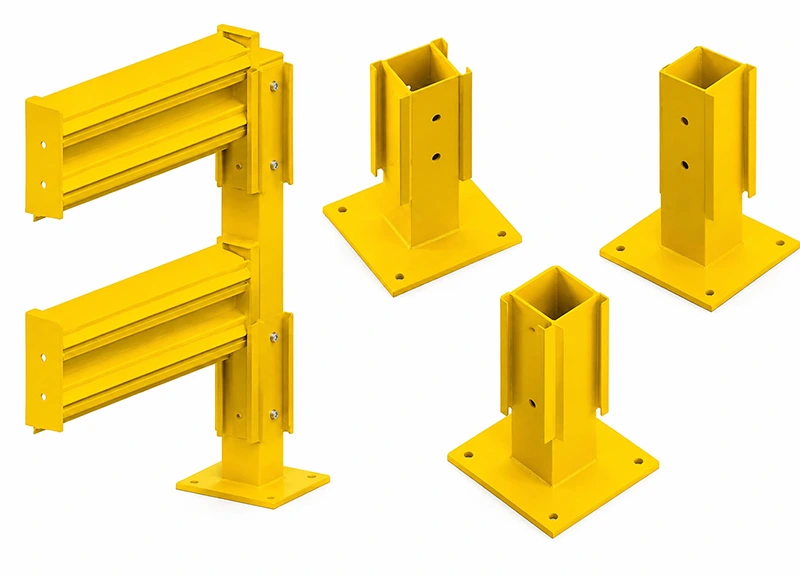
Where to Close the Line First
- Vehicle trunk routes against pedestrian walkways. A double-rail corrugated guard rail on the walkway edge gives pedestrian-vehicle separation a physical boundary instead of a painted strip, with yellow safety coating and optional reflective tape for low-light and wet conditions.
- Tally and checking areas beside straddle carrier lanes. Tally clerks stand still while 60-tonne-class machines move. A 1,000 mm double-rail run around the stand position keeps the person inside the steel, not inside a turning radius.
- Reefer racks, gensets, control cabinets and lighting pillars. These are the assets a reversing or turning chassis finds first; a single-rail or double-rail guard rail perimeter protects the asset and removes the repair downtime from the plan.
- Terminal tractor park rows and empty handler work zones. Custom length guardrail panels line up parking rows and work bays without cutting and welding under a live yard.
- Interchange gates where external drivers arrive. A short anchored run with a lift-out section defines the boundary for hauliers who have never seen your internal routes.
Set the priority by exposure: any location where a person stands with no steel between them and a moving machine is the first place to build.
Drawing Set and Base-Plate Schedule
Send your yard layout, the trunk routes you want to seal, and the slab detail along them. We will come back with a module layout, the custom length panels needed to close each run, the base-plate and anchor positions, and the finish options for the lighting conditions in that part of the terminal. Anchor sizing and slab adequacy should be confirmed against your own structural and load requirements before order — this is an industrial guard rail, not a highway barrier, and no third-party crash test is claimed for it.
Stop Waiting for the Next Incident
Yard safety does not improve because the next near-miss was caught on camera. Put steel between the machine and the person, then keep the sensors as the outer warning layer. Tell us the route and we will price the guardrail run for it.