RU
RU  EN
EN  DE
DE  PT
PT  JA
JA  ES
ES  IT
IT 

As a system integrator, you live by the deadline. You design sophisticated автоматизированные производственные линии and seamless интеграция робототехники layouts, only to see the project stall during the final “physical” phase. Why? Because traditional machine guarding is often an afterthought that doesn’t fit the reality of your site.
Stop treating safety barriers as just commodity steel. Discover how a modular, engineered промышленные защитные ограждения system can integrate directly with your ПЛК logic, eliminate on-site welding, and accelerate your final commissioning by 30%.
The Hidden Cost of the “Last Mile” in System Integration
For most turnkey solution providers, the most painful hours are spent on the factory floor just days before the client acceptance test. You have your KUKA or FANUC robots calibrated, and your Siemens ПЛК logic is sound. But then your electrical engineers hit a wall: the safety fence.
With generic fencing, mounting a sensitive safety interlock often involves a drill, a tap set, and a lot of frustration. Drilling into finished steel posts on a clean shop floor creates metal shavings that threaten your Оборудование с ЧПУ and electronics. Worse, a hand-drilled mounting hole rarely offers the precision needed for modern RFID safety switches to align perfectly. If the door sags or the switch is 1mm off, the machine won’t start. You lose hours diagnosing “faulty sensors” when the real culprit is poor mechanical integration.

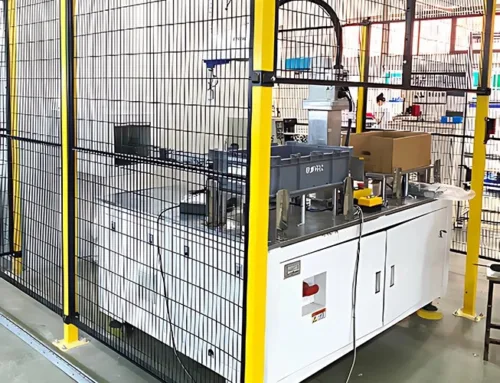
Standardized brackets eliminate the need for on-site drilling for safety interlocks.
The Solution: Pre-Engineered Interlock Carriers
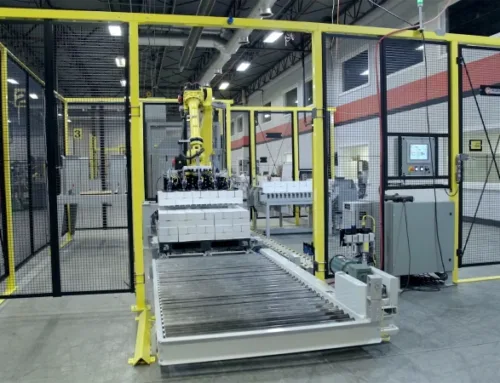
Высокоценные промышленные защитные ограждения systems, like Mdfence, treat the fence as part of the machine, not part of the building. By utilizing pre-engineered “Interlock Carriers,” you get a dedicated, factory-precision mounting interface for major brands like Omron or Pizzato. This means your team can mount the switch in minutes using standard fasteners, with zero drilling and zero dust. It transforms a crude construction task into a clean assembly process, protecting the integrity of your роботизированные рабочие ячейки.
Why “Cut-to-Fit” is Killing Your Profit Margins
In the Automotive Industry Association standards, precision is everything. Yet, many integrators still rely on fencing that requires an angle grinder to adapt to the facility’s columns or cable trays. Every time your installer cuts a panel on-site, you compromise the порошковое покрытие, inviting corrosion and violating the aesthetic standards expected in high-end автомобильное производство.
A true modular system utilizes a matrix of panel widths—ranging from 200mm to 1500mm—combined with adjustable fixing brackets. This allows you to navigate the complex “real world” geography of a factory floor—dodging existing конвейеры or structural beams—without modifying the hardware. For a project manager, this predictability is invaluable. It means the installation timeline you quoted is the timeline you actually achieve.

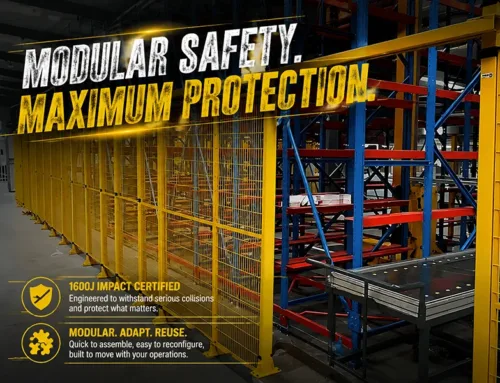
Robust Q235 Carbon Steel construction ensures long-term durability in harsh environments.
Liability Transfer: The Value of TUV Certification
When you hand over the keys to a turnkey solution, you are also handing over liability. If a robot arm throws a workpiece and it penetrates the guard, your design is liable. Using a fence built from generic углеродистая сталь Q235 is a start, but can you prove it works?
Partnering with a supplier that holds TUV certification for impact resistance provides an essential layer of legal insulation. It validates that the welding process, the 60x60mm post strength, and the framed mesh panel integrity have been tested against high-joule impacts. This isn’t just about safety; it’s about confidence. It allows you to present a certified compliance file to your end-user’s safety officer, smoothing the path to final sign-off and payment.
Часто задаваемые вопросы
1. Can the fencing system integrate with my existing Siemens or Rockwell PLC safety loops?
Yes. The system is mechanical but is designed with specific “Interlock Carriers” that accommodate standard safety switches from major electronic manufacturers, making physical integration with your PLC control loop seamless.
2. How does the system handle uneven floors in older factories?
The system uses adjustable fixing clips that can slide up and down the posts. This allows you to align the mesh panels perfectly level even if the concrete floor has significant variances, without needing shims or custom fabrication.
3. Is the powder coating durable enough for a chemically active environment?
Absolutely. The panels undergo a rigorous surface treatment process and are powder coated to automotive-grade standards. They are tested to pass ISO 9227 salt spray tests, ensuring they resist corrosion even in harsh industrial atmospheres.
4. What if I need a non-standard height for a robotic welding cell?
While standard heights are available for quick delivery, the system is fully modular. We can provide custom post heights (e.g., 2440mm) to ensure full containment of welding sparks or flying debris, complying with specific risk assessment requirements.
5. Do you provide CAD models for my layout design?
Yes. We support “Design for Automation.” You can send us your floor plan, and we can return a detailed CAD layout of the fencing, complete with a Bill of Materials, ensuring it fits your specific machine footprint before you order.