RU
RU  EN
EN  DE
DE  PT
PT  JA
JA  ES
ES  IT
IT 

Passing a safety audit isn’t just about ticking boxes; it’s about sleeping well at night knowing your workforce is protected. In the high-stakes environment of **automotive manufacturing** and heavy industry, a generic wire mesh fence is often a liability in disguise.
When an accident happens, the first thing auditors ask for is proof of compliance. Discover how a TUV-certified **industrial safety fencing** system provides the verifiable **impact resistance** and engineering integrity needed to meet global **machine safety** standards like ISO 14120 and OSHA requirements.
The Difference Between “A Fence” and “A Safety System”
Many facility managers make the mistake of treating **machine guarding fence** as simple facility maintenance hardware. But in the eyes of an ISO auditor, it is a critical safety component. The difference lies in certification. Does your current guarding have a documented “impact rating”?
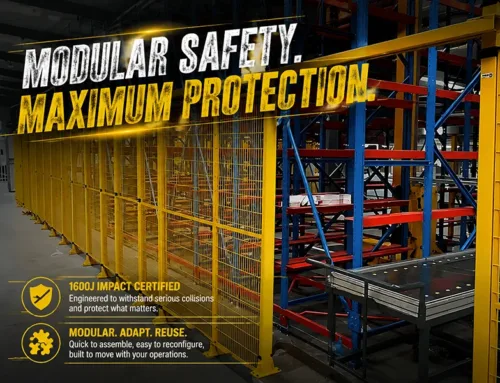
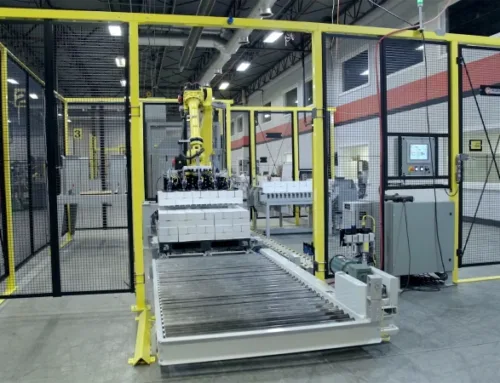
Our systems are rigorously tested to withstand high-joule impacts, simulating the catastrophic failure of a **robot work cell** or a projectile ejected from a machine. By using high-grade **Q235 carbon steel** with a fully welded frame construction, we ensure that the barrier contains the hazard. This TUV certification is your “insurance policy,” providing the documentation you need to prove due diligence in your **risk assessment**.
Don’t Let the Guard Be the Hazard
It’s a cruel irony when a worker gets injured by the very device meant to protect them. Cheaply manufactured fencing often suffers from sharp wire ends, rough weld spots, or peeling paint that can cause cuts and abrasions. This not only harms your team but signals a lack of quality culture to visitors.
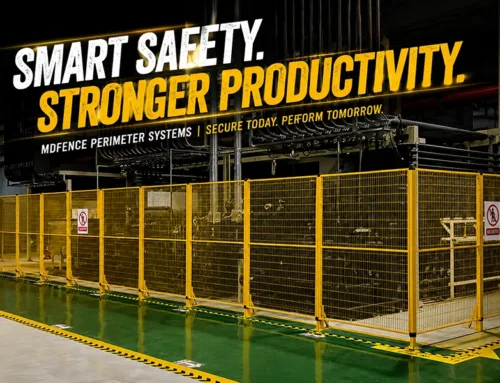
We utilize a “flat welding” technique that eliminates sharp edges, ensuring the mesh surface is smooth and safe to touch. Combined with a premium **powder coating** finish (tested to ISO 9227 for corrosion resistance), the system maintains its high-visibility safety yellow (RAL 1023) and black aesthetic for years, reinforcing a culture of safety and excellence in your plant.

Reliable mechanical and electronic locking options ensure strict access control.
Closing the Loop on Access Control
The weak point of any perimeter guard is the door. If a gate can be easily bypassed or if the lock fails, the entire system is compromised. Standard padlocks or generic latches are often insufficient for high-risk zones requiring frequent access.
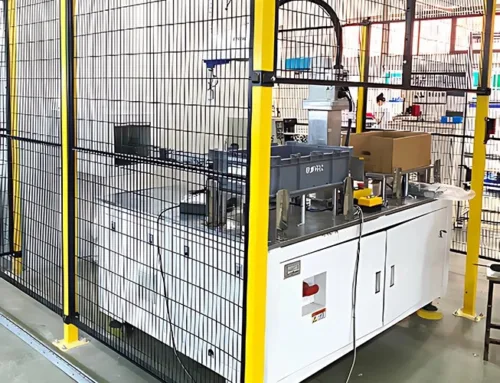
Our modular system integrates seamlessly with advanced **safety interlock** switches and captive key systems (like Jimmy Proof locks or **electronic safety switches**). We provide pre-engineered mounting plates for major brands, ensuring that your **robot safety fencing** acts as a true physical-electronic shield. Opening the gate physically breaks the safety circuit, stopping the machine instantly and preventing unauthorized restarts.
Часто задаваемые вопросы
1. What specific certifications do your safety fences hold?
Our systems are certified by TUV to meet ISO 14120 standards for impact resistance. This third-party verification ensures that the fencing performs as claimed under stress, crucial for high-risk industrial applications.
2. How do you prevent corrosion in harsh industrial environments?
We use a high-quality Q235 steel base treated with a specialized powder coating process. This finish has passed ISO 9227 salt spray testing, proving its ability to resist rust and chemical degradation in challenging factory conditions.
3. Can the system be integrated with our existing Lockout/Tagout (LOTO) procedures?
Yes. Our door handles and locking mechanisms are designed to support standard padlocks and multi-lock hasps, making them fully compatible with strict OSHA Lockout/Tagout protocols for maintenance safety.
4. Is the fencing suitable for welding areas?
Absolutely. For welding cells, we can replace standard mesh panels with solid steel sheet panels or UV-filtering polycarbonate to protect passersby from harmful arc flash and sparks, while maintaining the same modular post structure.
5. Do I need to weld anything on-site during installation?
No. The entire system is designed for bolt-on assembly using secure expansion anchors and specialized fixing clips. This eliminates the fire risk of on-site welding and allows for clean, dust-free installation in operational facilities.