RU
RU  EN
EN  DE
DE  PT
PT  JA
JA  ES
ES  IT
IT 

Your turnkey automation project is on a tight deadline. The last thing you need is a generic fence that requires on-site cutting, welding, and custom brackets just to mount a safety interlock. These “minor” modifications burn hours, introduce risks, and can cause nuisance trips that jeopardize your client’s production uptime. There is a more integrated way.
For system integrators in heavy industry, particularly in automotive manufacturing and robotics, защита машин is more than just a barrier—it’s a critical component of the machine’s control system. When a project involves high-speed robotic arms, welding stations, or CNC machining centers, the durability of your guarding system is non-negotiable. But durability alone doesn’t solve the integration challenge. A truly effective solution must be robust enough to withstand the plant floor and intelligent enough to simplify your commissioning process.
Beyond the Barrier: The Problem with Traditional Fencing in Automation
In a typical automation project, the safety fence is often treated as a commodity. This leads to predictable—and costly—problems. You specify a perimeter, get panels and posts, and the real work begins on-site. Your technicians spend valuable time drilling into posts, fabricating custom mounting plates for safety interlock switches, and hoping the alignment is perfect. When the door sags even slightly after a few hundred cycles, the interlock misaligns, triggering a fault in the PLC. The result? Your client’s line stops, and you get an urgent call to fix a problem that should never have existed.
This approach turns a safety component into a project bottleneck. It adds un-budgeted hours, compromises the integrity of the powder-coated finish (inviting corrosion), and creates a point of failure in an otherwise precisely engineered automated cell.
Engineered for Integration: A System Built for Durability and Uptime
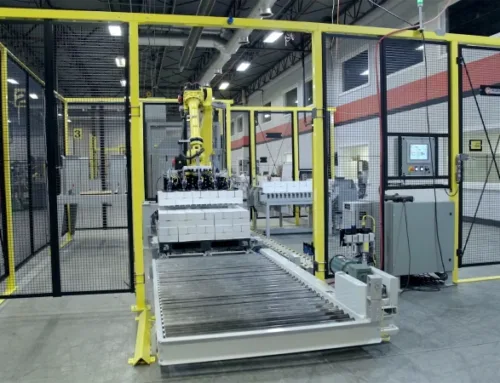
A modern Защитные ограждения для роботов system must be designed from the ground up to solve these challenges. The Mdfence system shifts the paradigm from a collection of parts to a fully integrated solution, built on a foundation of industrial-grade durability.
The Structural Backbone: Heavy-Duty by Default
The system’s resilience starts with its materials and construction. We don’t offer a “heavy-duty” upgrade; it’s the standard.
- Q235 Carbon Steel Construction: The entire structure is built from high-strength Q235 carbon steel, ensuring it can handle the rigors of a demanding industrial environment.
- 60 x 60mm Posts: With a substantial 2.0mm wall thickness, these posts provide a rigid frame that resists deflection and vibration, anchored securely by four M10 expansion bolts.
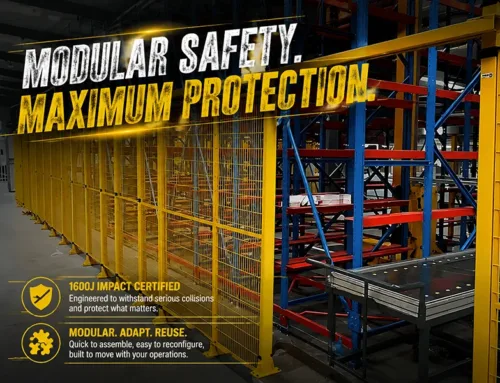
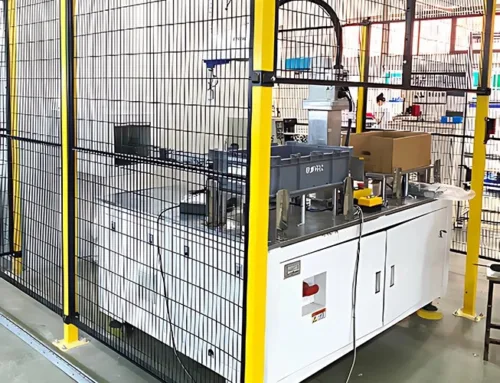
- Fully Welded Панели в рамке: Unlike simple mesh, our standard panels feature a 20 x 30mm tubular steel frame. The wire mesh is flat-welded inside this frame, creating a single, monolithic unit with exceptional Ударопрочность. This design is crucial for containing component failures or protecting assets from forklift traffic.

The Integration Game-Changer: The Safety Interlock Carrier
This is where the system saves you real engineering and installation time. Instead of forcing you to fabricate solutions on-site, we provide a pre-engineered Safety Interlock Carrier. This isn’t just a bracket; it’s a dedicated mounting solution designed to seamlessly integrate with industry-standard safety switches.
Our carriers, like the KKCK-LCK-B-D4NL-SET, are purpose-built for specific models from leading brands like Omron (e.g., D4NL series) and Pizzato. This means:
- No On-Site Drilling or Welding: The carrier bolts directly to the pre-drilled holes on Mdfence posts and doors.
- Perfect Alignment, Every Time: It guarantees precise alignment between the switch body and the actuator, eliminating the primary cause of nuisance trips.
- Plug-and-Play Commissioning: Your technicians can mount and wire the safety circuit in a fraction of the time, confident that the mechanical interface is reliable. The fence is no longer a passive barrier but an active, pre-validated node in your safety system.

From CAD to Crated: A Predictable Workflow for System Integrators
The final piece is a process that respects your project timelines. We work directly from your CAD layout designs to deliver a complete, kitted solution. Every post, panel, door, and fastener is accounted for. Whether your project requires a wide-span Раздвижная дверь for material access or a multi-panel hinged door for personnel, the system is configured to your exact specifications.
This modular, pre-engineered approach transforms machine guarding from an unpredictable variable into a reliable deliverable. You can allocate your skilled technicians to more complex tasks, reduce on-site assembly time, and deliver a safer, more robust, and more reliable automation system to your client. That’s how you protect not only people and machinery, but also your project’s profitability and your company’s reputation.

Frequently Asked Questions for Automation Integrators
1. Can your system accommodate custom layouts with odd angles or elevations?
Absolutely. Our system is fully modular. We work from your specific CAD drawings, like the complex layout for the GBM Automation project, to provide panels and posts that fit your exact footprint, including 45-degree corners or custom-height sections needed to clear conveyors or other equipment.
2. How does the system stand up to weld splatter or cutting fluids?
All steel components are finished with a durable порошковое покрытие that provides excellent corrosion and chemical resistance. For applications with intense welding, we can substitute the standard mesh panels with solid steel sheet panels to completely contain sparks and splatter.
3. What is the typical lead time from approved drawing to delivery?
Lead times vary based on project complexity and scale, but because we utilize a standardized, modular system, our production process is highly efficient. For a detailed timeline on your specific project, please contact our experts with your layout drawings.
4. Do you provide documentation to support our risk assessment process?
Yes. Our system is designed and tested to meet or exceed key international safety standards, including ISO 14120. We can provide compliance documentation and test certifications (e.g., TUV impact resistance) to support your validation and CE marking process.
5. What if our client’s safety spec calls for a different brand of interlock switch?
While we offer pre-engineered carriers for popular brands like Omron and Pizzato, our design team can readily develop a custom carrier solution for virtually any industry-standard interlock switch as part of the project scope. Our goal is to provide a truly integrated solution, regardless of the specified components.