RU
RU  EN
EN  DE
DE  PT
PT  JA
JA  ES
ES  IT
IT 

|
Setting up a perimeter around a new 6-axis robotic welding station or an automated assembly line rarely happens in a perfect square. Pillars, AGV paths, and existing CNC machining centers force system integrators into awkward 45-degree angles or tight geometric layouts. Custom fabricating these corners on-site means hot work permits, welding sparks near sensitive electro-optical elements, and days of delayed cycle times. It’s time to engineer a smarter boundary. |
The Nightmare of Non-Standard Floor Plans in Automotive Automation
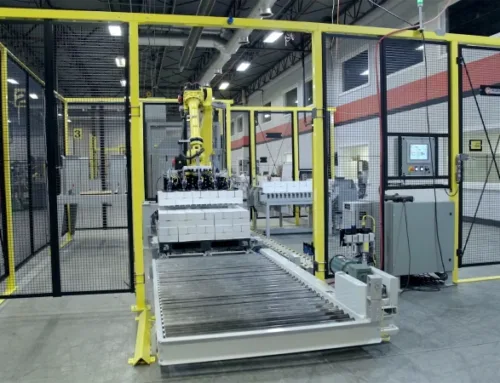
In the world of turnkey solutions and robotics integration, floor space is premium real estate. When designing an промышленное защитное ограждение for a high-speed mechanical assembly machine, you are often forced to navigate around existing infrastructure.
The Old Way (Pain): Standard chain-link or frameless wire mesh sags terribly at the corners. When a forklift navigating a tight warehouse AGV path clips a poorly supported corner, the entire line of fencing warps, exposing the robotics integration zone. Furthermore, if you rely on cheap 2″x2″ (50x50mm) mesh, OSHA and ISO 13857 reach-distance standards force you to push the fence 33.5 inches (850mm) away from the mechanical assemblies. At a corner, this massive safety radius eats up critical space needed for material handling.

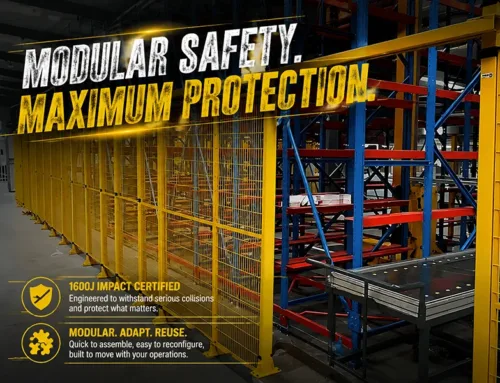
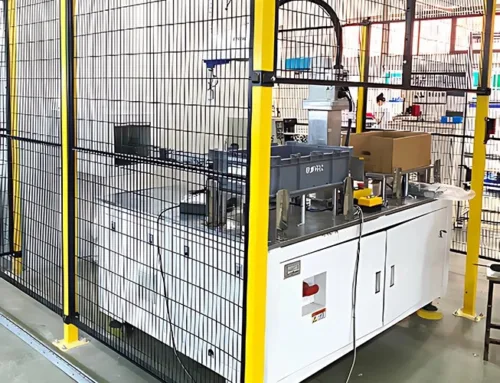
Why Our Logic Works: Mdfence utilizes high-tensile Q235 carbon steel panels with a full 0.8″x1.2″ (20x30mm) tubular frame. This framed architecture ensures out-of-plane stiffness, meaning the corner won’t act like a hammock when struck. More importantly, our 0.8″x3.9″ (20x100mm) “finger-safe” mesh allows you to install the защитные ограждения для роботов just 4.7 inches (120mm) from the moving hazards.
The Actual Benefit: Your corners stay rigid under a 1600 Joules impact—capable of stopping a 220 lbs object moving at 12.4 mph (like a dropped engine block or a stray AGV). By shrinking the safety distance, you reclaim nearly 10 sq. ft. of floor space per automated cell, allowing tighter AGV routing and higher machine density on your factory floor.
Integrating Safety Interlocks at Awkward Angles
The Old Way (Pain): You’ve managed to weld a custom 45-degree corner for a dedicated manufacturing line, but now the EHS manager requires an Omron D4NL or Pizzato safety interlock on the corner access door. Your technicians end up drilling into painted posts on-site. This leaves metal shavings dangerously close to your servo motors and vision systems, and the exposed steel rusts within months, failing your next ISO quality audit.

Why Our Logic Works: The modular 2.4″x2.4″ (60x60mm) posts in our machine guarding systems use a bolt-on connection node system. We provide pre-engineered mounting plates (lock carriers) that attach directly to the structural steel without a single drilled hole. Whether the door sits on a standard 90-degree corner or a custom bend, the mechanical alignment remains flawless.
The Actual Benefit: True plug-and-play integration. When the corner door opens, the mechanical separation instantly forces the Safe Torque Off (STO) circuit, communicating directly with your Siemens or Rockwell PLC. No drill shavings, no misaligned switches causing frustrating false machine stops, and a durable RAL 1023 powder-coated finish that maintains its integrity in harsh automotive welding environments.
Workflow Comparison: Corner Customization
| Implementation Phase | Traditional On-Site Welding | Modular Ограждение машин для обеспечения безопасности |
|---|---|---|
| Design & Layout | Guesswork on the floor; manual cutting of panels to fit odd angles. | 3D CAD verified layouts; precise BOM generation for 45° or custom angles. |
| Установка | Requires hot work permits. Sparks threaten pneumatics and electro-optical elements. | Cold assembly with wrenches only. Zero sparks, zero production downtime. |
| Maintenance & Reconfiguration | Corner must be destroyed with an angle grinder to move equipment. Zero asset recovery. | Unbolt the connection clips in 10 minutes. 100% asset reusability when the line changes. |
Frequently Asked Questions (FAQs)
1. How does the system handle non-90-degree corners around CNC machining centers?
Our modular system utilizes adjustable connection clips and standardized panel widths that can be configured to create 45-degree angles or other custom geometric layouts, seamlessly routing around existing infrastructure without on-site cutting.
2. Will customizing a corner layout compromise the 1600 Joules impact resistance?
No. Because our panels feature a full 20x30mm welded tubular frame, the out-of-plane stiffness is maintained regardless of the layout angle. The impact force is still efficiently transferred through the heavy-duty 60x60mm posts down to the concrete anchors.
3. Can we integrate safety light curtains at the corner of the perimeter?
Absolutely. We offer dedicated 80x80mm light curtain posts with internal cable routing. These can be positioned at the corners of your robotic work cells to create a seamless hybrid of physical and electro-optical safeguarding.
4. What is the minimum distance a corner panel can be placed from a moving robotic arm?
Thanks to our 20x100mm finger-safe mesh design, which exceeds ISO 13857 requirements, the fencing can be installed as close as 4.7 inches (120mm) from the hazard, drastically reducing the overall footprint of your automation cell.
5. Do customized corner configurations require longer lead times for system integrators?
No. We achieve custom layouts using our vast inventory of standard flat-pack modular components. By engineering the layout in CAD beforehand, we ship off-the-shelf parts that assemble into your specific corner requirements, ensuring rapid deployment.