RU
RU  EN
EN  DE
DE  PT
PT  JA
JA  ES
ES  IT
IT 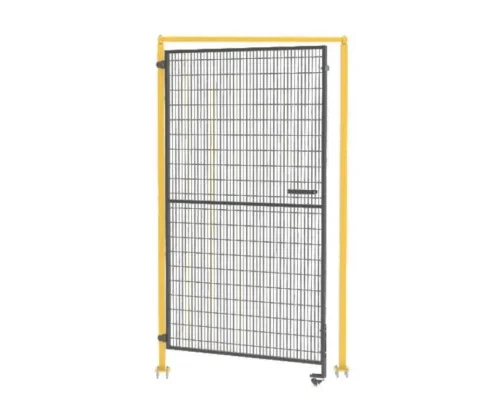

|
Designing a turnkey robotic welding cell or a high-speed assembly line? You already know the headache: generic perimeter guards either fail the ISO 14120 impact test or leave your technicians drilling holes on-site to mount Pizzato/Omron interlocks, eating up your integration margin. You need a modular barrier that drops into your CAD layout flawlessly, eliminates nuisance PLC trips, and passes EHS audits on the first try. |
Does Industrial Safety Fence Panels Meet ISO 14120 in Robotic Cells?
The “Before”: The Nightmare of Flimsy Perimeter Guarding
In an active automotive welding station or a CNC machining center, a rogue AGV or a forklift carrying engine blocks occasionally taps the perimeter. Cheap, frameless wire mesh buckles immediately. Worse, the lack of structural rigidity causes door hinges to sag over time. When a door sags by just a few millimeters, the safety interlock switch misaligns. The PLC registers a fault, drops the Safety Torque Off (STO), and halts your entire high-speed mechanical assembly line. Your MTTR (Mean Time To Repair) skyrockets simply because maintenance has to manually lift the door to reset the switch.
The “Why It Works”: Engineered for 1,600J ISO 14120 Compliance
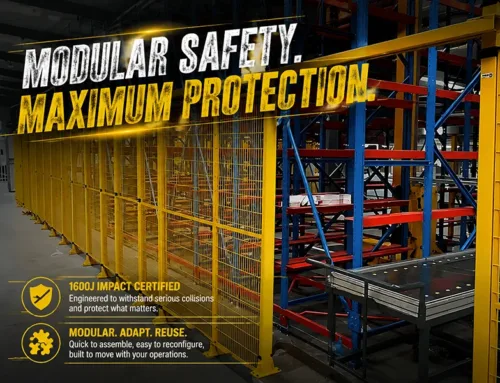
Mdfence промышленное защитное ограждение panels aren’t just bent wire; they are a passive energy dissipation system built from Q235 carbon steel. The panels feature a fully welded 20x30mm tubular frame, and the 60x60mm posts are anchored with heavy-duty M10 expansion bolts.

This architecture is TUV-certified to withstand a 1,600 Joule impact—equivalent to stopping a 220 lbs object moving at 12.4 mph. Instead of snapping and creating flying shrapnel near your automated equipment, the steel plastically deforms, absorbing the kinetic energy and maintaining the integrity of the hazard zone.
The “After”: Plug-and-Play Integration & Zero Nuisance Trips
Because the framed doors maintain absolute rigidity, your hinges never sag. Pre-engineered lock carriers allow you to bolt safety switches directly to the posts without on-site hot work (welding or grinding). The result? Perfect switch alignment, zero false STO triggers, and maximum Overall Equipment Effectiveness (OEE) for your automation systems.

ISO 13857 & The “Finger-Safe” Mesh Advantage in Tight Layouts
The “Before”: Wasting Premium Floor Space
Floor space in a modern automotive plant is premium. Standard 2×2 inch (50x50mm) mesh requires a safety distance (Sr) of up to 33.5 inches (850mm) from the hazard zone to prevent operators from reaching the pinch points of a 6-axis robot during teach pendant operations. This dead space chokes your AGV pathways and limits your layout options.
The “Why It Works”: Precision Slotted Mesh
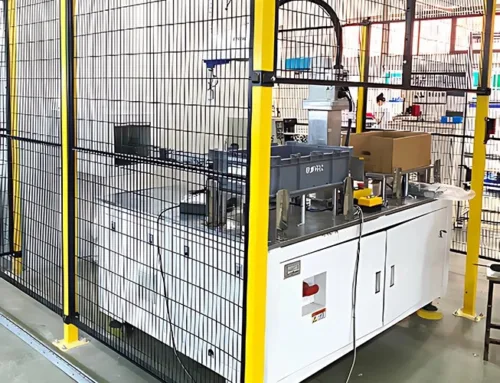
We utilize a 20x100mm (approx. 0.78″ x 3.9″) slotted mesh profile. This narrow gap restricts penetration strictly to the fingertips, exceeding standard ISO 13857 requirements for upper and lower limb reach distances.
The “After”: Reclaiming Your Factory Footprint
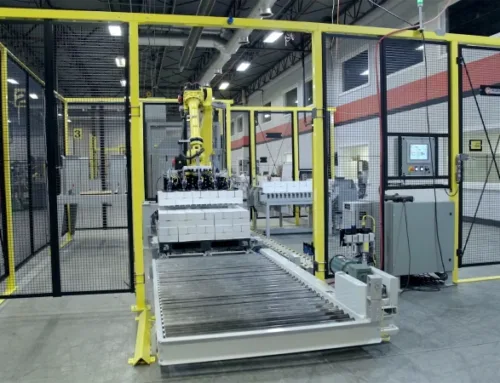
You can legally position your защитные ограждения для роботов as close as 4.7 inches (120mm) to the hazard. This reclaims nearly 3 square feet of floor space per machine, allowing you to widen your logistics corridors for material handling or deploy an additional CNC lathe in the exact same footprint.
Handling Complex Assembly Systems with Modular Door Configurations
The “Before”: Bottlenecks During Tooling Changeovers
Standard swing doors fail when you need to move a massive stamping die into a cell, or when a forklift needs a 15-foot wide opening without a top track obstructing the mast. Modifying standard fences on the fly compromises the structural integrity and invalidates your safety compliance.
The “Why It Works”: Heavy-Duty Folding & Sliding Systems
The system relies on highly modular door configurations, including heavy-duty folding doors supported by caster wheels and rigid overhead beams that keep the posts perfectly parallel.

The “After”: Seamless Material Flow
Operators can easily open massive access points (up to 15.7 feet / 4800mm wide) for overhead cranes or material handling equipment during tooling changeovers, then securely lock the machine guarding systems back into the PLC safety loop in seconds, ensuring zero downtime in production scheduling.
Frequently Asked Questions (Automotive & Robotics Integration)
1. How does this fencing handle weld spatter in an automotive welding station?
The Q235 carbon steel components feature an electrostatic powder coating (RAL 9005/1023) that passes ISO 9227 salt spray tests, offering high resistance to weld sparks. For direct spatter zones, solid steel or flame-retardant polycarbonate (PC) panels can be seamlessly swapped into the modular frames.
2. Can we mount our own Pizzato/Omron interlocks directly to the posts?
Yes. We provide pre-engineered lock carriers (e.g., KKCK-LCK-B-D4NL-SET) specifically designed with precise hole patterns for mainstream safety switches. This eliminates the need for on-site drilling and ensures perfect alignment for your STO circuits.
3. Does the 1,600J impact rating meet OSHA and ANSI/RIA R15.06 requirements for industrial robots?
Absolutely. The 1,600 Joules rating exceeds the typical foreseeable impact forces calculated in standard robotics risk assessments, ensuring full compliance with ISO 14120, OSHA machine guarding directives, and ANSI/RIA R15.06 standards.
4. What happens if a forklift damages a panel near the conveyor line?
Thanks to the bolt-on fixing rings, a damaged panel can be unbolted and replaced by a single maintenance technician in under 10 minutes (Cold Assembly). No cutting, no welding, and no need to shut down adjacent operational cells.
5. Are CAD/STP files available for our factory layout design?