RU
RU  EN
EN  DE
DE  PT
PT  JA
JA  ES
ES  IT
IT 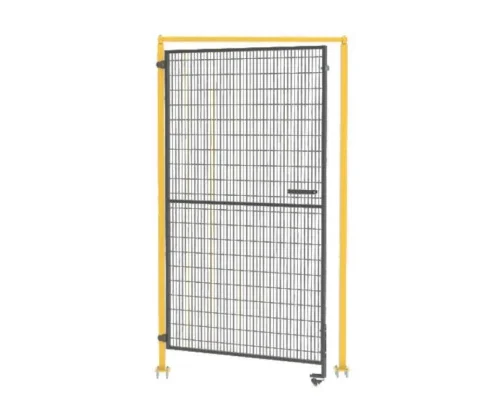

When integrating industrial robots into a high-speed mechanical assembly line, failing a safety audit over a floor-level clearance error is a costly nightmare. If a dropped CNC machined part rolls out, or an operator slides a foot under the barrier near a welding station, the resulting machine shutdown and system reset can derail your entire production schedule. You need a physical barrier engineered for precise, compliant floor clearances.
The Hidden Danger at Floor Level: Why the Bottom Gap Matters in Automation
In an automated production line, the focus is often on preventing operators from reaching over or through a barrier. However, the sweep space—the gap between the floor and the bottom edge of the промышленные защитные ограждения—is a critical compliance zone.
The Pain Point: Standard, low-cost welded fences often come with fixed-height mounting tabs. When installed on uneven concrete floors typical in heavy manufacturing plants, these fixed tabs create erratic bottom gaps. If the gap exceeds 150 mm to 180 mm (approx. 6 to 7 inches), it violates ISO 13857 and OSHA standards. A gap this large allows a worker’s ankle or leg to slip into the hazard zone of a moving AGV path or a robotic palletizer. Furthermore, it fails to contain heavy mechanical assemblies or cutting tools that might drop and roll out of a CNC machining center, creating a severe tripping hazard for the floor staff.

How Mdfence Solves the Floor-Level Clearance Challenge
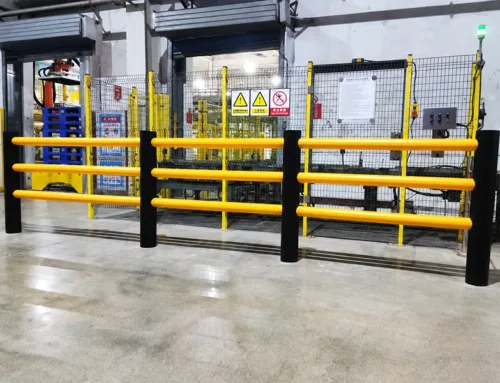
Our Logic: The Mdfence modular system eliminates the “fixed gap” problem. Instead of pre-welded tabs, our Q235 carbon steel posts utilize an adjustable lower fixing ring system. During installation, your integration team can slide the fixing ring up or down the 60x60mm post before locking it in with M8 flange bolts. Additionally, our specialized post base protective covers securely shield the M10 expansion bolts, ensuring no sharp edges exist at the floor level.
Actual Benefit: You pass the EHS safety audit on the first try. The installation team can easily compensate for uneven floors, maintaining a strict, compliant 150 mm (6-inch) gap across the entire perimeter of the robotics layout. This precise clearance is small enough to prevent ankle reach and contain dropped turning parts, yet high enough to allow facility cleaning equipment to pass underneath without snagging.
Combining Bottom Gap Compliance with the 20x100mm Mesh Advantage

Controlling the bottom gap is only half the battle. The mesh size of your machine guarding systems directly dictates how much valuable floor space you must sacrifice. Generic fences use 50x50mm mesh, which allows fingers to pass through easily.
| Размер ячейки | Hazard Reachability | Required Safety Distance (ISO 13857) | Impact on Plant Layout |
| 50×50 mm (Generic) | Hand/Arm can pass through | Up to 850 mm (33.5 Inches) | Wastes massive floor space |
| 20×100 mm (Mdfence) | Only fingertip access | As close as 120 mm (4.7 Inches) | Saves approx. 1 sqm per machine |
By utilizing our 20x30mm framed panels with a high-density 20x100mm mesh, you can install the physical barrier just 120 mm away from the robotic pinch points. This “finger-safe” design is crucial for system integrators trying to fit complex assembly systems into tight automotive plant layouts.
Ensure ISO 13857 Compliance – Get a Free Layout Review
Maintaining Clearances at Access Points: The Sagging Door Problem

The Pain Point: When designing a dedicated manufacturing line, doors are the weakest link for gap compliance. Over time, heavy single-hinge doors sag under their own weight. A door that sags not only drags on the floor, making it hard for operators to open, but it also creates an uneven, non-compliant gap at the hinge side. Worse, a sagging door misaligns the safety interlock switch, causing the PLC to generate false “door open” signals, unexpectedly triggering a Safety Torque Off (STO) and halting the entire production line.
Our Logic: Mdfence double hinged door systems are engineered for structural integrity. For wide spans (up to 3000mm) required for forklift or tooling access, we integrate heavy-duty caster wheel kits at the bottom corner of the door panels. This transfers the cantilevered weight directly to the floor.
Actual Benefit: The door remains perfectly level for thousands of cycles. The sweep gap remains consistent and compliant underneath the doors, and your Omron D4NL or Pizzato safety interlocks remain perfectly aligned on our pre-drilled lock carriers. Your защитные ограждения для роботов operates smoothly without causing phantom machine stops.
Real-World Application: Securing a Turnkey Automation Project

A leading system integrator recently deployed a complex robotics layout for an automotive parts supplier. The facility had significant floor leveling issues. Traditional welded fences would have resulted in bottom gaps exceeding 8 inches in certain zones, which would have triggered an immediate failure during the final risk assessment.
By utilizing the Mdfence modular CAD layout (shown above), the engineering team pre-planned the exact post locations. During installation, the cold-assembly process allowed workers to micro-adjust the lower fixing rings on every single post. They successfully maintained a strict 150 mm (approx. 6-inch) maximum gap across the entire perimeter, seamlessly integrating with the safety light curtains at the conveyor infeed/outfeed points, and delivering the turnkey solution ahead of schedule.
Frequently Asked Questions (Automotive & Automation Integration)
1. What is the standard maximum gap allowed under a robotic safety fence?
According to general ISO 13857 and OSHA guidelines, the sweep gap is typically maintained between 150 mm and 180 mm (approx. 6 to 7 inches) to prevent ankle/leg reach and contain dropped parts, while still allowing for industrial floor cleaning.
2. How does Mdfence handle uneven concrete floors in older manufacturing plants?
Our system uses adjustable fixing rings rather than pre-welded tabs. This allows the installation team to slide the mesh panels up or down the 60x60mm Q235 steel posts to match the floor’s contour, ensuring a consistent, compliant gap.
3. Does the 20x100mm mesh size affect the overall footprint of our robotic welding cell?
Yes, significantly. The 20mm narrow slit prevents finger penetration, legally allowing you to install the fence as close as 120 mm (4.7 inches) from the hazard, compared to 850 mm for standard 50x50mm mesh. This drastically reduces the required floor space for the cell.
4. Will wide access doors sag and violate the bottom gap clearance over time?
No. For wide spans required in automotive assembly, we utilize heavy-duty framed doors equipped with caster wheel kits or overhead bearing rails (for sliding doors). This prevents sagging, maintains the precise bottom gap, and ensures safety interlocks stay aligned.
5. How do we route PLC and servo motor cables without compromising the bottom gap?
Cables should be routed through dedicated floor cable trays or overhead drops. The Mdfence system’s adjustable bottom gap allows you to set the clearance exactly at 150 mm to clear standard low-profile floor cable covers without violating the maximum sweep standard.