RU
RU  EN
EN  DE
DE  PT
PT  JA
JA  ES
ES  IT
IT 
 |
Your robot integration project is on a tight deadline. The last thing you need is a week of on-site welding, grinding, and repainting just for the safety guarding. Stop burning hours and budget with outdated fabrication methods that create more problems than they solve. |
From Hot Work Permits to Hand Tools: The Problem with Welded Guarding in Automation Projects
As an automation system integrator, you live and die by the project timeline. You’ve meticulously planned the robot installation, the PLC programming, and the end-of-arm tooling. But then comes the Ограждение для защиты машин—often treated as an afterthought, yet capable of derailing your entire schedule.
The traditional approach of welding a custom fence on-site is a recipe for budget overruns and delays. It starts with applying for a hot work permit, a bureaucratic hurdle that halts all other activity in the area. Then comes the unavoidable chaos: the screech of angle grinders, the shower of sparks, the hazardous fumes, and the inevitable damage to the newly poured concrete floor. Once the structure is finally welded, it needs to be ground smooth and repainted, a messy process that never quite matches a factory finish and is the first thing to rust.
Worse yet, this manual process introduces massive variability. A slightly misaligned post means the gate won’t close properly, causing nuisance trips on the safety interlock. A weld spatter can interfere with a sensor. These small, frustrating issues during the final commissioning phase are what turn a profitable project into a marginal one.
The Bolt-On Advantage: A System Designed for Integrators
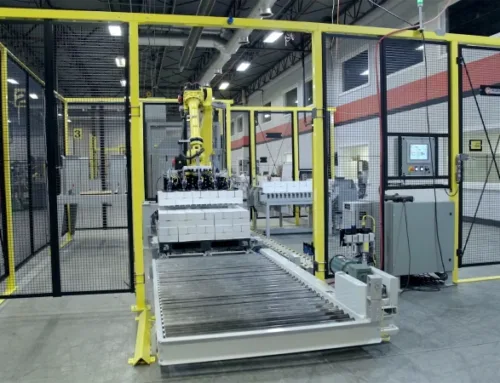
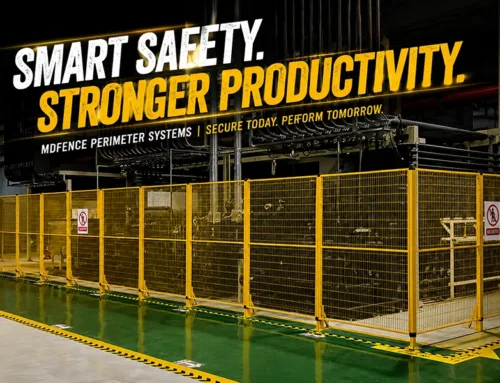
Instead of treating safety guarding as a construction project, what if it was just another component to be assembled? That’s the core principle behind the Mdfence bolt-on защитные ограждения для роботов system. We’ve replaced the welder and grinder with a single Allen wrench, transforming the installation process from a liability into a competitive advantage.
Engineered for Precision, Assembled in Hours
Our entire system is built on a foundation of pre-fabricated, standardized components that eliminate on-site guesswork.
- High-Tensile Q235 Steel Posts: The backbone of the system is the 60x60mm (approx. 2.36″ x 2.36″) square post, anchored directly to the concrete floor with M10 expansion bolts. Every post is identical, ensuring perfect alignment and structural integrity that meets ISO 14120 requirements.
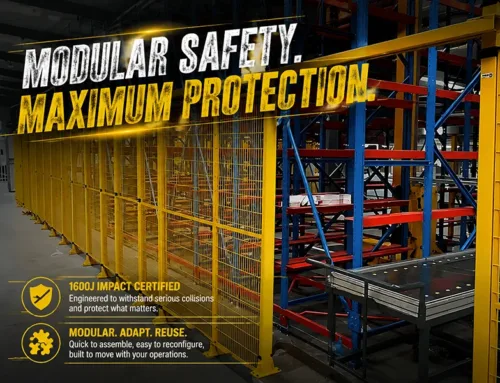
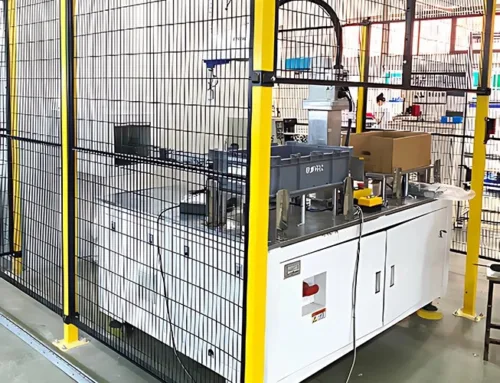
- Full-Frame Mesh Panels: Unlike flimsy, frameless mesh that deforms under impact, our panels feature a 20x30mm (approx. 0.79″ x 1.18″) fully welded tubular steel frame. This creates a rigid, impact-resistant barrier that protects both personnel and high-value automation assets from unexpected events.
- Captive Fastening System: Panels connect to posts using a high-strength steel clip and M8 bolts. This simple, non-destructive connection preserves the integrity of the powder-coated finish, preventing rust and maintaining a professional aesthetic that your clients will appreciate.

The result is a clean, quiet, and incredibly fast “cold assembly” process. A two-person team can erect over 150 feet of fencing in a single day, allowing your mechanical and electrical teams to work in parallel, not in sequence.
Seamless Integration with Your Safety PLC
We understand that a modern Ограждение для защиты машин is more than a physical barrier; it’s an active part of the machine’s control system. That’s why our system is designed for seamless integration with the safety components you already use.

Our modular door systems—whether hinged, sliding, or folding—come with pre-engineered mounting plates. This dedicated Safety Interlock Carrier is designed to accept industry-standard switches from brands like Omron, Pizzato, Schmersal, or Allen-Bradley right out of the box. No on-site drilling, tapping, or fabricating of flimsy brackets. This guarantees perfect alignment and reliable operation from day one, eliminating the frustrating “door closed but interlock open” faults during commissioning.
The Payoff: Faster Commissioning and Future-Proof Flexibility
Adopting a bolt-on assembly approach fundamentally changes your project’s financial and operational equation.
The most immediate benefit is a dramatic reduction in installation time—often up to 70% compared to welding. This isn’t just a labor saving; it means your robot cell is powered on, programmed, and producing parts days, or even weeks, ahead of schedule.

Furthermore, the модульная конструкция makes the guarding system a reusable asset, not a sunk cost. When the production line is retooled or moved in two years, the entire fence can be unbolted and reconfigured in the new layout with 100% asset recovery. This is a powerful value proposition for your end clients, who are constantly adapting to changing market demands. By specifying a modular, bolt-on system, you deliver a solution that is not only safer and faster to install but also smarter and more adaptable for the long term.
Часто задаваемые вопросы для системных интеграторов
1. Can you provide 3D CAD models (e.g., STP files) for our design team?
Absolutely. We provide a complete library of 3D models for all our components. This allows your engineers to import the entire fence system directly into their master layout, check for clearances with robots and conveyors, and generate a precise Bill of Materials, eliminating any on-site surprises.
2. Our robot cell has a 45-degree corner and needs to go around existing columns. How do you handle complex floor plans?
Our system is inherently designed for this. We use adjustable corner brackets and variable-length panels to accommodate any angle or obstruction. Simply provide your layout drawing, and our team will configure a kit that precisely matches your geometry without any need for on-site cutting or modification.
3. Are your interlock mounting plates truly universal? We often use Pizzato or Schmersal safety switches.
Yes. Our standard Safety Interlock Carrier plates are pre-drilled with mounting patterns that accommodate the most common safety switches in the industry, including Omron, Pizzato, Schmersal, and Rockwell Guardmaster. For less common models, we can provide custom-drilled plates to ensure a perfect fit.
4. What is the typical lead time for a standard 20′ x 30′ robot cell guarding kit?
Because our system is based on stocked, standardized components, lead times are significantly shorter than custom-fabricated solutions. For standard yellow/black kits, we can often ship within 5-7 business days, helping you meet even the most aggressive project timelines.
5. The robot cell will be located near a high-traffic forklift aisle. How does the system withstand impacts?
The system is engineered for industrial environments. The Q235 steel construction is designed to absorb significant impact energy by deforming plastically (bending) rather than fracturing and creating secondary projectiles. For high-risk areas, we also offer heavy-duty posts and optional floor-level bump rails to provide additional protection against forklift collisions.