RU
RU  EN
EN  DE
DE  PT
PT  JA
JA  ES
ES  IT
IT 

|
Your next robot cell deployment is on a tight schedule. The end-client specified Pizzato interlocks, the layout has multiple conveyor pass-throughs, and floor space is at a premium. Is your machine guarding solution an asset that accelerates commissioning, or a liability that causes delays and fails the final EHS audit? |
Compliance guide for robot safety fence standards.
For an automation system integrator, specifying a защитное ограждение для роботов is far more than just “putting up a cage.” It’s a critical component of the safety circuit that directly impacts project timelines, the final cell footprint, and your ability to pass a rigorous end-user acceptance test. A misstep in compliance with standards like ISO 14120 or ANSI/RIA R15.06 isn’t just a technical error; it’s a source of costly rework, project delays, and potential liability. This guide cuts through the complexity, focusing on the engineering principles that transform a simple barrier into a compliant, efficient machine guarding system.
ISO 14120: The Mandate for Structural Integrity
Before any discussion of access or integration, the first question is always: “Will the guard hold?” The ISO 14120 standard for machine guarding moves beyond simple demarcation and demands proven structural integrity. This is the foundation of your risk assessment.
The Before: The “Generic Barrier” Gamble
Many generic fencing solutions, particularly frameless “weldmesh” panels, offer no verifiable performance data. In the event of a robot malfunction or a dropped workpiece from the end-of-arm tooling (EOAT), these lightweight barriers can deform, detach, or fail entirely, turning the guard itself into a projectile. This poses a catastrophic risk during the Site Acceptance Test (SAT) and beyond.
The Engineering Logic: A System Built to Absorb Energy
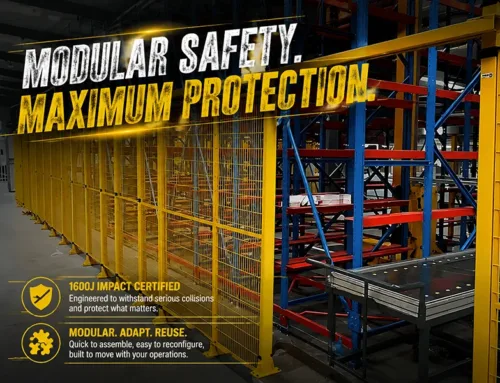
A compliant system is engineered to withstand predictable forces. Our Системы защиты машин are built from high-tensile Q235 carbon steel, featuring a full 20x30mm tubular frame around every panel. This isn’t just for aesthetics; the frame acts as a load-bearing structure. When an impact occurs, the force is distributed from the steel wire mesh, through the full welds, to the frame, and then to the robust 60x60mm posts anchored to the floor. This design is certified to withstand an impact of 1600 Joules—equivalent to stopping a 220 lbs (100kg) object moving at 12.5 mph (20 km/h)—ensuring the hazard remains contained.

ISO 13857: Winning the Battle for Floor Space
In modern manufacturing, every square foot of floor space is a valuable asset. The placement of your safety fence, dictated by ISO 13857 (Safety Distances), can either optimize your layout or consume your budget.
The Before: Wasted Space with Large Mesh
A common mistake is using fencing with large, 50x50mm (2″x2″) openings. According to ISO 13857, if a person’s fingers can pass through the opening, the safety distance required can be as much as 850mm (approx. 33.5 inches) to prevent limb access. For a typical robot cell, this can waste over 35 square feet of high-value production space, forcing wider aisles and a less efficient layout.
The Engineering Logic: “Finger-Safe” by Design
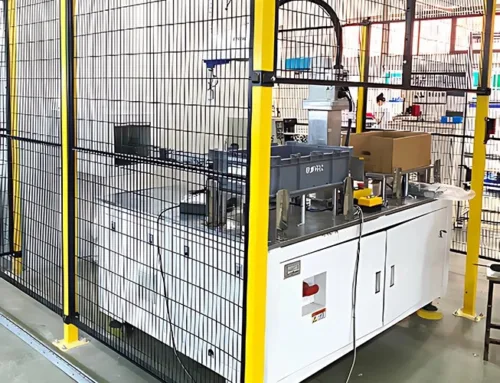
The key is to minimize the opening size. Our standard panels use a 20x100mm mesh aperture. This narrow 20mm (approx. 0.78 inch) opening is small enough to prevent fingers from passing through, only allowing the fingertips to enter. This physical limitation legally allows the защитное ограждение to be installed just 120mm (approx. 4.7 inches) from the hazardous motion. By simply choosing the correct mesh, you can reclaim over 700mm of depth along the entire perimeter of your installation.
The Integration Game-Changer: Seamless Safety Circuit Integration
A modern robot fence is an active component of the control system. The most frequent point of failure and frustration for integrators is the interface between the physical gate and the electronic safety circuit (e.g., STO, PLe/SIL3).
The Before: The Field-Drilling Nightmare
You’ve ordered a fence, but the client has specified an Omron D4NL or Pizzato FS series trapped-key interlock. The standard fence arrives with no provision for mounting. Your technicians are now forced to drill and tap holes on-site, a process that is time-consuming, imprecise, and permanently compromises the powder-coated finish, leading to corrosion and an unprofessional appearance that can be flagged during EHS audits.
The Engineering Logic: Pre-Engineered Interlock Carriers
We’ve eliminated this bottleneck. Our system includes a range of pre-engineered mounting plates and lock carriers specifically designed for industry-standard safety switches. These components bolt directly onto our doors and posts in pre-drilled locations. This “plug-and-play” approach ensures perfect alignment, maintains the integrity of the corrosion-resistant coating, and makes wiring clean and efficient. You’re not just buying a fence; you’re buying a pre-validated integration solution.

Whether the application calls for a simple slide bolt, a heavy-duty mechanical lock, or a fully integrated PLe-rated electronic interlock, the mounting process is standardized and repeatable, saving hours of custom fabrication on the shop floor.
The Time-Saver: Installation Without Hot Work Permits
Project schedules are unforgiving. The last thing you need is to shut down an adjacent production line to accommodate welding, grinding, and painting for your new safety fence.
The Before: The Delays of On-Site Fabrication
Traditional welded guarding requires a “hot work” permit, a designated fire watch, and extensive cleanup. The process is slow, hazardous, and generates fumes. Furthermore, the resulting structure is permanent. When the production line is reconfigured in two years, that entire investment is cut apart and sent to the scrap bin.
The Engineering Logic: Modular, Cold Assembly
Our entire system is designed for rapid, “cold” assembly. Panels, posts, and doors are connected using high-strength steel brackets and bolts. A two-person team equipped with basic hand tools can install over 150 feet of fencing in a single day. There are no sparks, no fumes, and no need to disrupt nearby operations. This modularity also means the system is an asset, not a consumable. It can be easily disassembled, reconfigured, and redeployed as your client’s production needs evolve, offering a 95% asset reuse rate.

True compliance is more than a sticker or a certificate. It’s an engineered system designed to integrate seamlessly, install quickly, and perform reliably under industrial conditions. By focusing on these core principles, you can de-risk your automation projects and deliver a safer, more efficient, and more valuable solution to your clients.
Часто задаваемые вопросы
Q1: What is the primary difference between ISO 14120 and ISO 13857 for robot fencing?
A: Think of it this way: ISO 14120 governs the fence’s strength and physical integrity—its ability to withstand an impact without failing. ISO 13857 governs its geometry and placement—how close you can safely place the fence to a hazard based on the size of its openings (like the mesh). A compliant system must satisfy both.
Q2: How does your system accommodate conveyors or material pass-throughs?
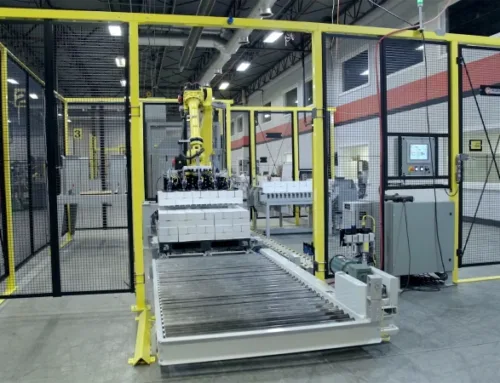
A: We offer customized “tunnel guard” solutions. These are specially fabricated panels that create openings for conveyors while strictly adhering to ISO 13857 standards for reach-over or reach-through distances. This ensures materials can pass freely, but personnel cannot access the hazard zone.
Q3: How do I select the right door type (hinged, sliding) for my robot cell?
A: The choice depends on access frequency and available space. Hinged doors are simple and cost-effective for personnel access where swing space is not an issue. Sliding doors are ideal for wider openings or in tight corridors where a swinging door would block a walkway. We also offer multi-panel folding doors for very large openings with limited clearance.

Q4: Do you provide 3D CAD models for layout planning?
A: Absolutely. We provide a complete library of 3D STP models for all our components. This allows your design engineers to import the entire fencing system directly into their master layout (in SolidWorks, AutoCAD, etc.) to verify clearances, plan interlock placement, and generate an exact Bill of Materials (BOM) before ordering.
Q5: What is the typical lead time for a standard robot cell guarding kit?
A: We maintain a significant inventory of standard components (posts, panels, and door kits in standard yellow/black). For standard configurations, we can often ship within a few business days to meet urgent project deadlines. Custom-sized panels or special colors will have a longer lead time, which will be quoted on a per-project basis.