RU
RU  EN
EN  DE
DE  PT
PT  JA
JA  ES
ES  IT
IT 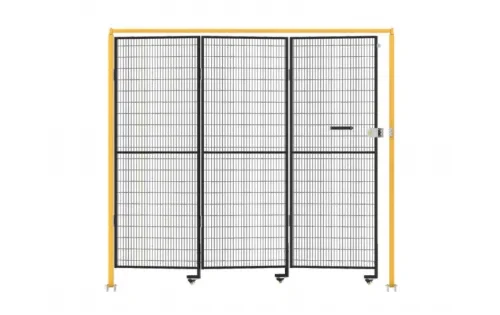

|
Think your welded fence was cheap? Wait until a forklift clips it, shutting down your entire robotic cell for a day. Or when an EHS audit flags your safety distances, forcing a costly redesign. The real cost of ‘cheap’ fencing isn’t the price tag—it’s the hidden expenses in unplanned downtime, wasted floor space, and compliance failures. |
The True Cost of Factory Fencing: 4 Hidden Expenses You’re Overlooking
When budgeting for a new automation cell, the Промышленные защитные ограждения is often treated as a commodity. A quick call to a local welding shop for some “angle iron and mesh” seems like the most cost-effective route. But for plant managers and automation integrators, this initial “saving” is often the down payment on future headaches, including production stoppages, compliance risks, and wasted capital.
The most significant savings don’t come from the initial purchase price, but from understanding the total cost of ownership. Here’s how a strategic approach to Охрана машин can directly save you money.
1. Save on Real Estate: Reclaim Valuable Floor Space
The Pain Point (Before): You’re installing a new FANUC robot cell, but your factory floor is already packed. Using standard 50x50mm mesh fencing, ISO 13857 safety standards dictate a large safety distance (potentially up to 850mm / 33.5 inches) to prevent operators from reaching through the openings. This “dead space” around every machine eats into your production area, constricting forklift paths and potentially preventing the addition of future equipment.
The Engineering Logic (Why it Works): The cost-saving mechanism isn’t magic; it’s physics and compliance. The Mdfence system utilizes a 20x100mm (approx. 0.8″ x 3.9″) narrow mesh aperture. This “finger-safe” design physically prevents an operator’s hand from reaching past the knuckles. According to ISO 13857, this small opening allows the physical barrier to be placed as close as 120mm (4.7 inches) from the hazard.

The Financial Gain (After): For a typical 10m x 5m (33′ x 16′) robotic cell, reducing the safety distance from 850mm to 120mm on all sides reclaims over 20 square meters (215 sq. ft.) of high-value production floor. In a high-cost manufacturing region, this translates to thousands of dollars in annual lease savings or, more importantly, provides the space needed to add another value-producing asset to your line.
2. Save on Downtime: From Hours of Repair to Minutes of Swapping
The Pain Point (Before): An AGV miscalculates its path and collides with your welded-in-place guarding. The panel is bent, the weld is cracked, and the entire cell is now unsafe and non-operational. Your maintenance team has to schedule a hot work permit, bring in cutting torches and welders, and spend half a shift grinding, welding, and repainting. Your OEE (Overall Equipment Effectiveness) plummets as thousands of dollars in production are lost.
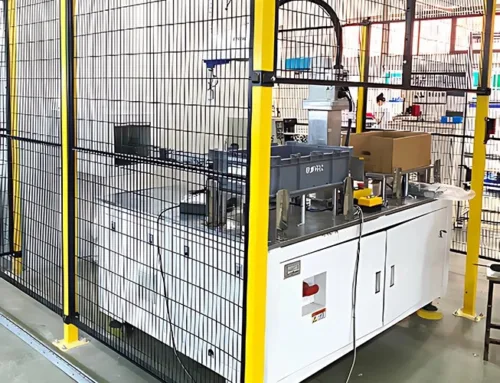
The Engineering Logic (Why it Works): Mdfence is a fully modular, bolt-together system. The带框网片 (framed panels) are secured to 60x60mm Q235 steel posts using high-strength steel brackets. There is no welding. This is a “cold assembly” system. If a panel is damaged, the repair process is simple: loosen four bolts with a standard Allen key, remove the damaged panel, slot in a new one, and tighten the bolts.

The Financial Gain (After): What was a 4-hour, multi-person repair job involving hot work becomes a 10-minute, single-person task. Your Mean Time To Repair (MTTR) is slashed by over 95%. For an automotive assembly line where downtime can cost upwards of $10,000 per minute, this rapid recovery capability pays for the entire fencing system in a single incident.
3. Save on Future Capital: Your Fence is an Asset, Not a Liability
The Pain Point (Before): Your production needs have changed. The line you installed two years ago needs to be reconfigured to accommodate a new product model. The custom-welded guarding you paid for is now an obstacle. The only way to remove it is with a plasma cutter, turning your initial investment into a pile of scrap metal destined for the recycling bin. You now have to pay for its removal *and* buy a completely new fence.
The Engineering Logic (Why it Works): Сайт модульная конструкция means your Защитные ограждения для роботов is not a permanent fixture. It’s a reconfigurable asset. Like industrial-grade LEGOs, the standardized panels, posts, and doors can be disassembled, moved, and reassembled in a new configuration to match your evolving production layout.
The Financial Gain (After): Instead of a 100% loss, you achieve over 95% asset reuse. When your production line changes, your safety system changes with it. The cost of reconfiguring your line is dramatically reduced because you’ve eliminated the need to repurchase and reinstall your machine guarding. This long-term flexibility delivers a far superior ROI compared to any “cheaper” welded alternative.
4. Save on Integration & Compliance: Pass Audits the First Time
The Pain Point (Before): You’ve purchased a generic fence and now your controls engineer is trying to mount an Omron D4NL safety interlock switch. The post is round, or the mesh is flimsy. They spend hours fabricating a custom bracket, drilling into the post, and compromising its powder-coated finish, inviting rust. During the final EHS audit, the inspector flags the setup as non-compliant, delaying the multi-million dollar line’s commissioning.
The Engineering Logic (Why it Works): A professional safety system is designed for integration. Mdfence provides pre-engineered mounting plates and kits specifically for industry-standard interlocks from brands like Omron, Pizzato, and Schmersal. The robust, framed door panels prevent sagging, ensuring the switch and actuator remain perfectly aligned, preventing nuisance trips that kill productivity.

The Financial Gain (After): You save dozens of hours of skilled labor costs in fabrication and rework. More importantly, you eliminate the risk of project delays. The system is designed to meet standards like ISO 14120 and ANSI/RIA R15.06 out of the box, ensuring you pass safety audits the first time and get your production line running on schedule.
Frequently Asked Questions for Automation Professionals
1. How does your fencing integrate with safety interlocks like Omron or Schmersal?
Our system is designed for seamless integration. We offer pre-engineered mounting plates and complete lock carrier kits (e.g., KKCK-LCK-B-D4NL-SET) that are purpose-built for specific models from leading brands like Omron, Pizzato, and Schmersal. This eliminates the need for on-site drilling or custom fabrication, ensuring a clean, compliant, and reliable installation that ties directly into your machine’s safety PLC.
2. What is the certified impact rating and what does it mean in a real-world scenario?
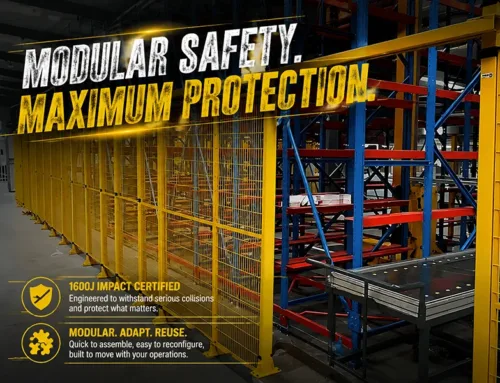
Our Mdfence system is certified to withstand an impact of at least 1600 Joules. To put that in perspective, it’s equivalent to stopping a 100 kg (220 lbs) object moving at 20 km/h (12.4 mph). This means it can effectively contain a workpiece ejected from a machine or withstand a significant collision from a cart or AGV, preventing a catastrophic failure that could injure personnel or damage the high-value robotic asset inside.
3. Can the system be modified on-site if our layout has unexpected obstructions?
Absolutely. This is a core advantage of the modular system. Since the system is assembled with bolts, not welds, adjustments are simple. We offer panels in various standard widths, and custom-sized panels can be made. If you encounter an unforeseen column or conduit, you can easily use a different combination of panel sizes to work around it without compromising the system’s integrity.
4. We have conveyors passing through the work cell. How do you handle that?
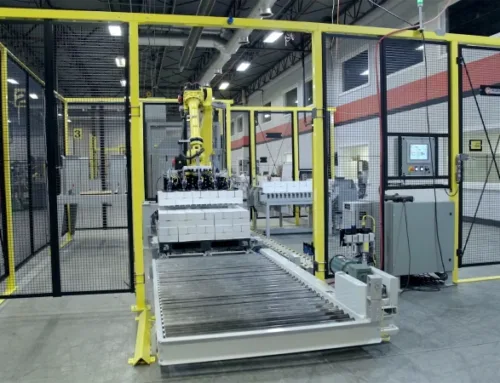
We address this common requirement with custom-fabricated tunnel guards or cutouts in the mesh panels. These openings are designed to precisely match the conveyor’s profile while strictly adhering to the safety distance requirements of ISO 13857. This allows your product to pass through seamlessly while ensuring the opening is too small for personnel to gain access to the hazardous area.
5. How exactly does the 20x100mm mesh save factory floor space compared to standard 50x50mm mesh?
The savings are dictated by the international safety standard ISO 13857, which defines safe distances based on the size of openings in a guard. A larger 50x50mm mesh allows a person’s arm to reach further through, so the standard mandates the fence be placed far away (e.g., 850mm) from the hazard. Our 20mm narrow aperture is considered “finger-safe,” meaning only the tip of a finger can pass. The standard recognizes this and allows the fence to be placed much closer (just 120mm), directly converting wasted buffer space into usable production floor.