RU
RU  EN
EN  DE
DE  PT
PT  JA
JA  ES
ES  IT
IT 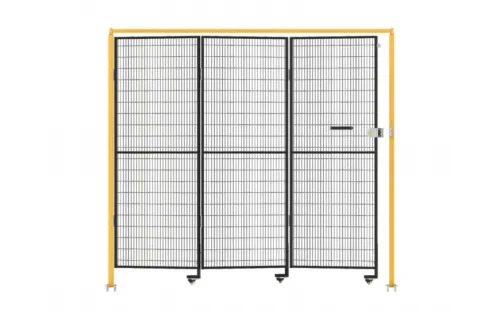

|
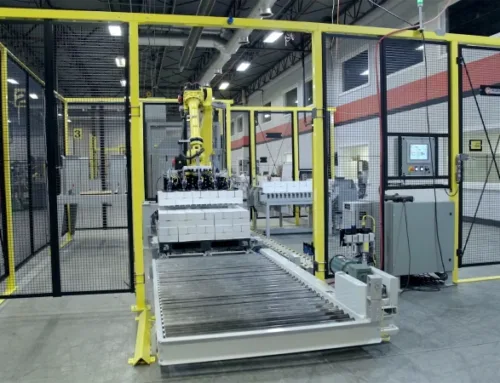
In the high-speed world of automotive assembly and robotic integration, a “generic” fence is a liability. When a 6-axis arm is moving at 2m/s, or an AGV drifts off-path, you don’t need a visual deterrent—you need a certified physical barrier. Stop welding on your factory floor and start integrating modular protection that adapts to your cycle times. |
The Material Debate: Why Q235 Carbon Steel Wins on the Assembly Line
When specifying Ограждения для безопасности машин for automotive or heavy industrial applications, the choice of material dictates both safety and longevity. While aluminum extrusion looks sleek in a cleanroom, it often fails the durability test in a heavy welding shop or metal stamping environment.
For robotic work cells (like those integrating Fanuc or KUKA arms), the gold standard is **Q235 Carbon Steel**. Why? Because in a “lights-out” manufacturing environment, impact resistance is non-negotiable.

Q235 Carbon Steel post cross-section showing 2.0mm wall thickness for maximum impact resistance.
Our Mdfence system utilizes **60 x 60mm posts** with a substantial wall thickness (up to 2.0mm). Unlike lighter gauge materials that dent or buckle upon accidental contact with a forklift or pallet jack, this structural steel absorbs energy. Furthermore, the **Powder Coating** (typically RAL 1023 Yellow for high visibility) is not just aesthetic; it provides essential corrosion resistance against cutting fluids and oils common in CNC machining centers.
Framed Panels vs. Unframed Mesh: Structural Integrity
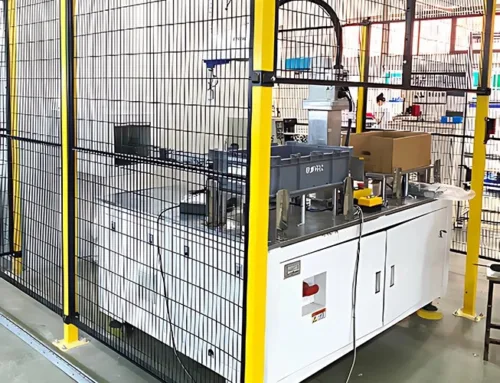
In the “Build to Print” world of system integration, rigidity matters. Many budget solutions offer “unframed” wire mesh that acts like a net. In contrast, a **Framed Panel** system uses a 20x30mm steel tube frame welded directly to the mesh.

This frame does two things for your layout:
1. **Prevents Deformation:** It stops the mesh from bowing out if a heavy part is ejected from a machine.
2. **Simplifies Assembly:** It allows for a flat-welded construction, eliminating sharp edges that could snag an operator’s PPE or gloves during maintenance checks.
Integration with Safety Interlocks: The “Hidden” Cost of Installation
As a System Integrator, your biggest labor sink isn’t erecting the fence—it’s the electrical integration. Drilling holes into hardened steel posts to mount a Pizzato or Omron switch on-site is a waste of skilled labor hours.
We have solved this by engineering the **Safety Interlock Carrier**. This isn’t just a bracket; it’s a pre-configured mounting solution compatible with major safety switch brands.

By using our Safety Interlock Carrier (like the KKCK-LCK series), your electrical team can mount the interlock and the actuator tongue in minutes, not hours. This ensures that your **Robot Safety Fencing** is fully integrated into the PLC’s emergency stop circuit without delaying the site acceptance test (SAT).
Door Configurations for Space-Constrained Cells
In automotive plants, floor space is premium real estate. A standard swing door might block an AGV path or a walkway. Selecting the right door mechanism is crucial for maintaining workflow efficiency.
The Sliding Door Advantage
For wide openings required to move large jigs or automotive chassis in and out of a cell, a **Sliding Door** is often superior to a hinged option.

Our suspended sliding systems use a heavy-duty upper rail with bearings, ensuring smooth operation even after thousands of cycles. This is critical for “machine tending” applications where an operator opens the gate every few minutes.
The Folding Door Solution
When you need a massive opening (e.g., 15 feet / 4.8m) for forklift access but have zero swing space, the **Folding Door** system is the engineered answer.

This allows you to collapse the barrier completely, providing full access for maintenance on heavy robotic bases or conveyor motors, without disassembling the fence line.
Meeting Global Safety Standards (ISO 14120 & OSHA)
Ultimately, materials don’t matter if the system isn’t compliant. Your risk assessment demands adherence to ISO 14120 and ISO 13857 safety distances.
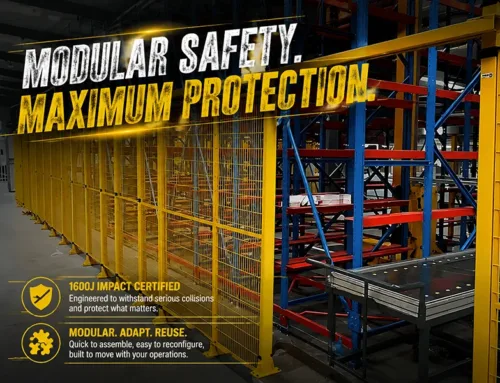
Our **Q235 Carbon Steel** system is TUV certified for Ударопрочность. This certification is your insurance policy. In the event of a catastrophic failure inside the cell (e.g., a robot throwing a payload), the fence is verified to contain the hazard, protecting personnel on the walkway.

The modular connection system, using Расширительные болты (M10 x 70mm) and adjustable fixing rings, allows for precise installation even on uneven concrete floors, ensuring no gaps exceed the allowable safety limits.
Часто задаваемые вопросы
1. Can this fencing withstand welding spatter in an automotive body shop?
Yes. Our Q235 steel panels feature a high-quality powder coating (GB/T9286-1998 standard) that resists heat and spatter adhesion better than standard paint. For high-intensity zones, we can also supply solid sheet steel panels to completely block sparks.
2. Is the system compatible with non-contact safety switches like Keyence or Sick?
Absolutely. Our modular Safety Interlock Carrier plates are designed with universal mounting patterns or can be easily modified to accept RFID and non-contact switches, ensuring seamless integration with your PLC safety logic.
3. How do we handle layout changes when the car model year changes?
This is the core benefit of Mdfence. Unlike welded angle-iron fences, our system is 100% modular. You can unbolt the fixing rings, relocate the posts, and reconfigure the panels to fit the new tooling layout without cutting or welding on site.
4. What is the standard height for robotic cells?
The industry standard is typically 2000mm (approx. 6.5 ft) to prevent reaching over. However, for high-reach robots, we offer custom heights up to 2440mm (8 ft) to comply with ISO 13857 reach-over calculations.
5. Do you offer “lock-out/tag-out” (LOTO) ready hardware?
Yes. Our slide bolt locks and handle mechanisms are designed to accommodate multiple padlocks, ensuring full OSHA compliance for maintenance personnel entering the hazardous zone.