RU
RU  EN
EN  DE
DE  PT
PT  JA
JA  ES
ES  IT
IT 

In a high-speed automotive assembly cell, a “blind” barrier is a liability. When a robotic arm faults or a pneumatic line bursts, your operators need visual confirmation instantly—without breaching the safety perimeter and triggering costly downtime. We engineer visibility directly into the structural integrity of your guarding.
The Operational Cost of “Black Box” Guarding
In modern automation, particularly within automotive body shops and Tier 1 component manufacturing, the Ограждения для безопасности машин serves two opposing masters: Isolation и Observation. You need to isolate the kinetic energy of a 6-axis robot, but you also need constant visual access to monitor servo status, hydraulic integrity, and material flow.
Solid steel barriers provide protection but turn your work cell into a black box. If a cycle is interrupted, an operator often has to open the gate—triggering the safety circuit and stopping the line—just to diagnose the issue. This adds unnecessary minutes to your Takt time. The solution lies in optimizing the mesh aperture and frame design to balance ISO 14120 compliance with maximum visual throughput.
Framed Mesh: Clarity Meets Impact Resistance
Visibility starts with the grid. Unlike polycarbonate screens that scratch, yellow, or become opaque from welding fumes and oil mist over time, steel wire mesh maintains visual clarity for the lifespan of the production line.
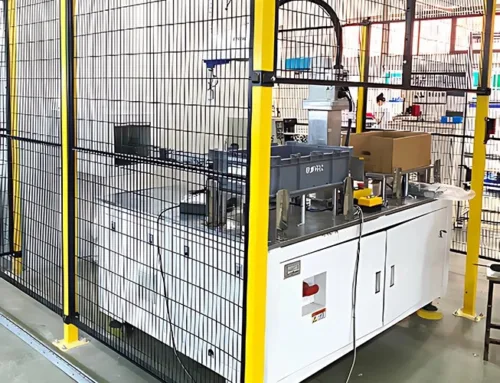
Our system utilizes a Панель в рамке design. The Q235 Carbon Steel wire is welded into a 20x100mm or 50x50mm grid. This specific spacing is critical: it is tight enough to meet safety distance calculations (preventing finger or hand encroachment) while open enough to allow operators to read gauges or check robot positioning from outside the danger zone.

Figure 1: The standard Framed Panel design maximizes visual pass-through while maintaining structural rigidity.
The darker RAL 9005 (Black) powder coating on the mesh is an intentional design choice used in the automotive industry. Unlike yellow or galvanized mesh, black mesh absorbs light reflections, allowing the human eye to focus через the fence to the lit equipment inside, rather than focusing on the fence itself.
Retrofitting an existing line?
We can match your existing footprint with modular panels that improve visibility without voiding your safety audit.
Active Monitoring at Entry Points
The most critical visual check often happens right at the access point. Whether it’s for material loading via AGVs or maintenance entry, the door system must not obstruct the view of the Lockout/Tagout (LOTO) verification points.
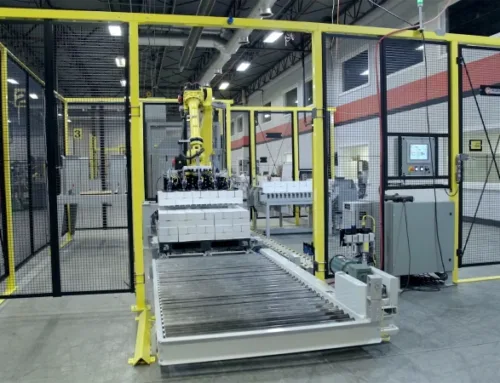
For tight layouts where swing radius is restricted, our Защитные ограждения для роботов system employs sliding doors constructed from the same high-visibility mesh as the perimeter. This ensures that even when the door is the primary interface, the operator has a clear line of sight to the “Safe” status indicators on the machine before attempting entry.

Figure 2: Single sliding door systems maintain the visual continuity of the perimeter.
Intelligent Hardware Integration
Visibility extends to the status of the safety system itself. A common failure point in generic fencing is the makeshift mounting of safety switches, which can become misaligned, leading to nuisance tripping.
Mdfence systems are designed with a dedicated Safety Interlock Carrier. We provide pre-engineered mounting kits for industry-standard switches like Omron D4NL or Pizzato. This ensures that the interlock is not only mechanically secure but also positioned where the LED status indicators are clearly visible to the operator from the outside, streamlining the reset process after an E-stop event.

Figure 3: Dedicated mounting points for mechanical locks and electronic safety switches ensure status visibility and reliability.
Conclusion: The Visible Advantage
In the automotive and automation sectors, Ударопрочность is non-negotiable, but it shouldn’t come at the cost of process oversight. By utilizing Q235 carbon steel framed mesh with optimized grid spacing and dark powder coating, Mdfence provides a barrier that protects your personnel while keeping your process fully transparent.
Часто задаваемые вопросы
Does the mesh size affect the required safety distance from the robot?
Yes. According to ISO 13857, the aperture size of the mesh dictates how far the fence must be from the hazard zone. A smaller mesh opening allows the fence to be placed closer to the machine, saving valuable floor space in your layout.
Why is black mesh recommended over yellow for visibility?
While safety posts are typically yellow (RAL 1023) to indicate caution, black mesh (RAL 9005) reduces glare and light reflection. This makes the mesh “disappear” visually, allowing operators to easily focus on the equipment inside the cell.
Can we install polycarbonate panels instead of mesh for welding cells?
Yes, we offer mixed panels. However, for welding cells, we recommend specialized welding curtains or steel plate lower sections to block sparks, combined with upper mesh sections to maintain visibility for overhead gantry systems or crane access.
Is the system compatible with existing Omron or Allen-Bradley safety switches?
Absolutely. Our Safety Interlock Carrier kits are engineered to accept most major third-party safety switches, eliminating the need for your integrators to fabricate custom brackets on-site.
How does the fence handle impact from a robotic arm collision?
The system is TUV certified for high impact resistance. The framed panel design, utilizing 20x30mm steel tubing and 3mm/4mm wire, is designed to contain debris and absorb energy, protecting personnel outside the cell from ejected parts or tool failures.