RU
RU  EN
EN  DE
DE  PT
PT  JA
JA  ES
ES  IT
IT FORKLIFT SAFETY | POLYMER IMPACT PROTECTION
Гибкий боллард для вилочных погрузчиков на линиях розлива: замените повторные ремонты самовосстанавливающейся защитой
When steel barriers in a bottling plant are hit, the result is often repainting, replacement work, blocked aisles, and secondary damage to the forklift. A Flexible Bollard and FCBarrier flexible safety barrier use energy-absorbing polymer protection to help shield racking, equipment, pedestrians, and the vehicle itself—so repeated impacts do not automatically become repeated maintenance.
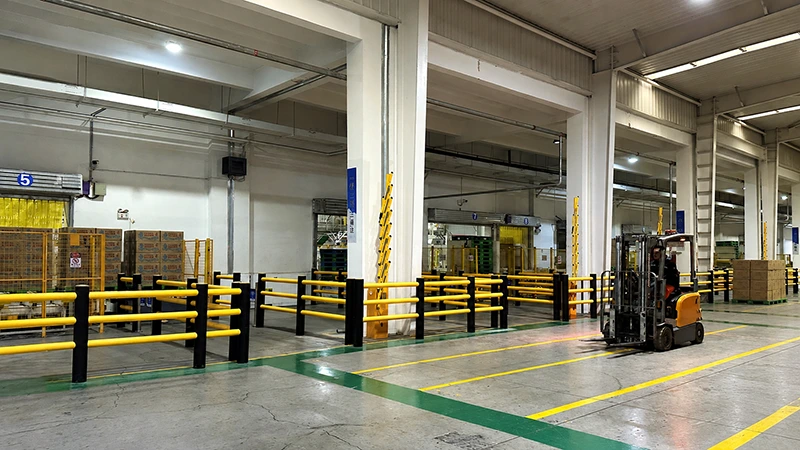
Why a Polymer Safety Barrier Fits Repeated-Impact Zones
Bottling plants, warehouses, and logistics centres combine narrow aisles, loading dock protection, fast forklift movements, and people working close to equipment. Traditional steel barriers can stop a vehicle, but a rigid steel impact can deform the guard, strip its coating, damage anchors, and transfer a hard load back into the forklift. The site then faces a familiar cycle: isolate the area, repaint or replace the steel, and lose operating time.
FCBarrier changes the objective from simply stopping impact to managing it. ARMORFLEX™ polymer is designed to absorb energy and self-rebound. The product profile records absorption of 80% of impact energy and a 28,950 J rated barrier level for an 8-ton forklift travelling at 9.6 km/h. These figures should be matched to the vehicle, speed, impact direction, slab, and layout during project design; they are not a substitute for site engineering.
| Требование к участку | Ответ FCBarrier |
|---|---|
| Frequent forklift contact around racking | Flexible rack protection and warehouse barrier rails absorb impact energy and return toward their original position. |
| Paint damage and corrosion on steel | Polymer construction is corrosion free and UV resistant, reducing coating-related maintenance compared with steel barrier systems. |
| Forklift damage after a rigid collision | Energy-absorbing flexibility helps reduce the severity of the secondary load transferred to the vehicle. |
| Repairs that block production routes | Low-maintenance, modular components and removable rails support faster inspection, release, or replacement when a component is genuinely damaged. |
Structure and Installation Evidence from the FCBarrier System
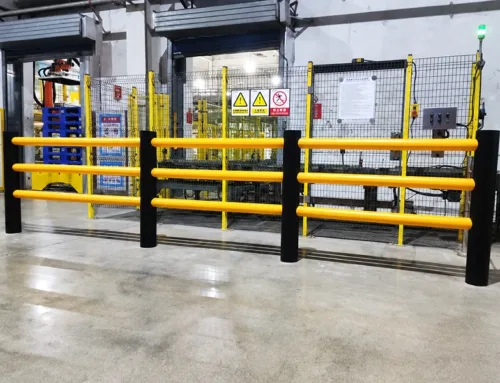
Dual-rail protection for people, assets, and traffic flow
The factory installation image shows a continuous dual-rail barrier with black posts and yellow rails positioned beside a walkway and equipment area. This is the practical role of a TR Series traffic rail or DR Series double rail: create a visible separation between forklift movement and pedestrian or asset zones. A floor-anchored base keeps the protection line defined while the flexible rail system is intended to move under impact rather than behave like a brittle rigid obstruction.
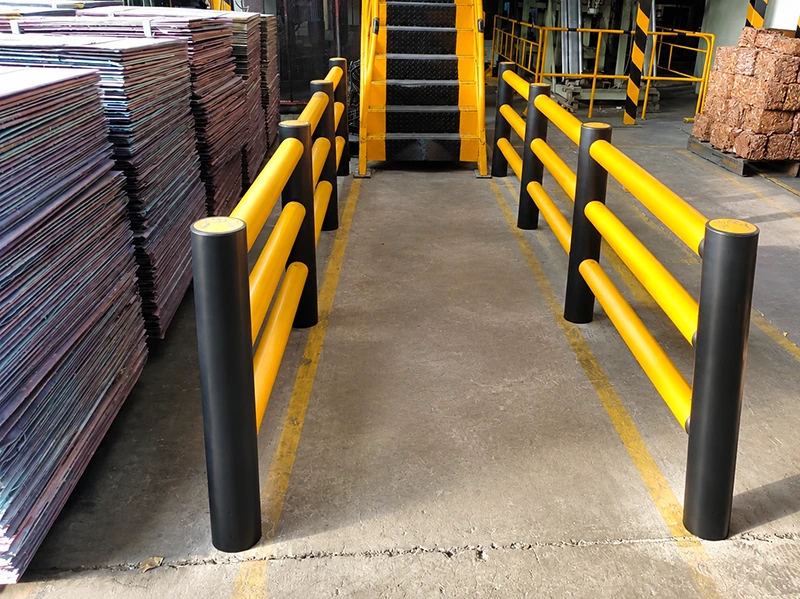
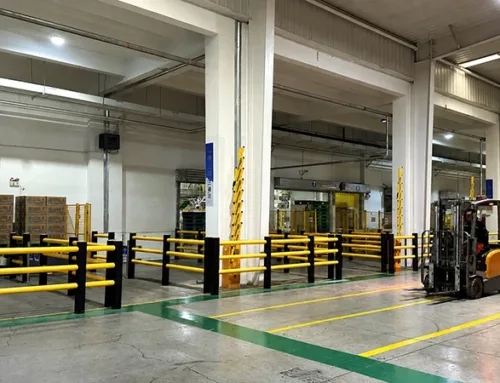
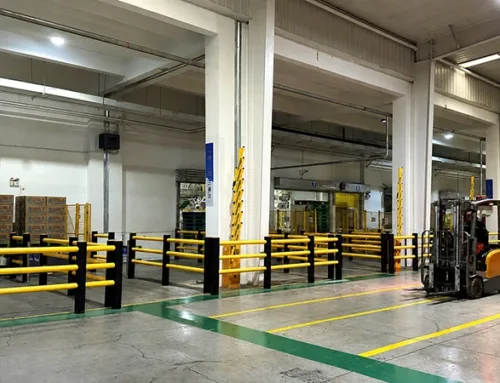
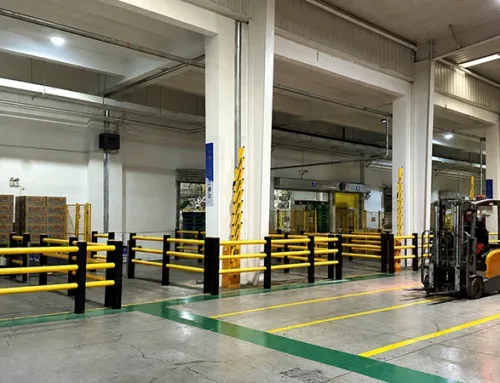
Continuous warehouse safety barrier layout
The long warehouse run shown here illustrates why modular installation matters in racking protection. A guard can be planned around aisle ends, loading dock approaches, columns, and machine access instead of treating every collision point as a separate steel repair. The same design language can be adapted for a Corner Barrier, Column Protector, or warehouse barrier rail. Easy-install and retrofit configurations make it suitable for adding protection to an operating facility without redesigning the entire traffic route.
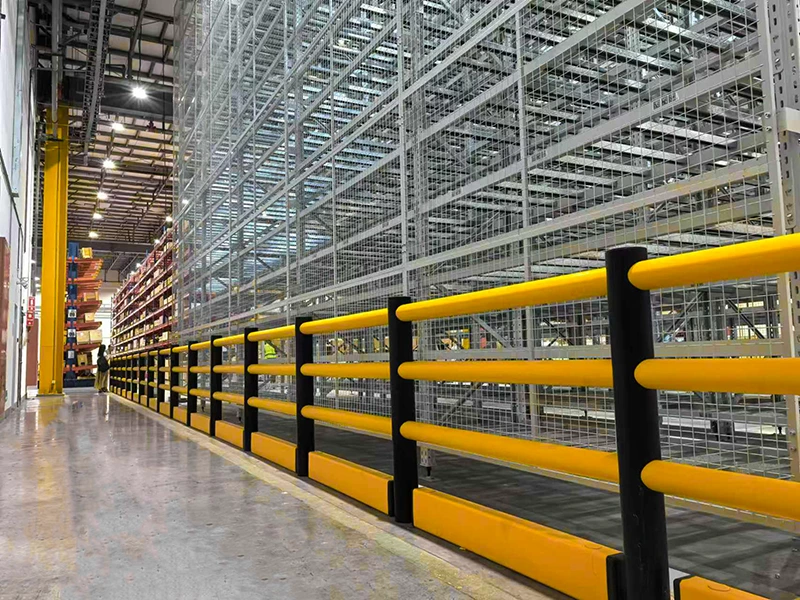
Modular barriers make the protection line easier to specify
The product configuration image shows multiple rail arrangements, upright spacing, and bolted base-plate positions. That visual evidence supports a modular barrier approach: select Single Rail, Double Rail, or traffic-oriented sections according to the hazard, then connect the protection line around the working area. Mortise and tenon quick-install and quick-release details can simplify controlled access and component handling. The final anchor design remains dependent on the concrete slab and impact assessment.
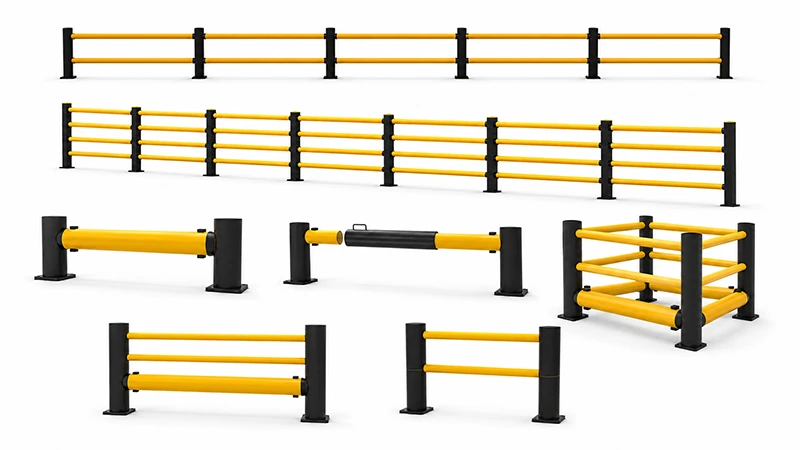
Where Flexible Bollard Protection Delivers the Practical Result
- Food and beverage safety barrier: protect bottling equipment, line entrances, and service routes where cleaning, corrosion resistance, and clear separation matter.
- Защита склада и стеллажей: reduce forklift damage to rack legs, end frames, columns, and loading-bay edges.
- Безопасность производственных предприятий: separate machinery protection zones from pedestrian paths and vehicle traffic.
- Безопасность логистических и распределительных центров: create visible, modular traffic rails that can be retrofitted as the operation changes.
The financial result is two-sided: fewer damaged guards and less exposure to forklift body damage. With self-rebounding, energy-absorbing behaviour, low maintenance, recyclable material, and modular replacement options, the protection system is designed to reduce repair cost and accident downtime over its service life.
Specify the Impact Before You Specify the Barrier
Share the forklift weight and speed, impact points, aisle width, slab condition, pedestrian routes, rack or machine locations, and whether the site needs a Single Rail, Double Rail, TR Series traffic rail, or CTR Series Column Protector. The 28,950 J rating, flexible polymer behaviour, floor-anchored base, and selected rail geometry can then be checked against the actual hazard rather than treated as generic claims.
Turn “Every Impact = One Repair” into Lower-Cost Protection
For a bottling plant, warehouse, or logistics centre where steel barriers are repeatedly damaged, FCBarrier offers a direct alternative: a Flexible Bollard and flexible safety barrier system that protects the asset and the forklift together. Send your layout and traffic details for a practical barrier configuration.