RU
RU  EN
EN  DE
DE  PT
PT  JA
JA  ES
ES  IT
IT MULTI-SITE BEVERAGE PLANT SAFETY
Ударопрочный барьер для многообъектных заводов по производству напитков: стандартизация защиты от вилочных погрузчиков
An Impact Resistant Barrier gives beverage groups a documented, modular way to standardize forklift safety across company-owned plants and independent bottling partners—while making the current PAS 13 certification gap visible before approval.
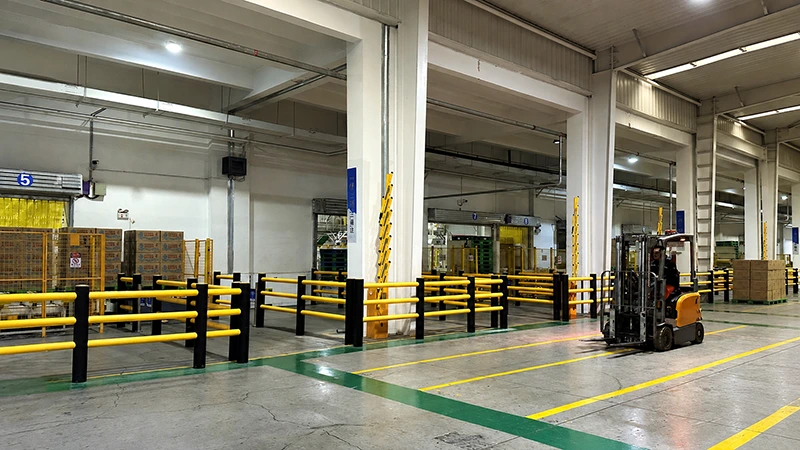
Why distributed bottling networks need one barrier standard
A beverage group may define its safety expectations centrally, but each bottling partner often buys locally. That creates different barrier types, undocumented impact assumptions and inconsistent installation records. A low-price steel barrier can appear acceptable at one site, yet repeated forklift hits may permanently bend the rail, damage anchors or transfer force into the concrete. When every incident triggers a different repair decision, corporate EHS teams cannot easily compare risk, maintenance exposure or compliance evidence across the network.
The practical requirement is not simply a guardrail. It is a repeatable Warehouse Safety Barrier и Food & Beverage Safety Barrier specification: defined impact conditions, a documented product family, installation instructions, site photographs and an approval record that can be audited by the group and applied by independent facilities.
| Specification point | FCBarrier basis for a common standard |
|---|---|
| Impact selection | SR, DR, TR and CTR series provide an energy ladder from 3,850 J to 28,950 J; DR190, TR190+ and CTR190+ are stated at 28,950 J for an 8-ton vehicle at 9.6 km/h. |
| Repeated contact | ARMORFLEX™ polymer is stated to absorb up to 80% of collision energy and self-rebound; post-impact inspection remains necessary. |
| Deployment | Modular rails and posts use a mortise-and-tenon quick-install connection with an internal long pin, supporting local replacement rather than automatic removal of a full run. |
| Approval evidence | Published impact figures and a complete document pack support review; FCBarrier does not currently publish a PAS 13 third-party certification report. |
How the Impact Resistant Barrier fits plant-level risks
Protect machinery and controlled access points
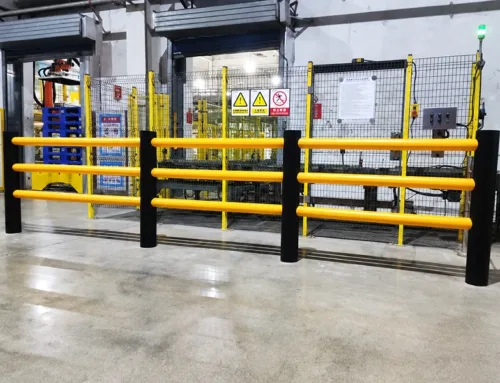
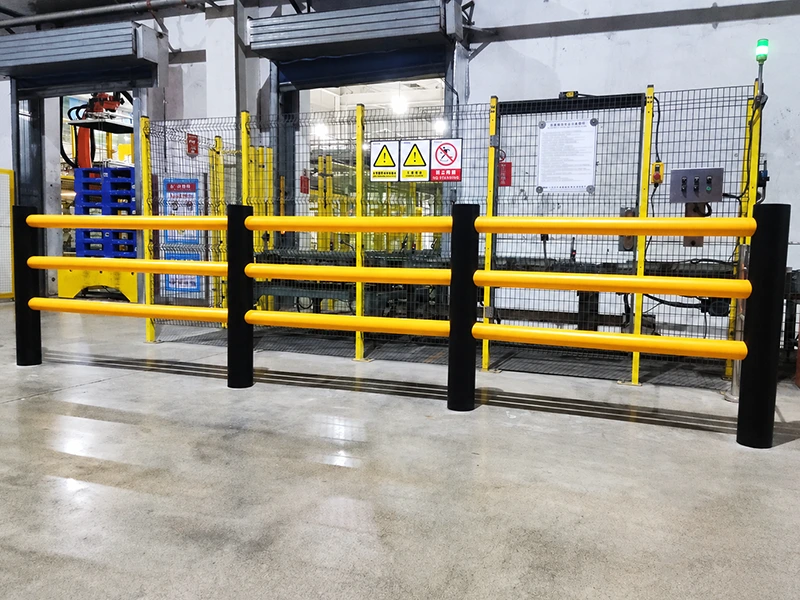
At a production line, the barrier has to separate moving equipment from forklift traffic without becoming a disposable visual boundary. The factory installation shown here places yellow tubular rails and black posts around machinery access, matching the Machinery Protection and workplace safety requirement. This is the type of site evidence a central team can require from every partner: location, configuration and installation condition recorded against the same product family.
Separate people, forklifts and loading routes
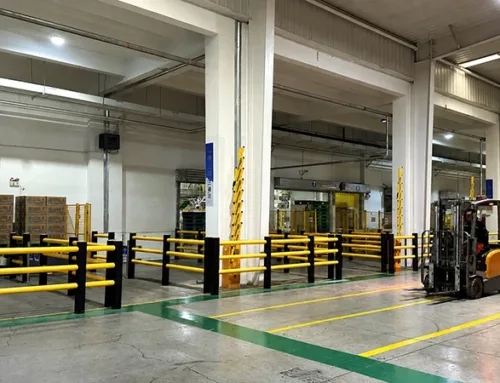
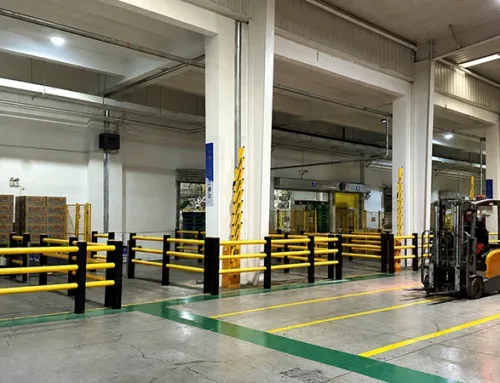
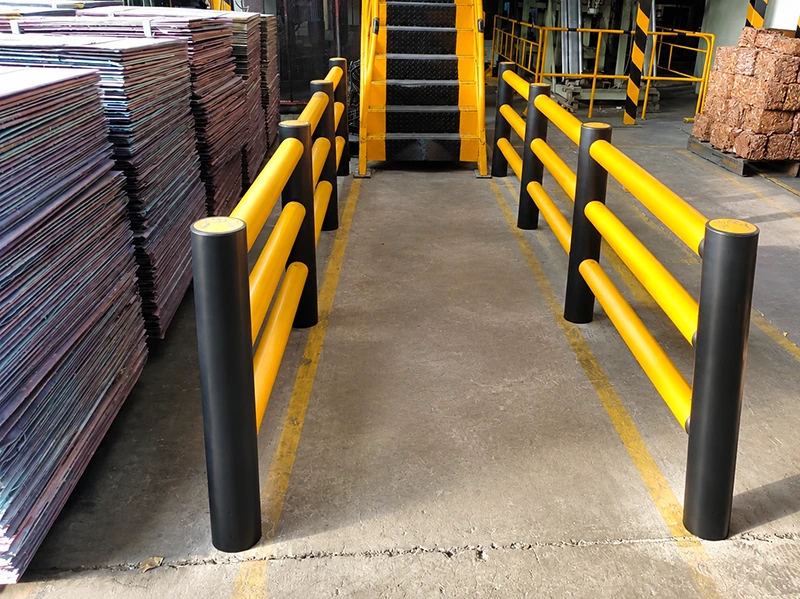
A beverage facility needs more than asset protection: pedestrian access, forklift routes and loading dock movements must remain visibly separated. The dual-rail installation demonstrates a floor-anchored Pedestrian Barrier with continuous alignment around a walkway. For a retrofit, teams can map the required SR, DR or TR configuration to the vehicle mass and speed, then confirm the concrete condition and anchor installation with a trained crew.
Use one modular family across different layouts
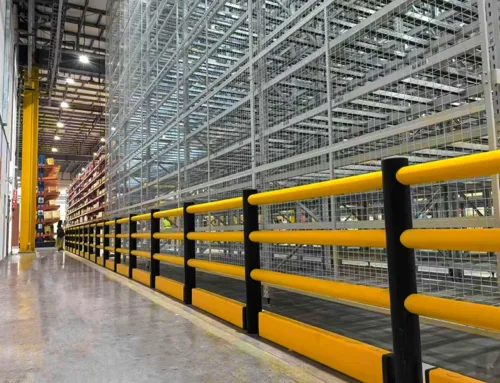
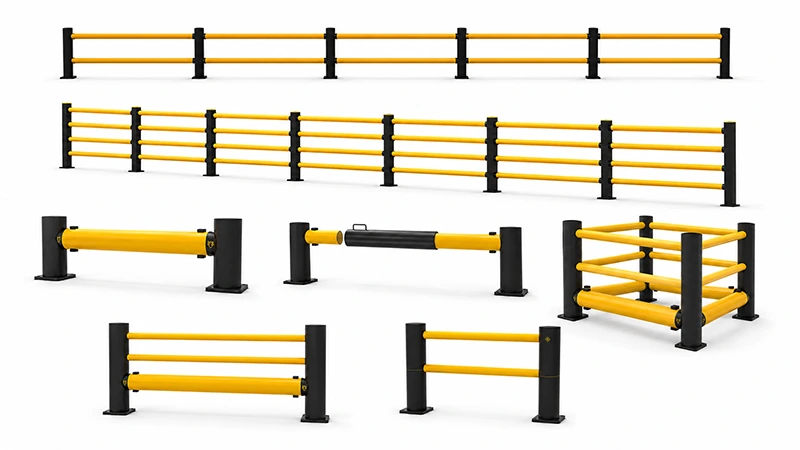
Independent bottlers rarely have identical floor plans. FCBarrier addresses that procurement problem with four series: SR single rail for defined asset edges, DR double rail for stronger vehicle separation, TR for pedestrian and traffic boundaries, and CTR for building columns. The configuration image shows multiple rail arrangements and bolted base plates. A central specification can therefore define approved series, impact level, layout drawings, installation checklist and replacement parts while allowing each site to select the matching module.
What a repeatable deployment package should contain
- Site survey: forklift or vehicle mass, travel speed, impact direction, rack edges, columns, machinery and pedestrian walkways.
- Product selection: choose the SR, DR, TR or CTR series against the stated energy condition; do not treat 28,950 J as a universal rating for every configuration.
- Installation record: verify a sound concrete floor, drilled anchors and torque-wrench tightening. The installation method also uses a rubber mallet, protective equipment and trained personnel.
- Audit file: retain the configuration, photos, test-data references, inspection history and replacement record for corporate review.
- Certification gate: before group-wide approval, request independent evidence for the required standard. FCBarrier currently has no published PAS 13 third-party certification report, so this is a clear qualification condition rather than a claim.
SGF can support global supply, multi-specification delivery and cost-competitive manufacturing from China. That combination is useful for a dispersed network only when every site receives the same approved documents, component logic and deployment instructions.
Turn product data into an auditable barrier specification
The public impact figures, image evidence and modular architecture provide a starting point for a beverage group’s common standard. The engineering review should still confirm the actual vehicle conditions, concrete and anchoring details, environmental limits, fire requirements and any food-industry site restrictions. Ask for the current FCBarrier document pack and a series-by-series quotation so local bottlers are evaluated against the same information.
Plan consistent forklift protection across every bottling partner
Share your site count, highest vehicle condition, loading-bay layout and required approval standard. SGF can map the FCBarrier series, modular installation plan and documentation package—and identify the PAS 13 certification evidence still required before procurement.