RU
RU  EN
EN  DE
DE  PT
PT  JA
JA  ES
ES  IT
IT FOOD PLANT RETROFIT | MEFENCE INDUSTRIAL SAFETY FENCING
重型建筑围栏用于食品工厂:实现零动火作业安装
When dust, packaging materials, and production schedules make welding impractical, Mefence provides a heavy duty construction fence approach based on cold-work assembly: a frameless 3D welded mesh industrial safety fence installed with clips and screws, without flame, sparks, or a site welding step.
Why the Installation Method Decides the Solution
In a food plant, a welding job is not simply another construction activity. Fine dust, cartons, films, labels, and other packaging materials can make hot-work controls extremely restrictive. A welded square-tube fence may require a hot-work permit, fire watch, area isolation, cleaning, and production disruption before the first panel is fixed. The same constraint appears in paper-packaging plants concerned about ignition and cold stores concerned about insulation panels. If the installation method cannot enter the site safely, the fence specification is irrelevant.
Traditional framed fencing also adds fabrication and alignment work around irregular equipment footprints. Barrier tape or rope can mark a temporary boundary, but it does not create a visible, modular workplace safety barrier for pedestrian vehicle separation, automated equipment guarding, or a controlled production-line perimeter.
Product Fit: A Cold-Work Industrial Safety Fence
Mefence changes the installation question. Its frameless design uses a 3D welded mesh panel rather than a perimeter frame, so the team can adapt panel lengths on site and build area demarcation around existing machinery, aisles, and access points. The assembly uses plastic clips and self-tapping screws in a three-step sequence. No welding is required during site assembly; the work produces no open flame and no welding sparks.
That means a food manufacturer can plan a retrofit partition for a night shift or weekend window without automatically entering a hot-work permit workflow or clearing the whole production area. Production continuity still depends on the plant’s own safety approval, hygiene controls, access rules, and risk assessment, but the fence itself does not force a hot-work operation into the project.
| Mefence specification | How it supports the retrofit decision |
|---|---|
| Frameless 3D welded mesh with T-shaped ridges | Supports flexible zoning, on-site cutting, and a slim visible boundary without a square-tube perimeter frame. |
| Q235 carbon steel; electrostatic powder coating | Provides the documented steel mesh and finish basis for factory area separation. Color can be specified beyond standard yellow and black. |
| 3 mm / 4 mm wire; 20×100 mm or 50×50 mm mesh | Lets the buyer match visibility and guarding layout to the application instead of using a solid wall. |
| Panel width 200–1400 mm; height 200–3000 mm | Allows modular planning around equipment, aisles, conveyors, and irregular retrofit dimensions. |
| 40×60 mm or 60×60 mm posts; 140 mm ground clearance | Supports base-plate post layouts and practical floor fixing with expansion bolts where the site permits. |
| Plastic clip + self-tapping screw connection | Enables the documented three-step, one-person installation method with no site welding step. |
What the Structure Shows on the Factory Floor
1. Modular panels replace fabrication-heavy framing
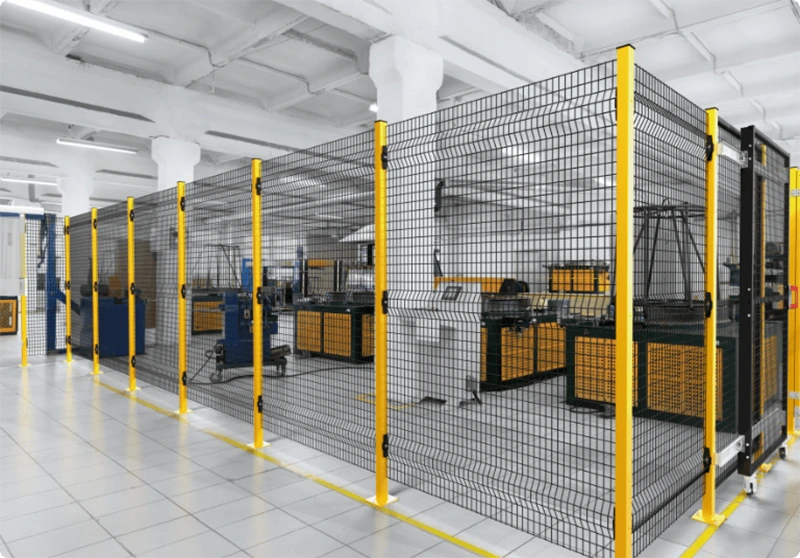
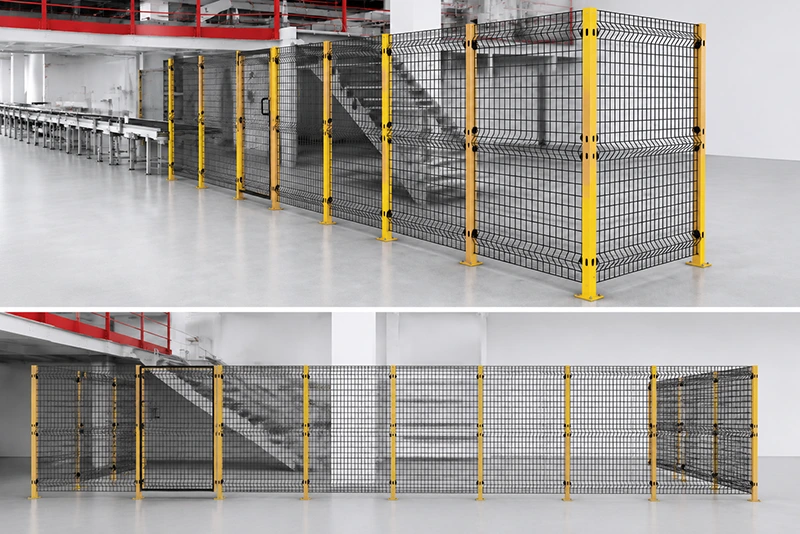
The warehouse-style enclosure shown here makes the layout logic clear: yellow steel posts define the line, while black welded wire mesh panels create a readable boundary around equipment and walkways. This is useful for warehouse zoning, workshop isolation, and machine guarding perimeters where the team needs a modular reconfigurable fence rather than a permanent welded frame.
2. 3D mesh supports routing without creating a blind wall
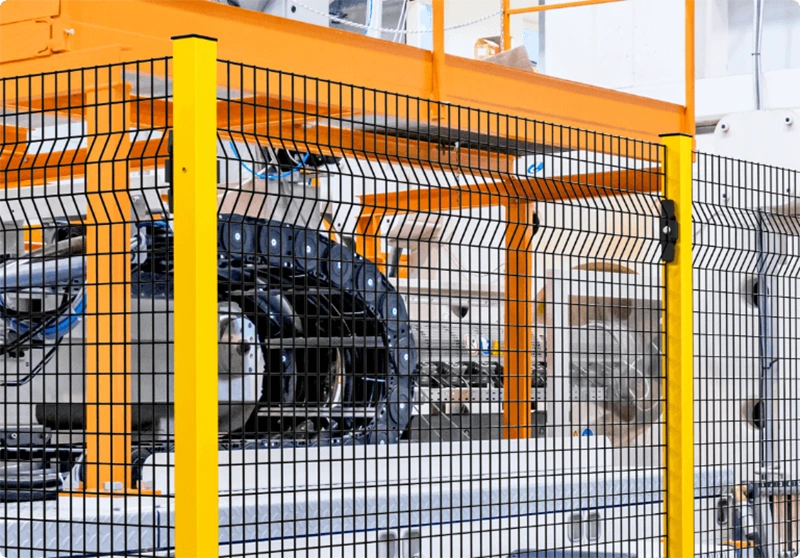
The bent profile and open welded mesh preserve line-of-sight while the raised T-shaped ridges can provide space for cable management. That matters beside conveyors and automated equipment, where cables should not hang outside the fence or cross a pedestrian route. The same structure can accept wood slat inserts when a process needs visual shielding. These functions are separate from fire performance: Mefence is not a fire-rated or flame-retardant fence, and its zero-hot-work installation must not be confused with fire protection.
3. Access points stay part of the traffic plan
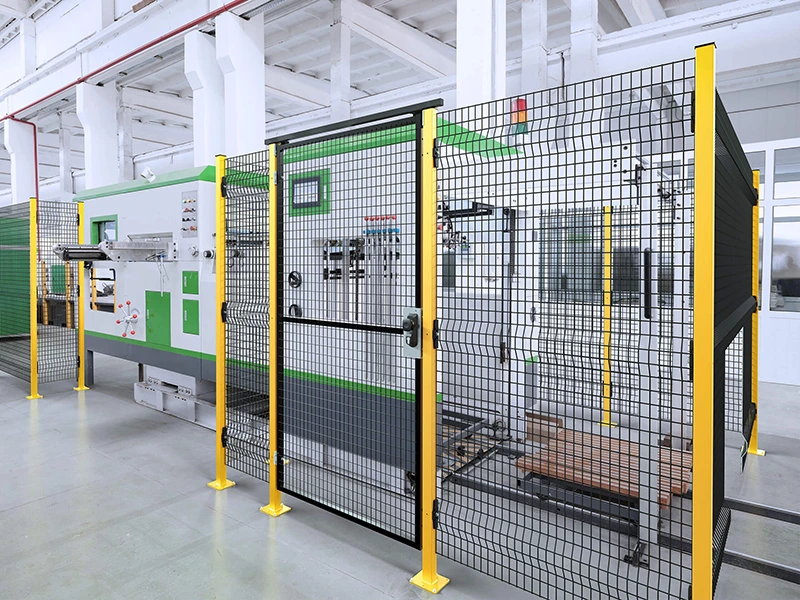
A fence around a machine or packing area only works when entry is deliberate. The single access gate visible in this installation supports controlled access to an automated work zone while keeping the surrounding boundary visible. In a mixed-traffic plant, the same principle can guide forklift path barriers, AGV or AMR lane separation, and pedestrian vehicle separation. Mefence is intended for demarcation and non-high-impact guarding; projects requiring certified impact containment should be evaluated against the higher-spec Machine Fence line.
Where Zero-Hot-Work Zoning Creates a Practical Advantage
- Food processing plants: separate automated equipment, packing lines, maintenance areas, and pedestrian routes without introducing an installation welding operation.
- Paper and packaging plants: create workshop isolation or storage area separation where combustible paper and film make hot work difficult to approve.
- Cold stores: plan warehouse zoning and forklift path barriers around insulated panels with a modular, bolt-down layout.
- Проекты модернизации: install a quick install safety fence during a controlled night or weekend window, then relocate or reconfigure modules when the layout changes.
The result is not a claim that every plant can keep running without controls. The result is a more feasible installation basis: no site flame, no welding spark, no square-tube fabrication step, and a documented path toward faster area setup. Video facts indicate one-person, three-step installation and a potential 50%+ installation-time reduction; actual duration depends on floor conditions, length, access, and the plant’s permit and hygiene procedures.
Specify the Boundary, the Floor, and the Risk
For a quotation, provide the planned fence length and height, mesh opening, wire diameter, post option, floor condition, gate positions, equipment clearances, cable routes, and whether visual shielding is required. Also define the hazard zone and traffic pattern. Mefence can support warehouse zoning, machine-guarding perimeters, and AGV lane separation, but it should not be specified as a certified anti-collision barrier or fire-protection product without separate evidence.
Make the Food-Plant Fence Project Feasible Before You Schedule Hot Work
Send the layout and installation window. SGF can help match a Mefence frameless safety fence to the area demarcation, machine guarding, and pedestrian vehicle separation requirements while keeping the zero-hot-work boundary clear.