RU
 EN
 DE
 PT
 JA
 ES
 IT
SAFETY GATE COMMISSIONING CHECKLIST / INTERLOCK VERIFICATION
Mechanical completion is not the end of a gate job, it is the start of the checklist
Site delivery teams often treat a hung leaf and a tightened latch as the finish line. Acceptance day then finds a door that will not close fully, a switch that does not reset, and a restart sequence nobody has tested, so the commissioning slot is lost to repeat visits. A safety gate commissioning checklist puts the work in an order that can be signed: factory-prepared hole positions, on-site alignment, then functional verification. Mechanical checks come first, electrical behaviour second, and documentation last. Each gate is cycled three to five times, opens to at least 90 degrees, and is measured against the dimensional tolerance agreed in the contract, with +/-5 mm used in project documents. Interlock verification and the local risk assessment stay with the controls integrator and EHS.

Send your gate count and switch models for a commissioning checklist
The commissioning sequence in the order it is signed off
Each step has an owner and a record. Skipping the mechanical checks means an electrical symptom gets investigated as a wiring fault, and the same gate comes back on the next visit.
| Step | Check and record |
|---|---|
| 1. Factory preparation | Confirm the carrier hole pattern against the approved drawing, gate handing, leaf width and part codes on the crate. Prepared holes remove site drilling from the sequence entirely. |
| 2. On-site alignment | Check post verticality, base plate anchors, panel flatness, latch engagement, header beam parallelism and the key-to-switch offset with the gate closed. Cycle the leaf three to five times and re-measure. |
| 3. Switch action | With the integrator, confirm the actuator withdraws cleanly and the switch contacts change state on every opening. A constant offset is a carrier problem; a growing offset is a hinge or post problem. |
| 4. Circuit break and restart inhibit | Verify that opening the gate removes torque through STO, that closing it does not restart the machine, and that only a deliberate manual reset outside the danger zone restores motion. |
| 5. Records and sign-off | Log dimensions against the agreed tolerance, the 90 degree opening angle, gate cycle results, fastener counts, switch and key models, circuit test results, the risk assessment reference and the names of the mechanical, electrical and EHS signatories. |
Common faults and the check point that finds them
Door will not close or latch
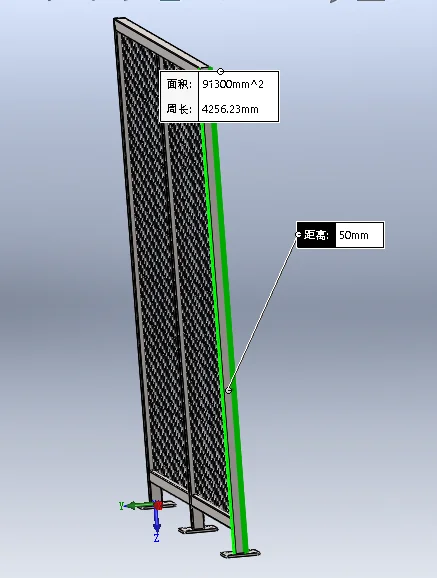
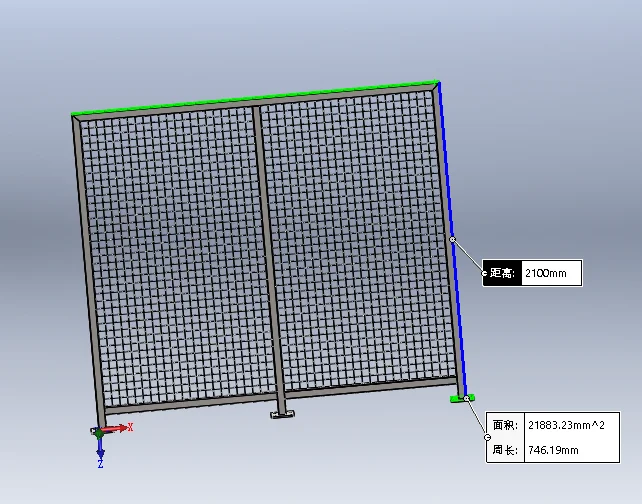
Check post verticality, header beam parallelism, floor flatness and leaf sag before touching the switch. Framed mesh panels with a 20x30x1.5 mm tube border and flat full welds hold the leaf rigid; heavy-duty hinges and ball-bearing rollers carry wide leaves; four M10 expansion anchors per base plate hold the post. A leaf that drops at the latch side is geometry, not an interlock fault.
Switch does not reset, or the line restarts unexpectedly
A switch that stays faulted after the gate closes usually has an actuator offset or a distorted mounting face. A machine that restarts on door closure is missing the deliberate reset. Both are recorded in the interlock verification step with the integrator present, along with the achieved safety rating under ISO 14120 and ISO 13849-1 as applicable. The safety lock mounting carrier supplies only the prepared mechanical interface for Omron D4NL or Pizzato FS series devices; the circuit and PLC logic are not our scope.
Intermittent nuisance stops after handover
Log the vibration source and cycle count, then re-measure the key-to-switch offset at the top and bottom of the switch head after three to five cycles. Agree a written re-check interval with maintenance. A 1600 J impact figure quoted for the standard configuration applies only to that tested build and is confirmed for the actual gate and carrier. Guard height, aperture and reach distance remain subject to ISO 13857 and the local risk assessment. This system is not intended for pure pedestrian guidance.
Projects where the checklist protects the schedule
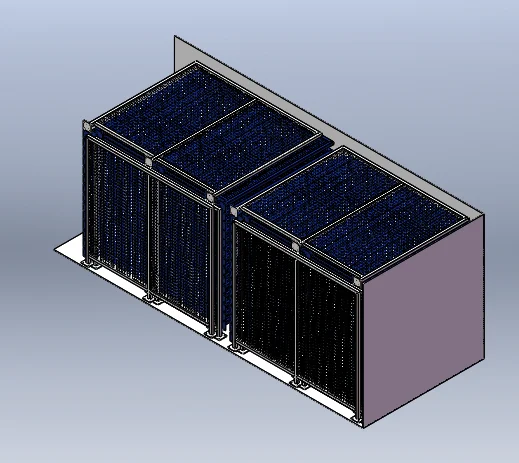
- Multi-door robot cell guarding: each leaf gets its own signed record instead of one blanket acceptance note.
- Conveyor line safety guarding with transfer openings: gate interlocks and light curtains are verified as separate line items.
- Press shop safety fence and CNC machine guards: gravity-loaded axes need a braking decision that STO alone does not cover.
- Automated material handling safety zones: restart inhibit protects technicians in partially cleared areas.
A signed sequence gives the delivery team, the controls integrator and EHS the same definition of finished.
What the acceptance pack contains
Send the gate count and types, leaf widths and swings, switch and actuator key models, target safety rating, reset button position and sightline, dimensional tolerance, floor and anchor conditions and the names of the mechanical, electrical and EHS owners. The returned pack carries the general arrangement, the carrier hole-position drawing, the panel and post BOM, the alignment and cycling record sheet, the interlock verification sheet and the acceptance checklist. Electrical schematics, circuit validation, PLC logic and the risk assessment signature remain with the customer’s team.
Sign the sequence, not the feeling
Prepared holes, measured alignment, a verified circuit and a written reset test turn acceptance day into a review of records instead of a round of adjustments.