RU
RU  EN
EN  DE
DE  PT
PT  JA
JA  ES
ES  IT
IT Machine guarding for forklift-heavy pallet production
Machine Guarding Fence Panels for Forklift-Heavy Pallet Lines
Machine Guarding Fence Panels are built for pallet plants where forklifts, wood chips, blind spots, and nonstop material transfer put automation and people at risk. Mdfence turns perimeter guarding into a physical barrier, not just a painted warning line.

Why Machine Guarding Fence Panels fit dense forklift traffic
Pallet production keeps forklifts moving all day: raw logs in, finished pallets out, stacks shifting, and operators walking through the same lanes. In that environment, a cheap barrier that only looks protective fails fast. Machine Guarding Fence Panels from Mdfence are designed for sites that need real impact resistance, stable structure, and a perimeter that helps protect both the line and the people around it.
| Требование к участку | Ответ Mdfence |
|---|---|
| Forklift contact risk at blind corners and narrow aisles | Q235 cold-rolled seamless square tube frame with fully welded construction for hard-wearing perimeter strength. |
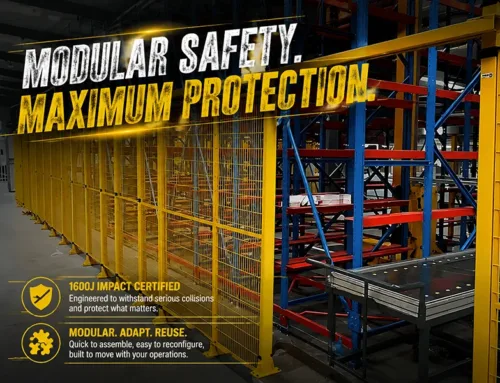
| Barrier collapse under repeated impact | 1600J impact resistance so the fence works as physical armor, not a visual marker. |
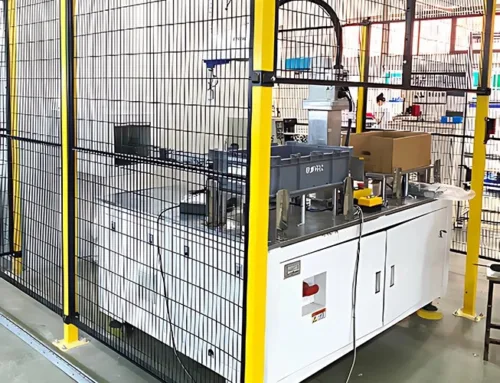
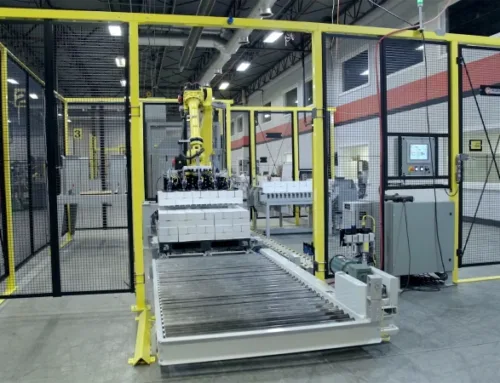
| Need to protect automated nailing lines and nearby personnel | Rigid machine guarding panels create separation between moving equipment, traffic lanes, and walk paths. |
| Continuous uptime matters more than low initial price | Heavy-duty build reduces damage-driven downtime, repairs, and production interruptions. |
What makes these panels different in the field
Welded frame strength that holds up under abuse
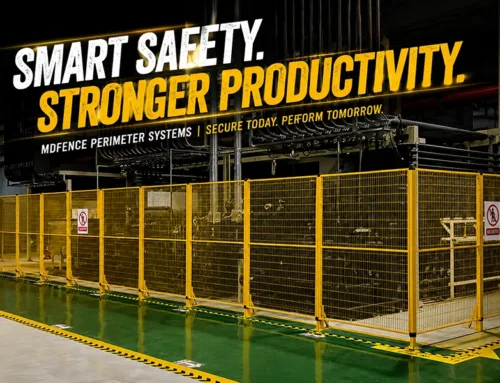
The first failure in a weak fence is usually the frame. Mdfence uses Q235 cold-rolled seamless square tube plus a fully welded framed process, which gives the panel the stiffness needed to survive contact from busy forklift routes. The image shows the perimeter structure as a true industrial barrier, not a light-duty warning fence.

Protection for automation where material flow never stops
Pallet production lines often run beside heavy traffic, so one wrong turn can put a forklift into the machine envelope. Machine Guarding Fence Panels create a hard boundary around automated nailing equipment and other exposed assets, helping reduce collision events that cause expensive downtime and repair work.

A physical armor layer, not just a warning line
Wood dust, stacked pallets, and line-of-sight dead zones make painted lines unreliable. Mdfence is built to do what visual marking cannot: absorb impact, keep the safety envelope intact, and preserve continuous operation. That is why the product is specified for high-risk industrial perimeters where forklift misjudgment is part of the daily operating reality.

Where Machine Guarding Fence Panels are most useful
- Pallet manufacturing lines with constant forklift transfers
- Automated nailing and assembly equipment that must stay isolated from traffic
- Plant areas with blind spots, floor debris, and tight turning radii
- Perimeters where a cheap fence would collapse after repeated contact
These are the sites where the cost of a bad barrier is not the panel itself, but the downtime after a collision. Machine Guarding Fence Panels give plant managers a practical way to keep the production line running while narrowing the chance of forklift impact reaching expensive equipment or nearby workers.
Что указать перед заказом
For a forklift-heavy line, specify the traffic pattern, the machine envelope, the exposed corners, and the points where operators cross. Then match that layout to a barrier built from Q235 cold-rolled seamless square tube, fully welded framing, and 1600J impact resistance. That combination is what turns Machine Guarding Fence Panels into a real protection system instead of a simple visual boundary.
Protect uptime before the next impact
If your pallet line runs beside fast-moving forklifts, Mdfence gives you a guarding wall designed for collision risk, not just compliance optics. Use Machine Guarding Fence Panels to protect automation, reduce repair exposure, and keep production moving.