RU
RU  EN
EN  DE
DE  PT
PT  JA
JA  ES
ES  IT
IT Защитное ограждение для роботов
Robot Safety Fence for WES-Connected Warehouse Interlocks
When an automated warehouse safety door has to talk to WES software, the real problem is not the fence panel itself. It is the field integration work around the interlock, the mounting hole pattern, and the way the door must stay aligned after daily vibration and repeated use. Mdfence turns that job into a bolt-in assembly instead of a cut-and-weld project.

Why WES-Connected Robot Cells Need a Different Fence Layout
In automated storage and robot handling zones, the safety gate cannot be treated as a standard barrier. The door has to accept an electronic interlock, keep a stable position under vibration, and match the site engineer’s wiring and mechanical layout without forcing field cutting, drilling, or welding on site. Mdfence is built around that reality. It is a pre-engineered safety fence system with a standardized lock carrier module, so the electrical and mechanical teams can finish the install with normal fastening work instead of hot work modification.
| Требование проекта | Ответ Mdfence |
|---|---|
| Connect the safety gate to WES and the interlock circuit | Standard lock carrier module prepared for electronic interlock mounting, so the gate can accept mainstream interlock hardware without improvised brackets. |
| Work with Omron, Pizzato, and similar interlocks | Designed for broad compatibility with common international electronic safety switches, reducing last-minute adapter fabrication. |
| Avoid field cutting, drilling, and welding | Bolted structure and predefined mounting interfaces keep the install in the screw-tightening stage, not the hot-work stage. |
| Prevent vibration-related misalignment alarms | Rigid frame, base plate, and fixing hardware help keep the interlock position stable after commissioning. |
| Finish fast in a live warehouse window | Standardized mechanical fit shortens the electrical integration sequence and helps field teams close the door, test it, and hand it over faster. |
What Makes Mdfence Suitable for Robot Safety Fence Projects
1. A lock carrier that is ready for electronic interlocks
The first failure point in a WES-connected safety door is usually the mounting interface. If the lock has to be fabricated on site, every tolerance issue becomes a delay. Mdfence uses a standardized carrier concept, so the interlock can be mounted on a purpose-built location instead of a hand-made plate. That is the difference between a clean installation and a job that keeps drifting because the bracket was adjusted too many times.

2. Base plate and fastening details that support repeatable alignment
Robot cell gates are opened and closed thousands of times. If the fixing point is weak, the door starts moving out of line and the interlock begins to report faults. The installation diagram shows that the system is built around base plate drilling, expansion bolts, and retaining ring assembly. That matters because the gate stays where the installer put it, even after the line starts running.

3. Fence geometry that keeps the cell neat and serviceable
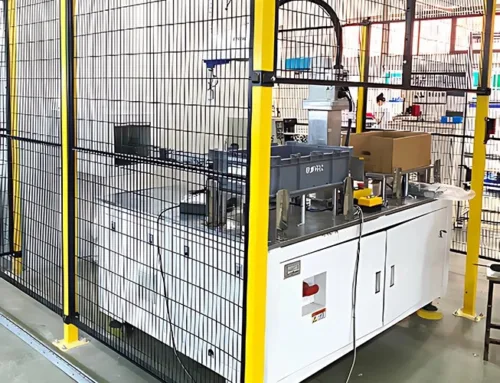
The technical front view makes the structural logic easy to read: post, mesh panel, and fixing clamp are separated into clear parts. That structure helps site teams replace or adjust a section without rebuilding the whole fence line. For automation projects, this is not just a neat visual. It is what keeps maintenance access controlled while leaving the robot cell easy to inspect and service.

Где это защитное ограждение для роботов подходит лучше всего
- Automated warehouse safety doors that must connect to WES software and an electronic interlock at the same time.
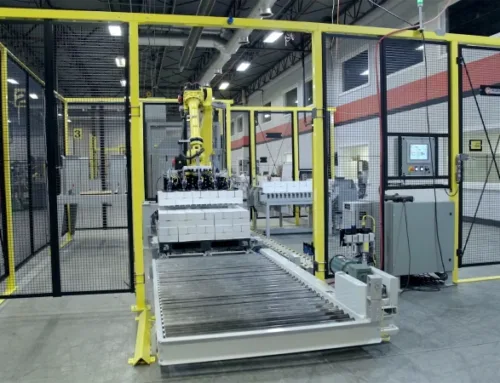
- Robot loading and unloading cells where door position stability directly affects alarm-free operation.
- Retrofit projects that need to replace a manual cut-and-weld fence layout with a standardized mounting system.
- Sites where the electrical team and the mechanical team have to finish the job inside a short shutdown window.
- Projects that use Omron, Pizzato, or similar interlock hardware and want a cleaner, faster installation path.
For these applications, the key value is not only guarding the robot. It is making the gate easier to integrate, easier to align, and easier to keep in service. Mdfence reduces the on-site fabrication burden, so the fence and interlock work like one system instead of two separate trades fighting each other.
What to Specify Before Ordering
To speed up the integration, prepare the gate opening size, swing direction, interlock model, mounting position, and control-side wiring requirement before you place the order. With those inputs, the Mdfence lock carrier and fence layout can be matched to the actual cell instead of adjusted repeatedly on site. That is how the project avoids rework, misalignment alarms, and late-stage drilling or welding.
Build the Robot Safety Fence as an Integration System
If your warehouse door must be safe, interlocked, and fast to install, Mdfence gives you the structural starting point. The fence is not just a barrier. It is a prepared mechanical platform for the interlock hardware, the wiring handoff, and the final acceptance test.