RU
RU  EN
EN  DE
DE  PT
PT  JA
JA  ES
ES  IT
IT 
You’ve done your research. You’ve identified the high-risk corners and vulnerable walkways. You’ve found a modern, engineered polymer safety barrier system that seems to solve your problems. You prepare the proposal and present it to your finance director, who asks: “This is nearly twice the cost of the steel barriers we approved last year. Why should we spend this much?”
It’s a fair question, but it focuses on the price tag instead of the cost of the problem it solves. Answering it requires shifting the conversation from a simple expense to a strategic investment with a clear Return on Investment (ROI). The cheapest option is rarely the least expensive. In safety infrastructure, choosing the lowest bidder is a false economy—a short-term saving that creates long-term costs. Let’s break down the true ROI of investing in a superior safety system like гибкие барьеры безопасности.
The Calculation They Don’t Show You on the Quote
A traditional steel barrier’s quote is simple. The ROI for an advanced polymer barrier is measured in the costs you no longer have to pay.
1. ROI Component: Elimination of Repetitive Repair Costs
This is the most direct return. Take a high-traffic corner that gets hit, on average, twice a year.
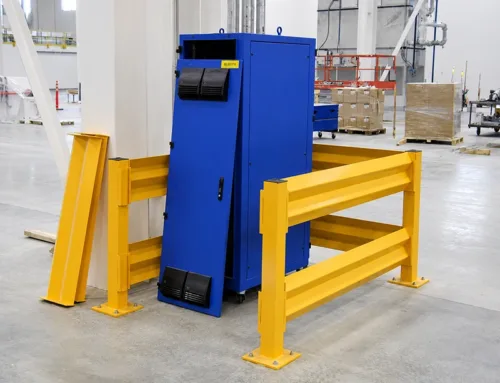
- Steel Barrier Scenario: With a cost per repair around $1,500, the annual repair cost is $3,000. Over three years, that’s a $9,000 direct expense.
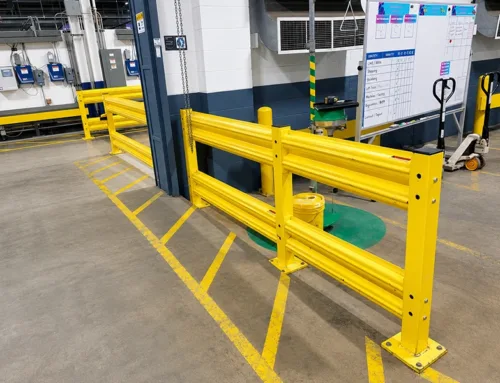
- Flexible Polymer Barrier Scenario: The barrier is engineered to be self-recovering. It flexes, absorbs the force, and returns to its original position. The annual repair cost is $0.
You have a recurring expense that is completely eliminated. The payback period for the initial price difference is often achieved within 18-24 months on this factor alone.
Получите бесплатное предложение
2. ROI Component: Prevention of Catastrophic Asset Damage
This is where the ROI becomes exponential. A cheap steel barrier doesn’t just fail itself; it fails the assets it’s supposed to protect. A rigid steel barrier transfers impact energy to your concrete floor, causing cracks that can cost tens of thousands of dollars to repair. The hard stop can also damage a forklift. A flexible barrier system acts as an insurance policy against these massive, unbudgeted capital expenditures.
3. ROI Component: Recapture of Lost Operational Uptime
Every time a steel barrier is damaged, a chain of “soft cost” events is triggered: the area is cordoned off, traffic is rerouted, and productivity dips. A flexible system that requires no repair downtime gives you back this time and efficiency. It is a direct contribution to your facility’s overall output.
Shifting the Conversation with Your Finance Team
Armed with this framework, you can change the nature of the conversation. Instead of saying, “I want to buy a more expensive guardrail,” try, “I want to make a one-time capital investment to eliminate a recurring expense that is costing us over $X per year and exposing us to significant structural risk.” Modern гибкие барьеры безопасности are an engineered asset protection system with a calculated ROI.
A smart investment is not about finding the lowest cost; it’s about finding the highest return. Choosing this system isn’t spending more; it’s spending smarter.