EN
EN  DE
DE  RU
RU  PT
PT  JA
JA  ES
ES  IT
IT OSHA / ISO audit pressure
Safety Fence Industrial for cross-border compliance programs
Safety Fence Industrial gives multinational plants one consistent machine-guarding baseline when OSHA scrutiny is strict and internal audit teams need evidence they can defend site by site.

Why the compliance problem gets harder at global scale
For a North American headquarters running plants in multiple regions, the real risk is not just a single unsafe machine cell. The risk is inconsistency. One site uses welded rail, another uses mixed barriers, a third relies on a quick retrofit that was never documented well enough for an OSHA audit. Once the audit question becomes, “Can you prove the same protection standard across every line?” weak, site-by-site improvisation stops being acceptable.
That is where many legacy guardrails fail. They may block access, but they do not create a repeatable baseline. The installation detail is vague, the panel layout is not easy to verify, and the field crew ends up building a local version of the same idea instead of a controlled system.
Why Mdfence fits an audit-driven machine guarding program
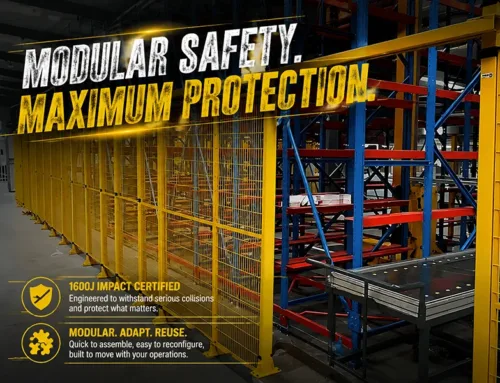
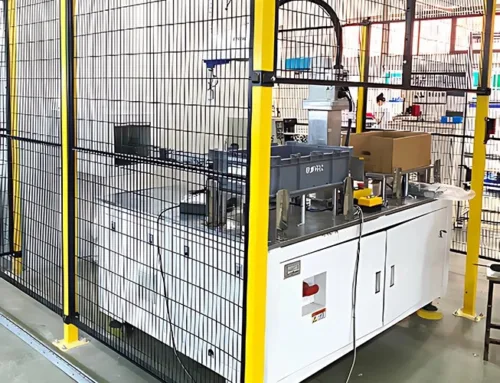
Mdfence is built as a modular steel post-and-mesh safety fence system, which is exactly what multi-site operators need when the goal is not a one-off barrier but a repeatable standard. The panel-and-post layout makes the protected zone legible. The machine line is separated from people, traffic, and transfer activity without turning the cell into an unmanageable custom fabrication job.
That modular logic matters for compliance. When the same guarding layout can be repeated across facilities, safety leaders can document one baseline instead of defending several different field solutions. For an enterprise with strict OSHA expectations and ISO alignment requirements, that consistency is the real value.
What the structure proves in the field
The technical view shows the post, mesh panel, and fixing clamp relationship clearly, which makes the guarding geometry easy to explain during a plant review.
The composite spec image highlights weld seam quality, coating, and base plate detail, which are the exact things that matter when the conversation shifts from “Does it look safe?” to “Can this installation hold up in day-to-day use and audit review?”
The installation image shows base-plate drilling, expansion bolts, and retaining rings, proving the system is anchored rather than loosely placed.
| Audit pressure | Old approach | Mdfence response |
|---|---|---|
| Proof of consistent guarding | Mixed local barriers and undocumented retrofits | Repeatable post-and-mesh layout with clear boundary logic |
| Installation credibility | Loose, site-specific assembly | Base plates, expansion bolts, and retaining ring fixing |
| Review by safety teams | Hard to explain and hard to standardize | Visible clamps, panels, and enclosure geometry |

How the system supports safer production flow
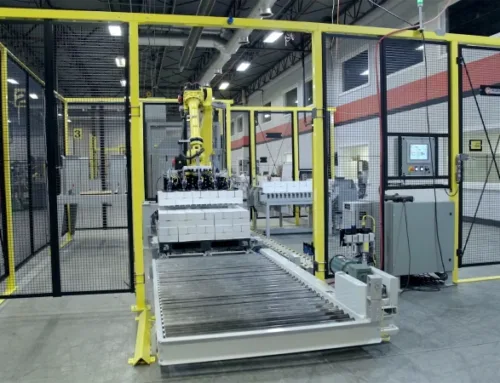
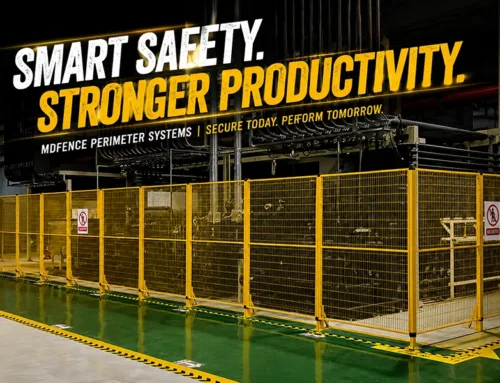
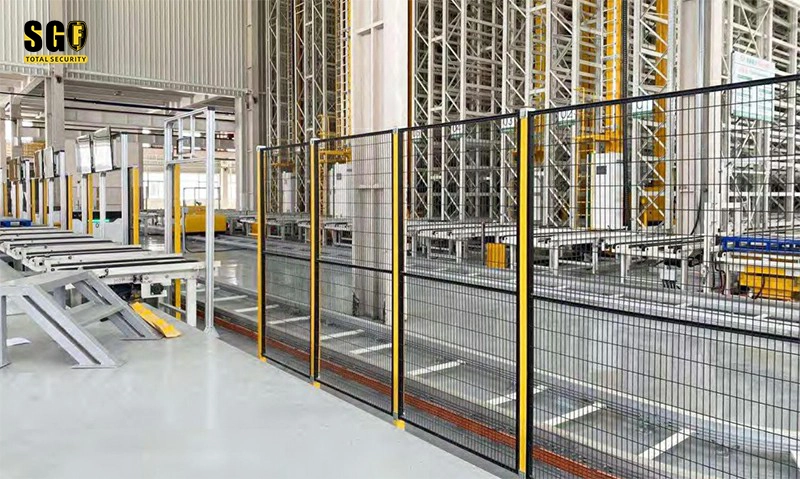
In a live plant, guarding is not only about stopping access to the machine. It also has to coexist with conveyors, transfer equipment, and day-to-day movement around the line. The wider fence layout keeps that separation visible. The machine zone stays inside the boundary while the workflow outside the fence remains efficient.
That balance is why Safety Fence Industrial is useful for a multinational compliance program: it protects the cell without making the site operationally awkward. Safety teams get a defensible boundary. Operations teams get a clean layout. Leadership gets one standard they can replicate across regions.

Final result for a cross-border audit program
When compliance scrutiny is strict, the winning answer is not a bigger patchwork of barriers. It is a unified guarding standard that can be deployed, documented, and defended everywhere. Mdfence gives multinational operators that baseline by combining modular structure, anchored installation, and clearly inspectable machine-cell boundaries.
For plant networks facing OSHA review and ISO alignment at the same time, that is the practical result: fewer exceptions, clearer evidence, and a safer system that can be repeated across sites.