EN
EN  DE
DE  RU
RU  PT
PT  JA
JA  ES
ES  IT
IT 

Modern Turnkey Solutions rarely involve just one type of process. A single Automated Production Line might transition from a wet CNC Machining Center to a high-heat Automotive Welding Station, and finally to a clean assembly zone. Using different guarding suppliers for each zone creates a disjointed, messy look and a nightmare for spare parts. Adopting a modular Industrial Safety Fencing system that supports mixed panel types allows you to manage diverse hazards—fluids, arcs, and impact—using a single, unified structural backbone.
Beyond Wire Mesh: Containing Process Byproducts
Standard wire mesh is excellent for impact protection, but it fails when the hazard is liquid or particulate. In Precision Machining cells, coolant mist and metal chips can escape through the mesh, creating slip hazards on the walkway and contaminating the facility.
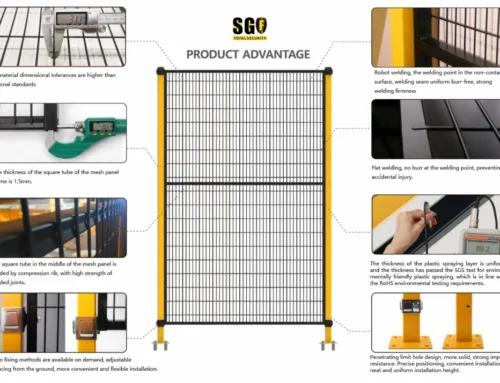
Our system solves this by allowing the seamless integration of Polycarbonate (PC) panels into the standard 60x60mm post infrastructure. These transparent, impact-resistant panels provide a sealed barrier that contains fluids and debris while maintaining the visibility required for monitoring CNC Machinery. You can protect the walkway from contamination without building a separate, custom enclosure.
Shielding Against Thermal and Optical Hazards
Robotics Integration in welding applications presents a different set of risks: UV arc flash and welding spatter. A standard fence allows harmful UV light to pass through, endangering the eyesight of anyone walking past the cell.
Instead of erecting temporary curtains or sourcing a different wall system, our modular design enables you to swap wire mesh for Solid Sheet Metal panels. These opaque panels block 100% of the arc flash and physical spatter. Crucially, they mount to the exact same Q235 Carbon Steel posts as the mesh panels. This allows you to have a solid wall facing the aisle and a mesh door for ventilation—all within the same coherent fence line.

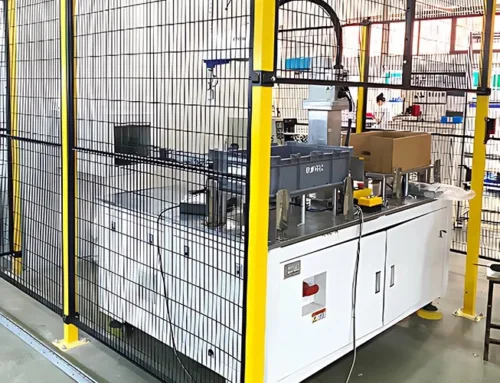
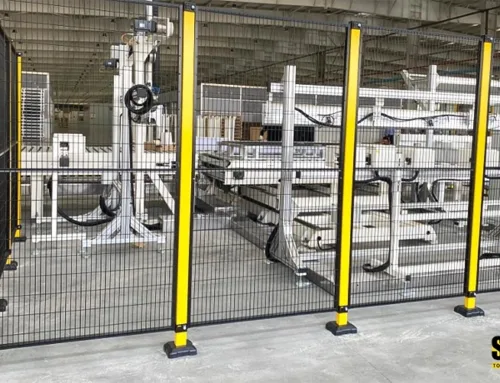
Figure: Complex layouts integrating different protection zones seamlessly.
Seamless Transitions in Hybrid Layouts
The true test of a Machine Guarding system is how it handles the transition between zones. In a “mixed-model” line, you might need high visibility for a robotic pick-and-place unit immediately followed by a shielded laser marking station.
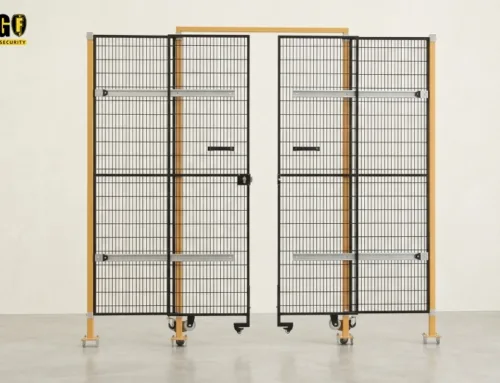
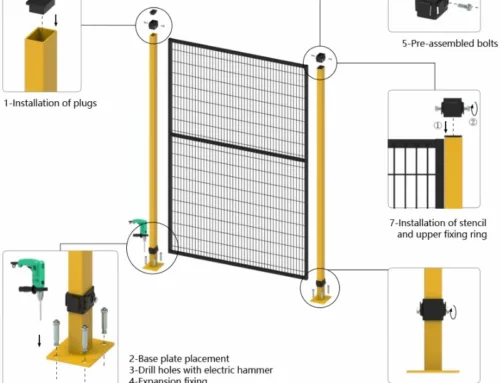
Because our system uses universal Fixing Rings, you can mount a wire mesh panel on one side of a post and a solid sheet metal panel on the other. There are no adapter brackets or complex joinery required. This modularity gives your Layout Design engineers the freedom to prescribe the exact protection needed for each meter of the perimeter, based on the specific Risk Assessment of that zone, without compromising the structural integrity or aesthetics of the line.
Streamlining the BOM for Multi-Process Lines
For a System Integrator, managing three different vendors for fencing, glazing, and partitions increases project overhead and risk. If one vendor is late, the line cannot be commissioned.
By consolidating all perimeter guarding into a single Industrial Safety Fencing system, you simplify your Bill of Materials (BOM). You utilize common posts, common anchors, and common door hardware across the entire project. This standardization not only speeds up installation but also simplifies the spare parts package you hand over to your client, adding long-term value to your Turnkey Solution.
Frequently Asked Questions
1. Can I retrofit polycarbonate panels to an existing mesh fence?
Yes. If your process changes (e.g., adding coolant to a dry machining cell), you can simply unbolt the mesh panels and replace them with PC panels using the existing posts and fixing rings.
2. Are the sheet metal panels suitable for laser safety?
Our standard steel panels are light-tight and prevent direct laser transmission. However, for high-power laser cells, we recommend consulting your Laser Safety Officer (LSO) to ensure the material thickness meets the specific containment requirements of your laser class.
3. Do you offer tinted polycarbonate for welding observation?
Yes, we can supply welding-grade polycarbonate (typically green or red tint) that filters harmful UV radiation while allowing safe visual observation of the welding robot.
4. How do you handle air pressure in fully enclosed cells?
For cells using solid panels that require ventilation, we often design a “hybrid” panel with sheet metal at the bottom (to contain heavy chips) and wire mesh at the top to allow airflow and heat dissipation.
5. Is the impact rating the same for all panel types?
While the steel frames provide consistent structural rigidity, the impact resistance of the infill material varies. Wire mesh and sheet metal offer the highest impact ratings, while polycarbonate is optimized for containment and visibility. We can advise on the correct choice based on your risk assessment.