IT
IT  EN
EN  DE
DE  RU
RU  PT
PT  JA
JA  ES
ES 
You’ve done the research. You’ve assessed your facility’s risks, chosen the appropriate level of protection, and invested in a professionally engineered, impact-rated guardrail system. The heavy-duty steel posts and bright yellow rails have just been delivered to your site. At this point, it can be tempting to think the job is almost done. But the truth is, the most critical phase is just beginning.
An engineered guardrail system is precisely that—a system. It is a chain of interconnected components where every link is designed to play a role in absorbing and distributing immense physical forces. The final, and most crucial, link in that chain is its connection to your facility’s floor. A poorly installed guardrail is little more than a decorative fence; a properly anchored one is a legitimate safety device. This is why the correct installation of parapetti per magazzini is paramount.
Let’s walk through the critical elements of installation, not just as a “how-to,” but as a “why-to,” to understand how these final steps unlock the full protective potential of your investment.
The Foundation of Strength: It All Starts with the Anchor
The single most common point of failure for an improperly installed guardrail is the anchor system. The entire force of a multi-ton impact is ultimately transferred through the posts and their base plates into the concrete floor. If this connection is weak, the entire system will fail.
The Anchor Itself
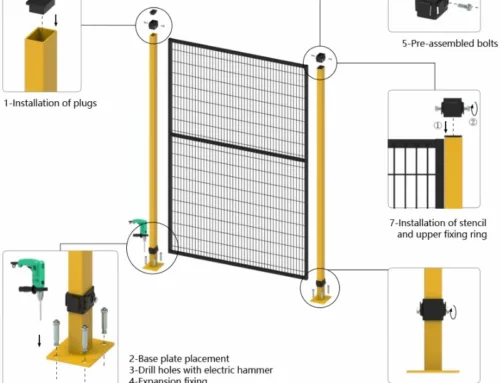
A professional guardrail system specifies the use of heavy-duty concrete anchor bolts. These are not optional suggestions. These fasteners are engineered to provide immense pull-out and shear strength. Using smaller, lower-grade hardware is a critical error that fundamentally compromises the system’s impact rating. The anchor bolt is the heart of the connection; it must be the correct type and size.
The Drilling Process
The installation requires drilling into your concrete floor with a rotary hammer or industrial drill. Precision here is key. The hole must be drilled to the correct depth and diameter as specified for the anchor bolt. A hole that is too wide will not allow the anchor to expand and grip properly. A hole that is too shallow will not provide sufficient embedment depth, drastically reducing its pull-out resistance. The anchor’s performance is directly tied to the quality of the hole it sits in.
The Base Plate as a Load Distributor
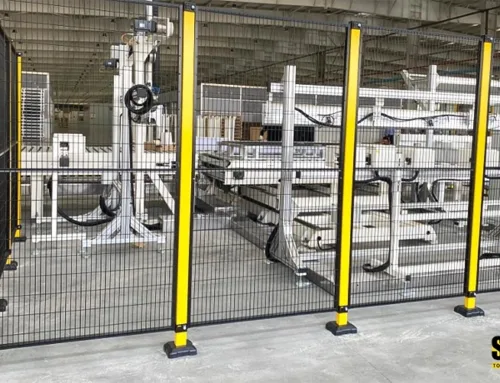
Notice the design of an engineered guardrail post. It features a wide, thick steel base plate, often 10×10 inches in size. This plate is not just for stability; it is a critical component for distributing the load. During an impact, the immense force is channeled down the post and spread across the entire surface area of this plate, reducing the pressure (psi) on any single point of the concrete and preventing the anchors from pulling through or cracking the floor. This is why a simple post welded to a small plate is not a true safety device.
Assembling the System: Ensuring a Unified Defense
Once the posts are securely anchored, the final step is to attach the W-beam rails.
The Importance of Proper Fasteners
The connection between the rail and the post is designed to be incredibly strong, using high-tensile bolts that fit into pre-threaded holes on the post. It is essential to use the supplied hardware and ensure each bolt is tightened to the correct torque using a proper tool, like a ratchet wrench. A loose connection creates a point of weakness where impact energy can cause a shearing failure rather than being absorbed by the full system.
Bolt-On vs. Lift-Out Integrity
Whether you are using a permanent Bolt-On connection or a flexible Lift-Out system, the principle remains the same. The Lift-Out brackets must be fastened to the post with the same level of care and precision as a standard rail. The integrity of this bracket is what allows the Lift-Out section to offer a comparable level of protection to its bolted-in counterparts.
Respect the Final Step
You would never accept a critical machine being installed with the wrong bolts or without being properly leveled. Your safety barrier system demands the same level of professional respect. The performance promised in the engineering specifications for our parapetti per magazzini is entirely contingent upon the quality of the installation.
By understanding the “why” behind each step—the critical role of the anchor, the physics of the base plate, and the importance of secure connections—you ensure that you are not just erecting a barrier, but are properly commissioning a vital piece of safety engineering. A well-made guardrail is an asset. A well-installed guardrail is a guardian.