EN
EN  DE
DE  RU
RU  PT
PT  JA
JA  ES
ES  IT
IT 
 |
Your production layout isn’t set in stone. Why should your safety guarding be? This article explores how a truly modular approach to safety fencing saves costs and adapts to the dynamic needs of your facility, moving beyond rigid, one-size-fits-all solutions. |
The High Cost of “Permanent” Safety
Traditional welded-in-place guarding presents a major operational problem: it’s permanent. In a modern manufacturing or logistics environment, processes are constantly optimized, and production lines are re-tasked. A welded cage that perfectly fit last year’s work cell becomes a massive steel obstacle today. The only solution is to cut it out and scrap it—a complete waste of the initial investment, not to mention the significant downtime required for its removal and the installation of a new solution.
This cycle of installing, scrapping, and reinstalling is incredibly inefficient. It treats safety guarding as a disposable expense rather than a long-term asset. The core issue is a lack of adaptability. A truly effective industrial safety fencing system needs to be as flexible as the operations it protects.
The Modular Advantage: A System, Not Just a Fence
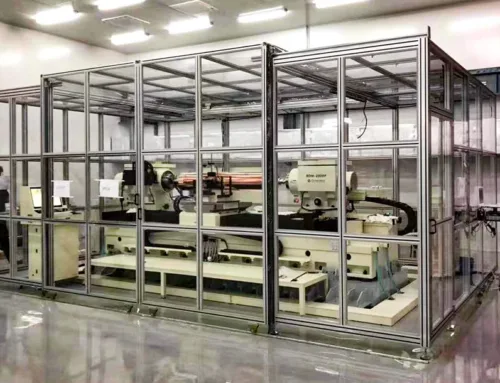
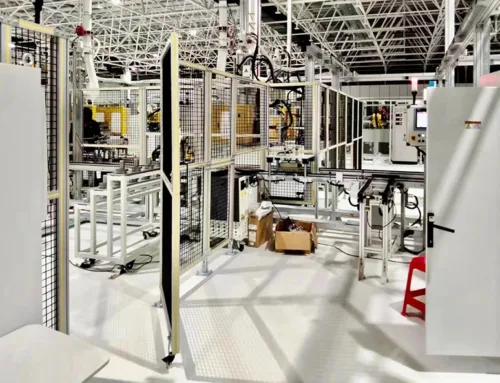
A modular system is fundamentally different. It’s an ecosystem of standardized components—posts, panels of various widths, and connection hardware—designed to be assembled without welding. This component-based design is the key to adaptability. The value isn’t just in the steel; it’s in the ability to reconfigure that steel with minimal effort.
When a production line needs to be moved or expanded, a modular system can be unbolted, reconfigured, and re-installed. The components are 100% reusable. This “unbolt and reconfigure” capability transforms the fence from a one-time cost into a capital asset that adapts with your facility.

Adapting to Real-World Layouts and Budgets
True modularity also means the system can be precisely tailored to your *actual* needs, not just a catalog standard. This flexibility works in two key ways:
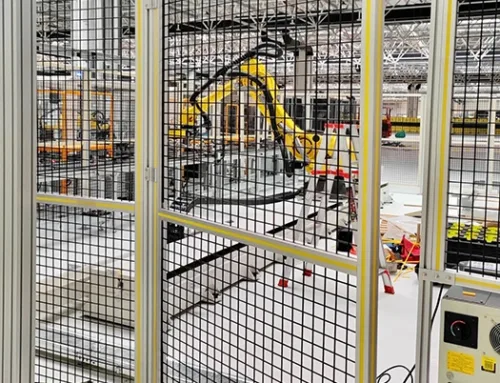
- Cost-Effective Scaling: For large-area perimeter guarding where high-impact protection isn’t the primary goal, the system can be value-engineered. Based on your risk assessment, you might use a 4-foot height (1.2m) and a 3.0mm wire diameter instead of a heavy-duty 8-foot (2.4m) high, 4.0mm wire system. This practical adjustment allows you to secure massive areas (e.g., 180+ linear feet) while staying within a strict budget, all while using the same core post and connection system.
- Purpose-Built Customization: For areas with unique challenges, the system can be built up. If you need to clear a tall piece of machinery, a custom 8-foot (2.44m) post and panel height is not a problem. If floor space is tight, a standard hinged door can be swapped for a wide-span sliding door that uses an overhead guide rail. This avoids the “one size fits all” trap and provides a solution that fits your exact layout.
Your Facility is Dynamic. Your Guarding Should Be Too.
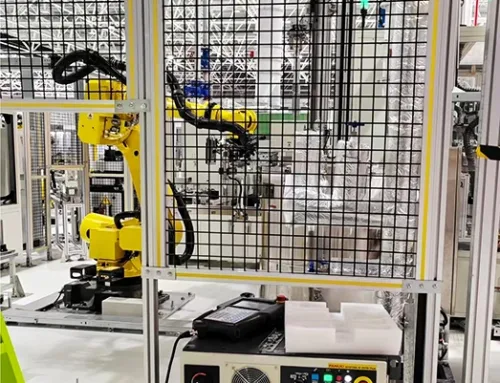
When you invest in a modular robot safety fencing system, you are investing in flexibility. You gain the ability to react quickly to operational changes without scrapping your initial purchase. This approach allows you to protect your team and your high-value automation equipment while also protecting your budget from the hidden costs of inflexible, “permanent” guarding.
Don’t let rigid fences dictate your workflow. Choose a system that can be reconfigured as easily as you reconfigure your production floor.
Frequently Asked Questions
1. What does “modular fencing” actually mean?
It means the fencing is built from standardized, interchangeable components (posts, panels, doors, connectors) that are bolted together on-site. This allows the layout to be easily changed, expanded, or moved without welding or fabrication.
2. Can I re-use the components if I move my work cell?
Yes. That is the primary value. You can unbolt the entire system, move it to a new location, and reassemble it in a new configuration. All components are reusable.
3. Is a modular system strong enough for heavy-duty protection?
Absolutely. A well-engineered modular system, built from heavy-gauge steel (e.g., 60x60mm posts) and framed mesh panels, can meet and exceed high-impact resistance standards (like TUV certification) for machine guarding fence applications.
4. What if I have a non-standard angle, like 45 degrees?
A good modular system is designed for this. It uses adjustable connection hardware or specific angled connectors that allow you to create layouts with any angle, not just 90-degree corners.
5. Can I mix different panel types in the same system?
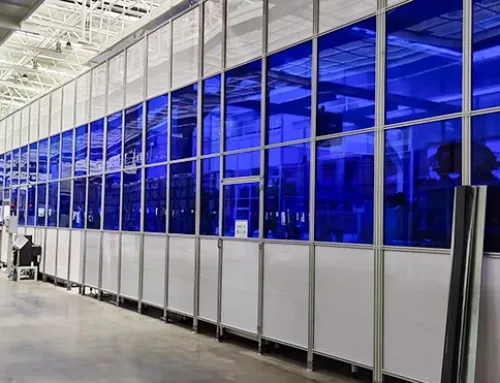
Yes. You can often combine standard wire mesh panels (for airflow and visibility) with clear polycarbonate panels (for enhanced visibility) or solid steel panels (for containing sparks or fluids), all within the same post-and-rail system.