EN
EN  DE
DE  RU
RU  PT
PT  JA
JA  ES
ES  IT
IT 
 |
In the execution of a turnkey solution, your most expensive resource is engineering time. Every hour a senior controls engineer spends figuring out how to mount a safety switch to a steel post is an hour lost on programming industrial robots or optimizing PLC logic. This “mechanical-electrical gap” is a silent profit killer in system integrator networks. Traditional fencing leaves this integration problem to be solved on-site, often with drills and zip ties. It is time to demand more from your Industrial Safety Fencing—transforming it from a passive barrier into a pre-engineered platform for your control equipment. |
The “Drill and Tap” Bottleneck
The scenario is all too common: The mechanical team erects the perimeter guarding and leaves. Days later, the electrical team arrives to install safety interlocks (like Omron D4NL or Pizzato FS series). They find bare 60x60mm posts with no mounting holes. Now, high-value personnel are forced to become metalworkers—measuring, marking, drilling, and tapping steel in a finished automated production line environment.
This manual process creates three problems: it slows down commissioning, it breaches the anti-corrosion powder coating, and inevitably, manual drilling leads to misalignment between the switch and the actuator key. This misalignment is the root cause of “nuisance tripping” that plagues robot work cells long after handover.
The Solution: The Interlock Carrier Strategy
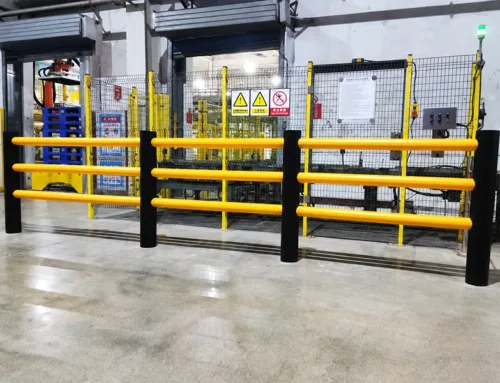
We believe the fence should arrive ready for the sensor. That is why we developed the Interlock Carrier system. As shown below, we provide engineered mounting kits and L-brackets specifically designed for industry-standard safety hardware.

Pre-engineered carriers for slide bolts and safety switches eliminate on-site fabrication.
Seamless Handover from Mechanical to Electrical
When you specify our system for your robotics integration, you are buying a guaranteed interface. Your mechanical installers bolt the carrier to the pre-drilled holes on the post. Your electrical team simply screws the switch into the threaded inserts. The alignment is perfect, the rigidity is absolute, and the installation time drops from 45 minutes per door to 5 minutes. This is how you protect the margins of your turnkey solutions.
Engineering Support as a Service
Your team excels at designing automation, not counting fence posts. We act as your specialized perimeter engineering department. Send us your CAD layout (DWG/STEP), and we return a comprehensive deployment plan.
We resolve conflicts between conveyors, building columns, and safety zones before the steel is even cut. By using our standard modular components—like the Q235 carbon steel posts and framed panels—we create a “custom” fit without the custom lead time. This allows you to present a polished, professional safety strategy to your clients in the automotive industry association, proving that you control every detail of the project.
Frequently Asked Questions
1. Which safety switch brands are your carriers compatible with?
We offer off-the-shelf mounting kits for major global brands including Omron, Pizzato, Sick, and Allen-Bradley. For niche brands, we can provide a universal mounting plate.
2. Does pre-drilling affect the structural integrity of the posts?
No. Our posts are engineered with specific reinforced zones for mounting hardware. The structural analysis ensures that even with mounting holes, the system maintains its TUV-certified impact resistance.
3. Can we combine mechanical locks with electrical interlocks?
Yes. Our system is modular enough to support a “layered” security approach, such as using a padlockable slide bolt for LOTO (Lockout/Tagout) alongside a coded magnetic safety switch for control logic.
4. How accurate does our floor layout need to be?
Our adjustable fixing rings and base plates allow for significant tolerance (up to ±50mm in some configurations), so minor discrepancies between the CAD file and the actual concrete floor can be absorbed during installation.
5. Do you provide 3D models for our digital twin?
Yes. We can provide STEP files of the full fence assembly to integrate into your master automated production line model, ensuring collision checking and visual validation before purchase.