EN
EN  DE
DE  RU
RU  PT
PT  JA
JA  ES
ES  IT
IT 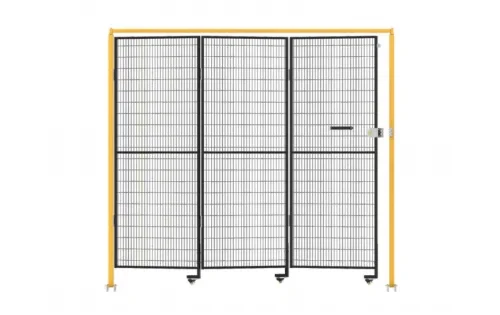

Your new robot arm is fast, precise, and… a major headache to guard safely in a tight footprint. Stop wasting project hours fabricating custom brackets for safety switches and wrestling with generic fencing that doesn’t fit your layout. There’s a smarter way to deploy a compliant, integrated robot work cell, fast.
For small factories, deploying a new robot isn’t just about the automation; it’s about safeguarding it without blowing the budget or project timeline. The challenge isn’t finding a fence, it’s finding a robot safety fencing system that understands the realities of a compact, multi-tasking workspace. Generic fencing often creates more problems than it solves, forcing your team into time-consuming on-site modifications that introduce risk and delays.
## The Hidden Costs of “Standard” Fencing in Small Robot Cells
In a small factory, floor space is premium. Every square foot dedicated to a robot work cell needs to be productive. When you try to secure a new FANUC or KUKA arm with a one-size-fits-all guarding solution, you immediately run into predictable, costly obstacles.
* **Integration Nightmare:** Your safety PLC requires the fence door to be tied into the E-stop circuit. This means mounting a safety interlock switch like an Omron D4NL or a Pizzato. Suddenly, your installer is spending hours drilling into posts, fabricating custom mounting plates, and hoping the alignment is perfect. It’s a bottleneck that can halt the entire commissioning process.
* **Wasted Footprint:** Standard panel sizes force you into inefficient layouts, creating awkward, unusable gaps or pushing the cell’s footprint out further than necessary. This eats into valuable floor space that could be used for material staging or access walkways.
* **Weak Points and Compliance Risks:** A hastily modified post or a flimsy door that sags over time isn’t just an operational nuisance; it’s a safety liability. An impact from a forklift or a failure of the end-of-arm tooling could compromise a weak point, putting both personnel and your expensive robot at risk.
These aren’t minor issues. They represent real project hours, increased labor costs, and the nagging risk of failing a safety audit.
## A Modular System Built for Integration, Not Just Isolation
The Mdfence system was engineered to solve these exact problems. It’s not just a collection of posts and panels; it’s a cohesive ecosystem designed for the demands of modern automation systems.
The Foundation: Robust, Adaptable Hardware
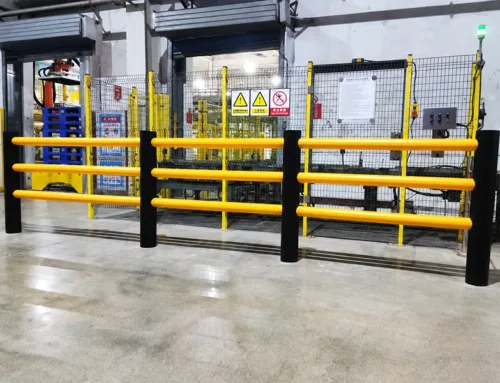
It starts with a solid structure. The system is built on 60 x 60mm posts made from high-strength Q235 carbon steel, anchored securely with M10 expansion bolts. This provides the TUV-certified impact resistance needed to protect your assets.

The panels are fully framed, using 20 x 30mm steel tubing with the wire mesh welded flat on the inside. This small detail is critical—it creates a smooth, catch-free outer surface and adds significant rigidity, preventing the panel from buckling under impact. This modularity allows for precise layouts, even with complex angles or obstructions, as shown in this customized project plan.

For small factories where space is tight, the door system is crucial. A space-saving sliding door can provide wide access for maintenance or material loading without the swing radius of a hinged door.

The Game Changer: The Pre-Engineered Safety Interlock Carrier
This is where the Mdfence system moves beyond a simple physical barrier to become an active part of your machine safety circuit. Instead of leaving the critical task of mounting interlock switches to chance, we offer a pre-engineered **Safety Interlock Carrier**.

This is not just a piece of bent metal. It’s a purpose-built mounting plate designed to securely and accurately position common safety switches from brands like Omron, Schmersal, or Pizzato.
**Before Mdfence:**
* Measure and mark the post.
* Drill pilot holes, hoping they are level.
* Tap the holes.
* Fabricate a custom bracket for the actuator on the door.
* Mount everything and spend 30 minutes adjusting alignment.
* **Total Time: 1-2 hours of skilled labor per door.**
**After Mdfence:**
* Bolt the pre-drilled Safety Interlock Carrier to the post.
* Bolt the switch and actuator plate on.
* **Total Time: 15 minutes.**
For a system integrator on a tight deadline or a small factory’s maintenance team, this time saving is immense. It eliminates a major source of on-site fabrication, reduces project risk, and ensures a clean, professional, and reliably functioning safety gate from day one. This is how you build a truly efficient and compliant robot safety fencing system.
Frequently Asked Questions (FAQ)
1. Our floor is uneven. Can your system accommodate that?
Yes. While the system is designed for level concrete floors, minor variations can be managed during installation. The modular nature of the panels and the fixing rings allow for slight adjustments. For more significant slopes, custom-length posts can be provided to ensure the top of the fence line remains level.
2. What is the typical lead time for a small robot cell project?
For projects using standard components (2000mm high posts, standard width panels, and common door types), lead times are typically very short. Since the system is modular and components are stocked, we can often ship within days of a finalized layout. Custom heights or colors will require a longer lead time.
3. Do we need special tools for installation?
No special tools are required. Installation is done with standard hand and power tools, including a hammer drill for the floor anchors (M10 expansion bolts), a laser level, and metric hex wrenches/sockets for the fasteners. The system is designed for rapid, on-site assembly with no welding needed.
4. Can we modify the layout later if we change our production line?
Absolutely. This is a core benefit of the modular design. The entire system can be unbolted, reconfigured, and re-assembled to fit a new layout. This protects your initial investment and provides the flexibility needed in a dynamic small factory environment.
5. How does the fencing system comply with safety standards like ISO 14120?
The Mdfence system is designed and manufactured to meet or exceed the requirements of key international safety standards, including ISO 14120 (Safety of machinery – Guards). This includes specifications for materials (Q235 carbon steel), mesh opening size to prevent reach-through, and certified impact resistance to withstand foreseeable hazards in an industrial environment.