EN
EN  DE
DE  RU
RU  PT
PT  JA
JA  ES
ES  IT
IT 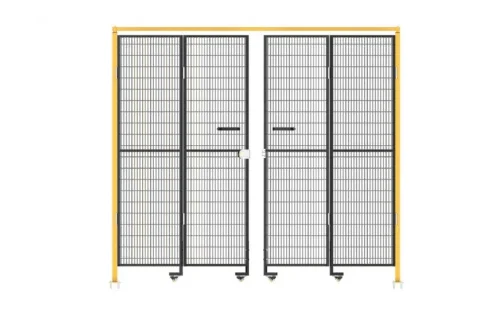

|
Stop compromising between visibility and arc flash protection. In a high-amperage robotic welding cell, a standard wire mesh fence stops the robot arm, but it won’t stop UV radiation or molten spatter from blinding a forklift driver passing by. Conversely, a solid wall kills ventilation and creates dangerous “dark spots” on the floor. Here is the engineering logic on how to configure your perimeter for both OSHA compliance and operational efficiency. |
The Core Conflict: Impact Energy vs. Process Byproducts
In the metal fabrication industry, particularly within automotive chassis welding or heavy machinery construction, the safety barrier serves two distinct masters. First, it must contain the kinetic energy of a rogue manipulator (e.g., a FANUC M-2000iA carrying a heavy jig). Second, it must contain the process byproducts: Arc flash (UV/IR radiation), weld spatter, and fumes.
Choosing the wrong panel type results in two scenarios: either your EHS manager shuts you down for ISO 25980 violations (light leakage), or your maintenance team revolts because they can’t see the robot’s axis status without opening the door and tripping the safety circuit.
1. The Case for Standard Wire Mesh (The Structural Backbone)
Standard Industrial Safety Fencing using wire mesh is the default for 80% of the perimeter.
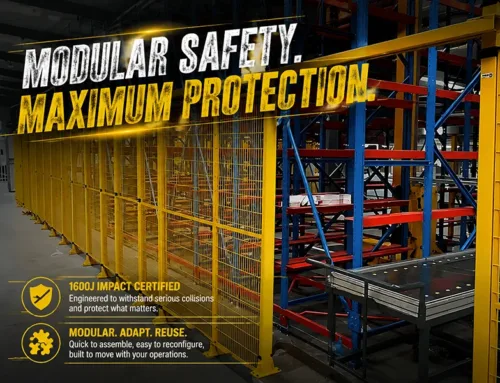
* **Impact Resistance:** Mdfence uses a 20x30mm tubular steel frame with 3.0mm or 4.0mm wire. This structure is TUV certified to withstand **1600 Joules** of impact. If a workpiece is thrown by the positioner, the mesh deforms plastically to absorb the energy, preventing catastrophic breakthrough.
* **Visibility & Airflow:** In high-duty cycle welding, smoke extraction systems need makeup air. Solid walls create negative pressure zones that disrupt shielding gas coverage. Mesh allows free airflow.
* **The Limitation:** Standard 20x100mm or 50x50mm mesh offers **zero protection** against UV radiation or flying sparks.

Figure 1: Standard framed mesh installation. Ideal for perimeters outside the direct “splash zone” of the weld arc.
2. The Case for Welding Shields (Polycarbonate or Sheet Metal)
When the fence line is within the direct line of sight of the arc (specifically MIG/MAG welding with high spatter), mesh is insufficient.
* **UV Filtration:** Dark green or red polycarbonate panels (compliant with EN 1598) block harmful UV rays while allowing supervisors to safely observe the weld pool stability from the outside.
* **Spatter Containment:** Molten slag can fly up to 20 feet. If it lands on a nearby hydraulic hose or a cardboard bin, you have a fire hazard. Solid panels provide a physical containment wall.
3. The “Hybrid” Solution: The Industry Standard
You do not need to choose one or the other. The most effective solution for robotic cells utilizes the **Mdfence Modular Architecture**.
Because our system uses a **Framed Panel** design (unlike frameless “crimped” wire), you can easily retrofit protection where needed without replacing the steel structure:
1. **The “Kick Plate” Method:** Use sheet metal for the bottom 3 feet of the panel to stop rolling slag and heavy debris from escaping onto the aisle.
2. **The “Curtain” Method:** Install standard Machine Guarding Fence Panels for structural integrity, and simply zip-tie or bolt welding curtains directly to the 20x30mm steel frame on the inside. This gives you the 1600J impact rating of steel *plus* the UV protection of the curtain, at a fraction of the cost of solid sheet metal walls.
Access Control: Solving the “Overhead Crane” Problem
In heavy welding (e.g., excavator buckets or truck frames), parts are often loaded via overhead crane. A standard hinged door is useless here because the header beam blocks the crane cable.
For these scenarios, the **Open-Top Sliding Door** or **Cantilevered Sliding Door** is mandatory.
* **No Overhead Obstruction:** The door slides on a floor track or a cantilevered guide, leaving the space above the door completely open for the crane to drop the part into the jig.
* **Spatter Proof Guides:** Unlike cheap aluminum rails that get clogged with weld dust, Mdfence uses heavy-duty steel guides that resist industrial grime.

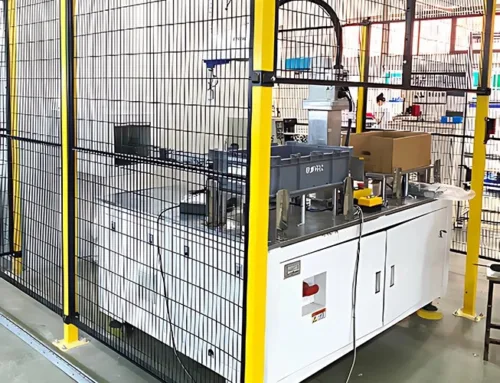
Figure 2: Double Sliding Door system providing wide access for forklifts or AGVs loading heavy welding fixtures.
Safety Interlock Integration in High-Risk Zones
A welding cell is a PLe / SIL 3 hazard zone. If a worker opens the door while the robot is arcing, the system must shut down immediately.
Cheap fencing fails here because the mesh flexes, causing the safety key to misalign with the switch. Mdfence solves this with **Rigid Framed Doors** and pre-drilled mounting plates for Omron, Keyence, or Fortress Interlocks.

Figure 3: Dedicated mounting brackets for safety interlocks ensure precise alignment, preventing nuisance tripping in high-vibration welding environments.
Summary: The Mdfence Configuration for Welding
For a typical Tier 1 Automotive welding line, we recommend the following configuration:
* **Front (Operator Side):** Polycarbonate-lined mesh or welding curtains attached to Mdfence frames. Protects eyes, maintains visibility.
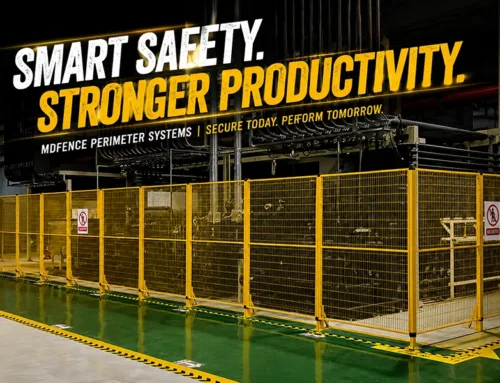
* **Sides (Perimeter):** Standard 20x100mm Robot Safety Fencing. Maximizes airflow and reduces cost.
* **Loading Zone:** Heavy-duty Sliding Doors (Trackless if AGV access is needed) with interlock integration.

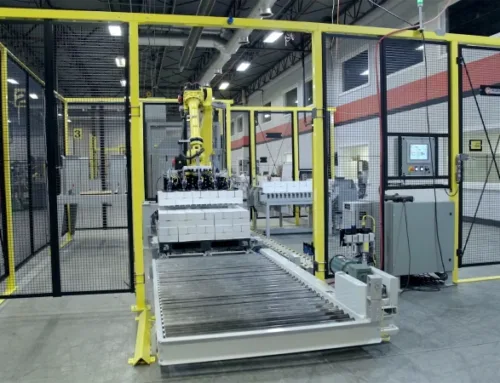
Figure 4: A complex robotic cell layout utilizing modular panels to navigate around columns and positioners.
Frequently Asked Questions (Welding & Robotics)
Q1: Can weld spatter damage the powder coating on the fence?
Mdfence uses a high-grade electrostatic powder coating (RAL 1023/9005). While it is resistant to heat and oil, direct, sustained contact with molten slag will eventually mar any finish. For areas within 2 feet of the arc, we recommend attaching a sacrificial sheet metal shield to the mesh frame.
Q2: How do I calculate the safety distance for a welding robot?
You must follow ISO 13857. With our standard 20x100mm mesh aperture, the safety distance is significantly reduced compared to 50x50mm mesh, allowing you to place the fence as close as 120mm from the hazard zone, saving valuable floor space.
Q3: Can I mount welding curtains directly to your fence?
Yes. The Mdfence system features a 20x30mm tubular steel frame (not just a bent wire edge). This provides a rigid surface to bolt, screw, or zip-tie standard welding curtains without compromising the structural integrity of the guard.
Q4: My welding cell has a smoke collector duct passing through the fence line. How do we handle this?
Our “Cut-to-Fit” on-site capability allows installers to cut the mesh to accommodate ducts or cable trays. Because the wire is welded to a frame, cutting a small section for a duct does not unravel the entire panel. We also offer tunnel guards for conveyor pass-throughs.
Q5: Do you offer “Anti-Glare” mesh?
Our standard mesh panels are powder-coated in RAL 9005 (Jet Black). Black mesh absorbs light rather than reflecting it, which significantly improves visibility for operators looking into the lighted cell, reducing eye strain compared to grey or galvanized mesh.