EN
EN  DE
DE  RU
RU  PT
PT  JA
JA  ES
ES  IT
IT  |
Your robotic cell is commissioned, the PLC code is flawless, but the entire project is on hold. Why? The safety fencing doesn’t align with the specified interlock, and the end-client’s EHS manager just red-tagged your installation. On-site fabrication is not an option. This isn’t a fencing problem; it’s a project-killing integration failure. |
Beyond the Barrier: Choosing a Safety Fencing Machine Guarding System That Accelerates Commissioning
For an automation system integrator, the physical barrier around a robotic cell is the last thing that should cause a headache. Yet, too often, it becomes a major bottleneck during the final, most critical stages of a project. The choice of industrial safety fencing is not just about containment; it’s about seamless integration, rapid assembly, and first-pass EHS audit approval. A fence that requires on-site cutting, welding, or drilling is a liability that introduces delays, compromises quality, and erodes profit margins.
The Nightmare of On-Site Fabrication: A Familiar Story
Imagine this: you’ve sourced a generic, low-cost fence for a new automated assembly line. During installation, the technician discovers there’s no provision for the Omron D4NL safety interlock specified in the FMEA. The only solution is to get out the angle grinder and hand drill.
This “simple” fix instantly creates a cascade of problems:
- Hot Work Permits: Welding and grinding require permits, introducing administrative delays and potential production shutdowns in the surrounding area.
- Contamination Risk: Metal shavings and weld spatter fly near sensitive, six-figure robots and conveyors, creating a significant contamination risk.
- Compromised Durability: The protective powder coating is destroyed at every drill point, creating an immediate entry for rust—a glaring red flag for any quality-conscious end-client.
- Nuisance Trips: A hand-drilled mount for a door interlock is rarely perfect. Over time, the door sags, the alignment shifts, and the safety circuit starts triggering nuisance trips, killing the OEE of the very line you just commissioned.
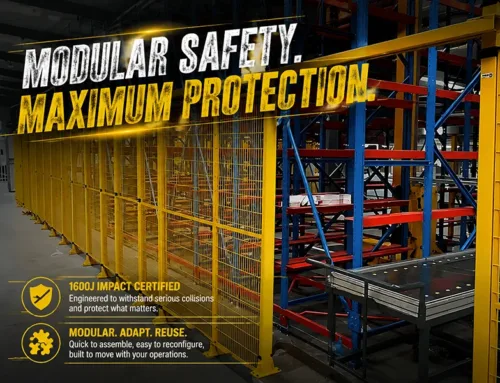
This approach transforms a simple hardware installation into a complex, high-risk fabrication project. The Mdfence modular system was engineered to eliminate this entire scenario. It is a 100% “cold assembly” solution. Every component, from the robust framed panels to the posts, is bolted together. Two technicians with basic hand tools can assemble 50 meters in a single day—up to 70% faster than a welded solution—with no fire hazards, no fumes, and no mess.

From “Dumb Barrier” to Smart Component: Integrating Safety Logic by Design
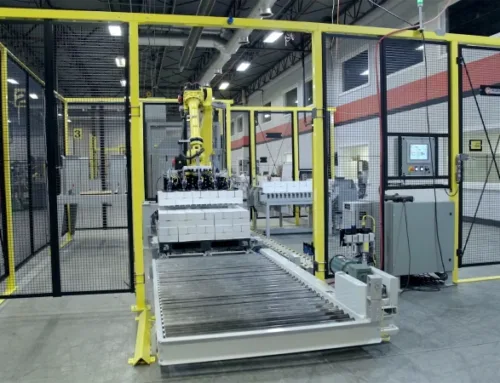
The most critical failure of generic fencing is treating it as a dumb barrier. In a modern automated system, the fence is the physical extension of the safety PLC. It must reliably host the interlocks, switches, and E-stops that form the core of the machine’s safety circuit.
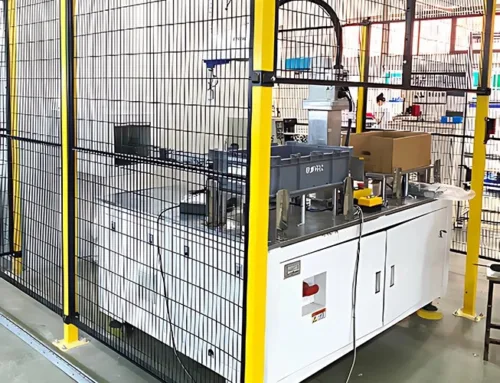
When your project specs call for a specific Pizzato, Schmersal, or Omron safety interlock, your machine guarding system shouldn’t require a custom-welded bracket. Mdfence is designed as an integrated safety platform. We provide pre-engineered safety interlock carriers—standardized mounting plates designed with the precise hole patterns for industry-leading switch brands. This isn’t an accessory; it’s a part number in the BOM.

This design-for-integration approach delivers immediate value:
- Guaranteed Alignment: The switch bolts on perfectly, ensuring the actuator key engages without issue.
- Structural Integrity: Our rigid, framed door panels prevent sagging, meaning the interlock maintains its precise alignment through thousands of cycles.
- Zero Rework: You eliminate the risk, time, and cost of fabricating one-off solutions on the plant floor.
The result is a safety system that passes the EHS audit on the first walkthrough, accelerating your project’s final acceptance and payment.
Reclaim Floor Space: The Financial Impact of Smart Mesh Design
In today’s factories, floor space is a high-value asset. The physical footprint of your safety system directly impacts the efficiency and accessibility of the entire work cell. Many conventional fences use a 50x50mm mesh, which, according to ISO 13857 safety standards, may require the barrier to be placed as far as 850mm (approx. 33.5 inches) from the hazard to prevent reach-through.
Mdfence utilizes a 20x100mm “finger-safe” mesh aperture. This seemingly small detail has a massive impact. This design allows the robot safety fencing to be installed as close as 120mm (approx. 4.7 inches) from the hazard. For a 20-meter (65-foot) long automated line, this can reclaim over 14 square meters (150 sq. ft.) of high-value production floor space. This reclaimed space can mean a wider maintenance access corridor, more room for material staging, or even the ability to fit an additional piece of equipment into a tight layout—a powerful selling point for your solution.

Ultimately, the best safety fencing for your automated assembly line is not the one with the lowest price per foot. It’s the system that functions as a true integration tool—one that accelerates your installation, guarantees compliance, and enhances the overall value and efficiency of the solution you deliver to your client.
Frequently Asked Questions
1. Can your system accommodate specific safety interlocks like Schmersal or Pizzato?
Absolutely. We offer a range of pre-engineered safety interlock carriers designed with the exact mounting patterns for major brands like Omron, Pizzato, Schmersal, and others. This eliminates the need for on-site drilling or fabrication, ensuring a perfect fit and reliable operation as part of your machine’s safety circuit.
2. We have conveyors passing through the robot cell. How do you handle that?
We design and provide custom tunnel guards (also known as conveyor pass-throughs). These are specifically engineered to fit your conveyor’s dimensions while strictly adhering to the safety distance requirements of ISO 13857, ensuring materials can pass through while preventing personnel access to the hazard zone.
3. Our end-client is in the automotive industry and has very high EHS standards. Is your system certified?
Yes. The Mdfence system is engineered to meet or exceed key international safety standards, including ISO 14120 (General requirements for the design and construction of guards). Its structural integrity and impact resistance are validated by TUV testing, making it suitable for the rigorous EHS audits common in the automotive and other high-spec manufacturing sectors.
4. How quickly can we get a layout and BOM for our project?
We understand the fast pace of integration projects. We provide a full library of 3D CAD models (STP files) for our components. This allows your engineering team to directly import the fencing system into your master assembly layout, verify fit and clearances, and generate a precise Bill of Materials (BOM) automatically, drastically reducing design time.
5. What happens if a forklift damages a panel during operation post-installation?
This is a key advantage of a modular system. Because every panel is bolted in place, a damaged section can be replaced in minutes. You simply unbolt the four connectors, swap in a new standard panel, and tighten the bolts. This significantly reduces Mean Time to Repair (MTTR) compared to a welded fence, which would require a lengthy process of cutting, grinding, welding, and repainting, causing extended downtime.