EN
EN  DE
DE  RU
RU  PT
PT  JA
JA  ES
ES  IT
IT 

|
Your robot cell is a masterpiece of engineering, but the safety guarding looks like an afterthought. Cables are zip-tied everywhere, your team had to drill into the brand-new powder coat to mount a single interlock, and now you’re worried about the EHS audit. There has to be a better way. |
The Integrator’s Dilemma: Cable Management vs. Machine Guarding
As an automation system integrator, you live and die by project timelines and client satisfaction. You specify the best FANUC or KUKA robot, the most reliable PLC, and the most precise servo drives. But when it comes to the robot safety fencing, a critical detail often gets overlooked until commissioning: how do you cleanly and safely run power, I/O, and air lines to the devices mounted on it?
The traditional approach is a recipe for headaches. You see your team:
- Drilling Holes: Taking a drill to a brand new, powder-coated post to mount a Schmersal interlock or an emergency stop button. This not only looks unprofessional but instantly compromises the corrosion resistance, inviting rust at the first exposure to coolant or washdown.
- The “Zip-Tie” Method: Creating a “spider web” of cables held on with zip ties. These exposed cables are vulnerable to being snagged by maintenance carts, abraded by vibration, and create a messy appearance that undermines the quality of your entire integration project.
- On-Site Fabrication: Wasting precious hours on-site, cutting and welding custom brackets to mount a simple sensor or junction box because the “guarding” wasn’t designed to be a functional part of the control system.
This isn’t just an aesthetic issue; it’s a direct hit to your efficiency, your reputation, and the long-term reliability of the system you deliver.
Thinking Beyond the Barrier: Guarding as an Infrastructure
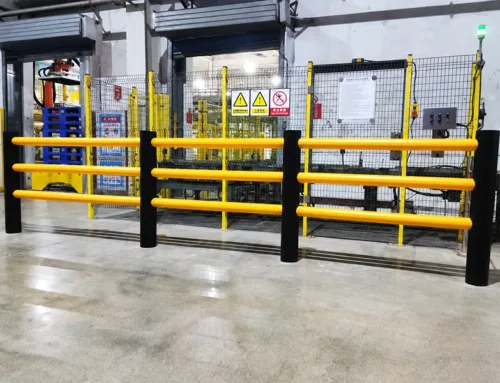
The best way to run cables through machine guarding is to stop thinking of it as a simple barrier and start seeing it as part of your automation infrastructure. A well-designed system should anticipate the need for electrical and pneumatic integration from the very beginning. This is where the structural design of the Mdfence system provides a built-in solution.
Instead of being a problem to work around, the fence itself becomes the solution for cable management. Here’s how:
1. Use the Hollow Posts as Vertical Raceways
Every standard Mdfence post is constructed from a robust 60x60mm (approx. 2.36″ x 2.36″) hollow Q235 carbon steel tube. This isn’t just for strength; it creates a protected, vertical channel. You can run a multi-conductor cable from your overhead tray or floor conduit directly up through the post to the exact height of your device, completely shielded from the industrial environment.

This eliminates exposed vertical cable runs, providing a clean, professional look and superior protection for critical wiring like your Safety Torque Off (STO) circuit.
2. Leverage Panel Frames as Horizontal Conduits
Unlike cheap, frameless mesh, every Mdfence panel features a full 20x30mm (approx. 0.79″ x 1.18″) tubular steel frame. This frame acts as a perfect, rigid raceway to run sensor or actuator cables horizontally along the perimeter of the cell. Cables can be neatly secured to the inside of the frame with industrial clips, keeping them out of sight and away from potential snag points.
3. Mount Devices on Flat, Stable, Pre-Engineered Surfaces
The rigid, flat surfaces of the steel posts and frames provide an ideal mounting plane for all your peripheral devices. More importantly, the Mdfence system includes pre-engineered mounting plates and carriers specifically designed for the industry’s most common safety interlocks.

Need to install an Omron D4NL or a Pizzato FS series switch? There’s a standardized, bolt-on solution. No more on-site drilling. No more custom brackets. This “plug-and-play” approach transforms a time-consuming task into a simple, repeatable assembly step, slashing your installation and commissioning time.
The Result: A Faster, Cleaner, More Profitable Integration
By treating your industrial safety fencing as an integrated part of your design, you shift from a problematic “Before” to a streamlined “After.”
- Before: Hours lost to on-site fabrication, messy cable runs, and worrying about EHS compliance.
- After: A clean, “spec-built” appearance that impresses your client. Cables are protected, devices are securely mounted on standardized brackets, and the entire cell is audit-ready the moment you power it on.
Ultimately, the best way to run cables through your machine guarding is to choose a system that was designed with a controls engineer’s challenges in mind. It saves you time, enhances the quality of your finished product, and protects your profitability.
Frequently Asked Questions
1. Can I mount my specific brand of safety interlock on Mdfence doors?
Yes. We offer a range of pre-engineered mounting plates and lock carriers specifically designed for common safety interlocks from brands like Omron, Pizzato, Schmersal, and others. This eliminates the need for on-site drilling or custom fabrication, ensuring a perfect fit and fast installation.
2. Is it acceptable to drill a hole in a post to pass a conduit connector through?
We strongly advise against drilling into the main structural components. Doing so breaks the protective powder coating, creating a point for corrosion to begin, and can compromise the certified impact resistance of the system. The recommended method is to use the natural hollow of the posts as a vertical raceway.
3. What is the best way to secure cables along the panel frames?
Standard industrial-grade cable clips or high-quality UV-resistant zip ties are effective. By running the cables along the interior-facing side of the 20x30mm tube frame, they are shielded from external contact and maintain a clean, organized appearance.
4. Do you offer components for mounting HMIs or operator panels?
Yes, the modular nature and structural rigidity of our system make it easy to mount HMI arms and operator panels. The 60x60mm posts provide a solid foundation, and we can provide guidance on the best mounting practices for your specific equipment.
5. How do you manage cables across a sliding door opening?
For sliding doors, cables are typically managed using a flexible cable carrier (e-chain) that runs parallel to the door track. The Mdfence system provides solid structural points on the door and fixed posts to securely mount the ends of the cable carrier, ensuring long-term reliability.