EN
EN  DE
DE  RU
RU  PT
PT  JA
JA  ES
ES  IT
IT 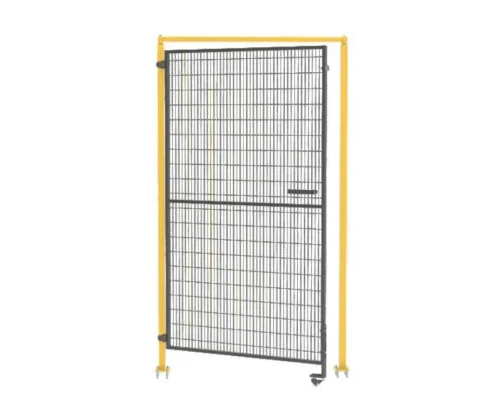
 |
Your CNC machining center is the heart of your operation, but flying chips, coolant spray, and the risk of operator reach-in are constant threats to both safety and uptime. A generic fence is a clumsy patch; you need an engineered guarding system that understands the realities of metalworking. |
The Problem with “Good Enough” CNC Guarding
In any busy machine shop, the area around a CNC mill or lathe is a controlled chaos of high-speed spindles, sharp tooling, and corrosive cutting fluids. The conventional approach to safety—often bulky, welded-in-place barriers or flimsy mesh—creates its own set of problems. Solid panels obstruct the operator’s view, hiding critical machining processes. Cheap mesh with large openings forces you to waste valuable floor space to meet safety distance requirements. And when a forklift inevitably clips a post, the “hot work” required for repair means shutting down a cell that should be making you money.
A modern Safety Fencing Machine Guarding system must do more than just build a wall. It needs to contain hazards, optimize your shop’s footprint, and integrate seamlessly with your production workflow.
Challenge 1: Containing Chips and Coolant Without Sacrificing Visibility
The “Before” Scenario: Hot metal chips from a roughing operation ricochet off a polycarbonate panel, scratching it until it’s opaque. Corrosive coolant mists and splashes, pooling at the base of a poorly coated fence post, starting a rust bloom within months. Your operator has to crane their neck or squint through a cloudy panel to check for tool wear, compromising both their view and their safety.
The Mdfence Logic: Our system is engineered for the harsh reality of a CNC environment. We combine two key elements:
- High-Visibility Black Mesh: Our standard RAL 9005 black mesh panels use a simple principle of optics: black absorbs light and reduces glare. This creates a “see-through” effect, giving your team a crystal-clear view of the workpiece and tool, while physically stopping any ejected material.
- Durable Q235 Steel with Powder Coating: The entire system is built from high-tensile Q235 carbon steel. More importantly, it’s protected by an electrostatic powder coating that passes ISO 9227 salt spray tests. This means it actively resists the corrosive effects of synthetic coolants and industrial oils, preventing rust and maintaining structural integrity.
The “After” Result: Your machining cell is safely contained, yet fully visible. The shop floor stays cleaner and safer from stray chips and slippery coolant slicks. The guarding system looks as professional on day 1,000 as it did on day one, withstanding the chemical onslaught of daily production.
Challenge 2: Reclaiming Valuable Floor Space in a Crowded Shop
The “Before” Scenario: You’re trying to squeeze a new vertical machining center onto the floor, but your existing safety fence, with its 2×2 inch mesh, requires a massive 34-inch standoff distance from the machine’s moving parts to be compliant. That wasted perimeter space is the difference between adding a new machine or not, and it creates inefficient, tight walkways for personnel and tool carts.
The Mdfence Logic: This is a problem of physics and standards, solved by precision engineering. According to ISO 13857, the size of the opening in a guard determines how close it can be to a hazard. Our standard 20x100mm (approx. 0.78″ x 3.9″) mesh is specifically designed to be “finger-safe.” The narrow opening prevents an operator’s fingers from reaching through to the danger zone. This allows the Mdfence system to be installed as close as 120mm (approx. 4.7 inches) from the hazard.
The “After” Result: You immediately reclaim floor space. Compared to the 34 inches required by larger mesh, our system saves you over 29 inches of depth along the entire perimeter of the machine. For a typical 15′ x 10′ CNC cell, that’s over 40 square feet of high-value production space recovered—enough for a tool rack, a quality check table, or a wider, safer aisle.

Challenge 3: Integrating Safety Interlocks Without On-Site Fabrication
The “Before” Scenario: Your new CNC cell requires a PLe-rated safety interlock on the access door. The integration team is now stuck drilling into a brand-new fence post, trying to fabricate a custom bracket to mount an Omron or Schmersal switch. The alignment is tricky, the door sags over time causing nuisance trips, and the raw steel from the drill holes starts to rust, creating an EHS red flag during the next safety audit.
The Mdfence Logic: A machine guarding system should be a platform for safety, not an obstacle to it. Our system is designed for seamless integration. The rigid, fully-welded 20x30mm steel frame on our door panels prevents sagging. Crucially, we offer pre-engineered “Safety Interlock Carrier” mounting plates designed for leading brands like Omron, Pizzato, and Schmersal. These kits bolt directly onto our posts and doors, ensuring perfect alignment and a secure, professional installation every time.

The “After” Result: Your safety systems are integrated in a fraction of the time, with no on-site drilling or welding. The door interlock works reliably, eliminating the false trips that kill OEE. The final installation is clean, compliant, and passes even the most stringent EHS audit with ease, transforming the fence from a simple barrier into an active component of your machine’s safety circuit.
Frequently Asked Questions for CNC Environments
1. How does the 20x100mm mesh size affect the required safety distance for my CNC lathe?
The narrow 20mm (0.78″) vertical opening is the critical dimension. According to ISO 13857 safety standards, this small aperture prevents fingers from reaching the hazard, allowing the fence to be installed just 120mm (4.7″) away. This is a significant space saving compared to fences with 50mm (2″) openings, which can require distances of 850mm (33.5″) or more.
2. Can your fencing withstand an impact from a dropped workpiece or a tool cart?
Yes. The system is certified to withstand an impact of at least 1600 Joules, which is equivalent to a 220 lbs object moving at 12.5 mph. The Q235 steel construction is designed to deform and absorb energy upon severe impact, rather than shattering and creating secondary projectiles. This ensures the hazard remains contained even in an accident.
3. Is the powder coating resistant to common synthetic and semi-synthetic cutting fluids?
Absolutely. The electrostatic powder coating process is specifically chosen for its durability in industrial environments. It provides a robust, non-porous barrier that resists corrosion and degradation from the chemicals found in common coolants, lubricants, and cleaning agents, as verified by ISO 9227 corrosion testing.
4. How do I integrate my existing safety interlock switches (e.g., Allen-Bradley, Omron) with your doors?
We offer a range of pre-engineered mounting plates and kits specifically designed for popular safety interlock switches. These “Safety Interlock Carriers” provide pre-drilled holes that align perfectly with switches from major brands, eliminating the need for custom, on-site fabrication and ensuring a fast, reliable, and compliant installation.
5. What is the repair process if a panel or post gets damaged by a forklift?
Repair is fast and requires no “hot work.” Because the system is entirely modular and bolted together, you simply need to unbolt the fasteners on the damaged section, remove it, and bolt a replacement panel or post in its place. A single worker with a basic Allen key can typically swap a panel in under 15 minutes, minimizing machine downtime.